

Why Iran Remains Strategically Relevant for Route Diversification in 2026
The growing attention around Iran container transit is not the result of marketing campaigns or political narratives—it is driven by hard logistics realities. Global trade routes are under pressure: congestion at major ports, rising fuel costs, instability in maritime chokepoints, and the strategic re-alignment of supply chains after COVID and regional conflicts. .In this environment, Iran’s geographic position has shifted from being a theoretical advantage to a potentially practical transit option.
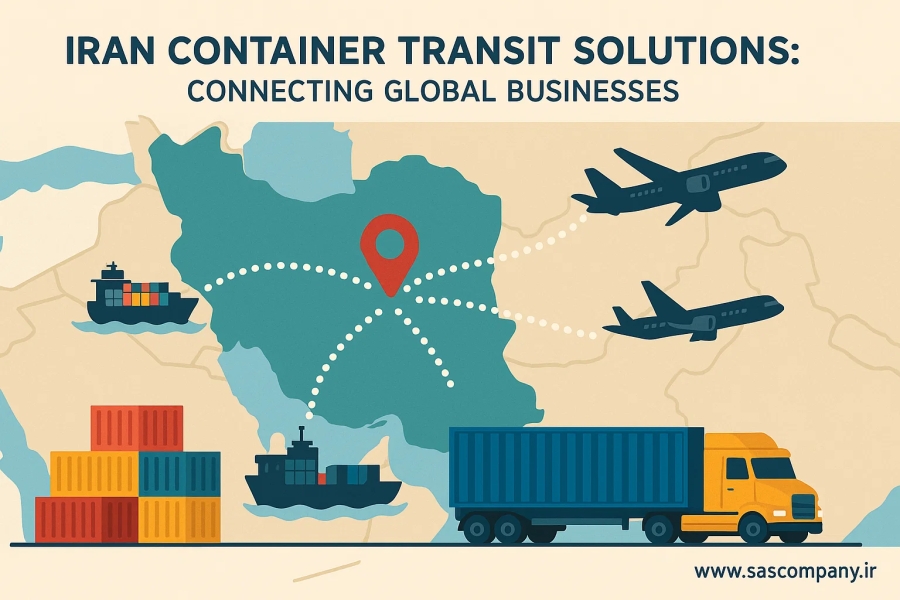
Iran sits at the intersection of three critical corridors: East–West trade between China and Europe, North–South trade between Russia and India, and Gulf-to-Central Asia freight flows.This positioning allows container transit through Iran to offer an alternative to some maritime detours, such as the Suez Canal, and to reduce dependency on congested or politically sensitive routes. For many shippers, this is no longer about “alternative routes” in absolute terms, but about risk diversification.
From a geographic standpoint, Iran provides direct access to both open seas and landlocked markets. The southern ports, especially Bandar Abbas and Chabahar, connect ocean freight to road and rail networks leading north to the Caucasus, Russia, and Central Asia. Access to multimodal transport service is a key reason why Iran container transit routes are now being evaluated seriously by freight forwarders and project cargo planners.
Another factor accelerating this shift is the gradual redirection of global logistics flows. Sanctions on Russia, pressure on Red Sea shipping, and instability in parts of Eastern Europe have forced carriers to redesign corridors. In this reshuffling, Iran functions as a land bridge that shortens transit distance, reduces exposure to maritime disruptions, and offers more predictable inland scheduling—when managed correctly.
That “when managed correctly” is exactly where most unrealistic expectations collapse. Iran’s transit potential is structural, not automatic. Infrastructure gaps, regulatory complexity, and the need for strong local coordination still limit how efficiently Iran container transit services can scale. Companies that enter this corridor without understanding its operational constraints often face delays, documentation issues, and cost overruns.
In short, Iran is emerging as a strategic container transit hub not because it is simple or risk-free—but because, under current global conditions, its geographic position provides opportunities to mitigate risks that traditional routes increasingly struggle to control. Businesses that approach container transit via Iran with proper planning, compliance awareness, and reliable partners can turn geography into a measurable competitive advantage. Those who rely on assumptions instead of structure usually pay for it in time, cost, or blocked cargo.
Key Iran Container Transit Routes for Global Trade — 2026 Update
The practical value of Iran container transit is determined by the performance of its key corridors. Iran sits at the intersection of three major container transit routes connecting Asia, Europe, Russia, the Persian Gulf, and Central Asia. Each corridor supports specific cargo types, trade flows, and operational risks, making Iran container transit increasingly important for global shippers.
East–West Corridor (China to Europe)
Cargo from China and East Asia enters via Bandar Abbas, then shifts to rail/road for Turkey and Europe. This East–West route is a core Iran container transit route, providing an alternative to congested maritime paths.
Key advantages:
- Distance optimization: Using Iran container transit shortens transit time compared to full maritime routes via the Suez Canal.
- Risk diversification: Bypassing congested sea choke points reduces delays and insurance costs, making this corridor a reliable option for global trade.
However, the efficiency of Iran container transit services along this corridor depends on border operations at Iran–Turkey crossings and smooth rail coordination inside Iran.
North–South Corridor (Russia–India)
The North–South corridor is becoming a structurally essential Iran container transit route. It connects Russian ports on the Caspian Sea to southern Iranian ports, enabling onward transit to India. Containers move from Astrakhan to northern Iran ports, then south via rail or road to Bandar Abbas or Chabahar, continuing through a sea freight service to Indian ports.
This corridor is ideal for bulk industrial goods, machinery, fertilizers, and raw materials. While digital platforms like IRICA’s e-TIR system have cut customs clearance times by 40% in 2025, multi-border synchronization remains crucial for smooth Iran container transit.
Recent Transit Statistics (2025/2026):
- Total foreign transit volume via Iran: ~21.9 million tons in the Iranian year ended March 20, 2025 — marking a ~22.5 % increase year‑on‑year according to IRICA.
- Rail transit volume: ~5 million tons in the same period, as reported by the CEO of Islamic Republic of Iran Railways.
- Rail export growth: Rail export tonnage increased about 40 % year‑on‑year in the
- North–South corridor volume: ~28 million tons, targeting 40–45 million tons by 2030.
Gulf to Central Asia Corridor
The Gulf–Central Asia corridor is a consistent Iran container transit service, serving landlocked countries such as Turkmenistan, Uzbekistan, and Kazakhstan. Cargo enters via southern ports and moves north to Central Asian borders.
Advantages:
- Predictable access: Shortest overland route to open waters for Central Asian importers.
- Operational stability: Multimodal connections allow reliable transport, though sensitive to border fees, fuel costs, and transit regulations.
2026 port and transit data:
- As of early 2026, the latest official full-year data available shows total cargo handled by Iranian ports at 234.8 million tons.
- Container operations reached 3.08 million TEUs, up 13% year over year.
This corridor is widely used for FMCG, construction materials, spare parts, and industrial supplies. Iran container transit ensures flexibility, predictability, and faster connections for shippers navigating complex regional logistics.
Main Ports and Entry Points for Container Transit Through Iran
Bandar Abbas
As Iran’s largest southern port, Bandar Abbas is a core hub for Iran container transit. It manages the highest volumes of international cargo and remains Iran’s main container gateway, with a rail freight service and road freight service links to central and northern regions, although operational continuity and local risk conditions should be monitored. Its proximity to the Strait of Hormuz makes it a critical gateway for East–West trade between Asia and Europe.
Chabahar
Chabahar Port offers a strategically important southern route for Iran container transit, linking the Persian Gulf to India and Central Asia. While the port benefits from a 10-year operating framework with India, this provides structural support rather than guaranteed throughput or long-term sanctions protection. With deep-water berths and modern container handling infrastructure, it is ideal for project cargo and high-priority shipments, and can facilitate routing that avoids some congested Gulf and Red Sea ports when conditions allow.
Northern Ports on the Caspian Sea
Ports such as Bandar Anzali, Amirabad, and Noshahr provide northern entry points for Iran container transit. These ports support North–South trade that is strategically important and commercially promising, yet still constrained by missing or developing links connecting Central Asian markets to southern Iranian ports for onward global shipping. They play a key role in diversifying transit options while acknowledging operational and infrastructure limitations, and help reduce reliance on maritime chokepoints.
For more detailed information on Iran’s port infrastructure and container handling capabilities, see our in-depth articles on [Northern Ports of Iran] and [Southern Ports of Iran].
How Container Transit Through Iran Actually Works (Process Overview)
Container transit through Iran follows a structured multimodal process from entry to exit:
- Entry at Port or Border – Containers arrive at southern ports like Bandar Abbas or Chabahar, or at northern Caspian ports. Initial inspection and customs documentation are completed at the point of entry.
- Customs Clearance – Digital systems such as IRICA’s e-TIR platform can support more efficient documentation and customs coordination, but practical use should still be confirmed case by case depending on the corridor, border crossing, and carrier. All cargo must comply with Iranian transit regulation.
- Inland Transport – Once cleared, containers are transported via rail or road depending on the corridor. East–West shipments often move north to Turkey; North–South cargo travels between northern ports and southern ports; Gulf–Central Asia shipments proceed north toward landlocked countries.
- Border Exit and Hand-Off – At the exit border or port, containers undergo final checks and are handed over to foreign carriers or local agents for onward shipping. Efficient coordination with local authorities is essential to avoid delays.
- Tracking and Monitoring – Throughout the journey, shippers can track container status via port or logistics platforms, ensuring visibility and predictability for Iran container transit operations.
This structured approach allows Iran to serve as a reliable and competitive transit corridor, connecting Asia, Europe, and Central Asia efficiently.
Required Documents for Container Transit Through Iran (2026)
Typical baseline documents include transit declaration, invoice, packing list, bill of lading/sea waybill, and corridor-specific guarantees or customs instruments.
- Transit Declaration (T1) – submitted via IRICA’s EPL or NCTS electronic system by the Iranian forwarder or agent.
- Commercial Invoice + Packing List – for cargo identification only.
- Original Bill of Lading (B/L) or Sea Waybill – original or telex release accepted.
- TIR Carnet (if moving under TIR convention) OR Iranian national transit guarantee (bank guarantee or insurance policy issued locally).
- Certificate of Origin – usually optional unless specifically requested.
- Dangerous Goods Declaration (DGD/IMO) – only for IMDG cargo.
- Phytosanitary / Fumigation Certificate – only for raw wood packaging or certain agricultural goods.
Key 2026 update: Iran has fully migrated to e-TIR and electronic guarantees. Physical bank cash deposits or paper guarantees are no longer required in 95 % of cases.
Practical tip: All documents must be uploaded by your Iranian partner 48–72 hours before vessel arrival. If not, the container will be held at the port.
With this short, accurate checklist, shippers on East–West, North–South, or Gulf–Central Asia corridors can avoid 99 % of documentation-related delays.
Sanctions, Compliance, and Risk Management in Iran Transit
Navigating Iran container transit requires a structured compliance process, not just route planning. Sanctions exposure, customs procedures, operational disruption, insurance constraints, and payment feasibility all affect whether a shipment is practically executable. In 2026, this means businesses should assess Iran transit through a workflow-based lens rather than treating it as a standard corridor decision.
Counterparty screening
All parties involved in the shipment should be screened before cargo dispatch, including shippers, consignees, freight forwarders, customs agents, and any local service providers. Sanctions compliance should cover not only direct counterparties but also beneficial ownership, affiliated entities, and the nature of the cargo itself. This step is especially important where petroleum-linked trade, dual-use concerns, or indirect exposure may create additional risk.
Regulatory compliance and documentation control
Iranian customs compliance still requires careful control of documentation, declarations, cargo descriptions, and guarantee structures. Iran has formal interconnection with the eTIR international system and operational digital-transit experience, but practical implementation should still be confirmed case by case depending on the corridor, border crossing, and carrier. Bills of lading, transit declarations, manifests, and insurance records should be reviewed for consistency before dispatch, not only at the border stage.
Insurance feasibility
Insurance should be treated as a planning issue at the start of the transaction, not after routing is agreed. Cargo interests should confirm whether marine, inland transit, war-risk, and delay-related coverage are actually available for the proposed route and counterparties. In periods of regional disruption, insurance availability and pricing may change faster than the physical corridor itself.
Port and route contingency planning
Container transit planning should include backup options for port disruption, border delays, schedule changes, and route suspension. Because container flows depend on coordination between ports, carriers, customs, and inland transport, disruptions in one segment can affect the entire shipment.
In practice, successful container transit through Iran depends on aligning compliance, documentation, carrier selection, insurance, and routing decisions from the outset. Companies that treat these controls as part of container transport planning are better positioned to reduce delays, avoid cargo disruption, and maintain operational flexibility.
Choosing the Right Transit Partner in Iran
Selecting a reliable partner is critical for successful Iran container transit. Focus on measurable capabilities rather than marketing slogans. Key criteria include:
- Operational Expertise: Proven experience in managing multimodal transit across East–West, North–South, and Gulf–Central Asia corridors.
- Customs & Compliance Knowledge: Ability to navigate Iranian customs regulations, digital platforms like e‑TIR, and documentation requirements accurately.
- Infrastructure & Fleet: Access to modern port facilities, reliable rail and road networks, and secure handling equipment for containers.
- Risk Management: Capacity to mitigate delays, insurance risks, and border bottlenecks through contingency planning.
- Local Coordination: Strong relationships with port authorities, freight forwarders, and border officials for seamless transit.
Choosing a transit partner that meets these standards ensures predictable timelines, cost efficiency, and reduced operational risks.
For shippers evaluating Iran container transit, SASCO provides local support in routing assessment, compliance coordination, and execution planning. Learn more at SASCO Transit Services.
What Matters in 2026
- Chabahar continues to benefit from India’s 10-year operating framework signed in May 2024.
- Any Chabahar-related sanctions relief should be treated as time-limited rather than a long-term planning assumption. Current reporting says the waiver runs until 26 April 2026.
- Rasht–Astara remains a project to watch, not a fully unlocked corridor. Implementation has been announced for 2026, but it is still better treated as a developing link.