

Why Traditional Asia–Europe Routes Are Becoming Less Cost-Efficient
For decades, trade between Asia and Europe has relied on predictable maritime loops through the Suez Canal and high-capacity rail across the Northern Corridor. However, a combination of geopolitical shifts, rising operational costs, and infrastructure constraints has made these traditional routes less cost-efficient.
1. Declining Predictability in Maritime Shipping
The main driver of rising costs is reduced reliability in key maritime passages. Disruptions at critical choke points, such as the Suez Canal or nearby conflict zones, have forced some carriers to reroute via the Cape of Good Hope. This detour adds roughly 3,500 nautical miles to a one-way journey, increasing:
- Fuel costs: Higher bunker fuel consumption for longer voyages.
- Container turnaround delays: Longer cycles create localized equipment shortages, pushing peak-season rates year-round.
- Insurance premiums: Additional surcharges, including "War Risk," are applied for vessels using high-risk routes.
2. Port Congestion and Infrastructure Bottlenecks
As shipments divert around conflict-affected areas, major transshipment hubs in Europe and Asia are facing congestion. Overcrowded ports lead to demurrage and detention fees, eroding the cost advantages of lower nominal ocean freight rates.
3. Rising Cost of Time and Capital
Longer transit times—now 45–60 days compared to the previous 30–35 days—tie up significant working capital in goods in transit, or “floating inventory.” For high-value or time-sensitive shipments, these delays translate directly into financial costs and reduced supply chain responsiveness.
4. Regulatory and Environmental Pressures
New environmental regulations, such as the EU Emissions Trading System (ETS), assign a carbon cost to maritime transport. Longer detours increase fuel use and emissions, adding regulatory levies that further raise the effective cost of traditional corridors.
Key Takeaway:
Traditional Asia–Europe routes are no longer the default low-cost option. Rising operational risks, transit delays, and regulatory pressures are prompting companies to explore alternative, multimodal logistics options.
Iran’s Strategic Role in Asia–Europe Transit Corridors
Iran sits at a strategically important location, connecting East Asia, Central Asia, and Europe. Its geographic position allows it to serve as a multimodal transit corridor, linking maritime, rail, and road networks to provide efficient access between the Indian Ocean, the Caspian Sea, and European markets.
1. Maritime Gateways: Bandar Abbas and Chabahar
Iran’s southern ports are crucial entry points for cargo from India, Southeast Asia, and China:
- Bandar Abbas (Shahid Rajaee Port): Iran’s largest container port, integrated with the national railway network for efficient ship-to-rail transfers, reducing dependency on congested road freight.
- Chabahar Port (Shahid Beheshti): Outside the Strait of Hormuz, it offers direct access to the Indian Ocean. Recent investments and its role in the International North-South Transport Corridor (INSTC) make it a key hub for Central Asia and Europe-bound shipments.
2. Rail Connectivity
Iran’s rail network forms a backbone for Asia–Europe logistics corridors:
- East–West Links: Connects Iran to Turkey and the European rail system, enabling continuous rail shipments.
- Northern Gateways (Sarakhs & Incheh-Borun): Connect to Turkmenistan and Kazakhstan, facilitating cargo from China and Central Asia.
- Rasht–Astara Segment: Nearing completion, it will link the Persian Gulf to Russia and Eastern Europe entirely by rail.
3. Road Networks
Iran’s extensive highways connect southern ports to northern ports and western borders, such as Bazargan, the main gateway to Turkey and Europe. A road freight service in Iran offers flexibility for time-sensitive cargo and supports door-to-door delivery when multimodal options are used.
4. Strategic Integration
Iran is part of several global transit initiatives:
- INSTC: Linking India to Russia and Northern Europe.
- Middle Corridor: Providing an alternative to Northern rail routes, connecting China to Turkey via Central Asia and Iran.
- Belt and Road Initiative (BRI): Iran is a key node in China’s Eurasian logistics vision.
Iran combines ports, railways, and roads into a cohesive transit ecosystem, offering a shorter and more versatile alternative to congested sea routes or the Northern rail corridor. While not the default route for all Asia–Europe trade, it is increasingly considered for shipments where cost, reliability, and transit time need careful optimization.
Main Logistics Routes to Europe via Iran
Iran’s multimodal infrastructure allows companies to optimize Asia–Europe logistics corridors via Iran based on cargo type, urgency, and cost considerations.
1. Key Rail Corridors
A rail freight service is a central component of cost-effective Asia–Europe logistics, especially for bulk and containerized shipments.
- Southern Route (Middle Corridor Branch): Connects China to Europe via Central Asia and Iran. Cargo enters through the Sarakhs or Incheh-Borun borders and exits toward Turkey via the Razi border, linking into the European rail network. This rail option enhances the reliability of Iran transit routes for Asia–Europe trade.
- North-South Rail Link (INSTC): Connects Bandar Abbas to northern borders. When the Rasht–Astara segment is fully operational, it will provide a continuous rail route from the Persian Gulf to Russia and Eastern Europe, strengthening Iran as a transit hub for Asia and Europe.
2. Road Transport Networks
Iran’s road network complements rail and offers flexible logistics routes between Asia and Europe for high-priority cargo:
- Trans-Iranian Highway (Port-to-Border): Runs from Bandar Abbas to the Bazargan border, providing fast truck transit for EU-bound goods.
- East-West Road Link: Connects eastern borders with Afghanistan and Pakistan to western gateways, enabling efficient overland trade for South Asian shipments.
3. Multimodal Options (Sea–Rail / Sea–Road / Ro-Ro)
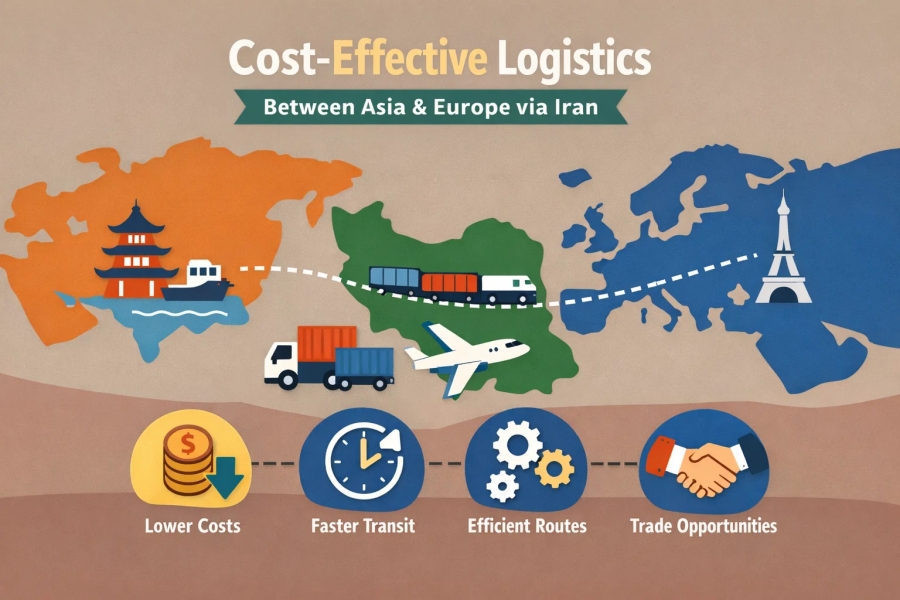
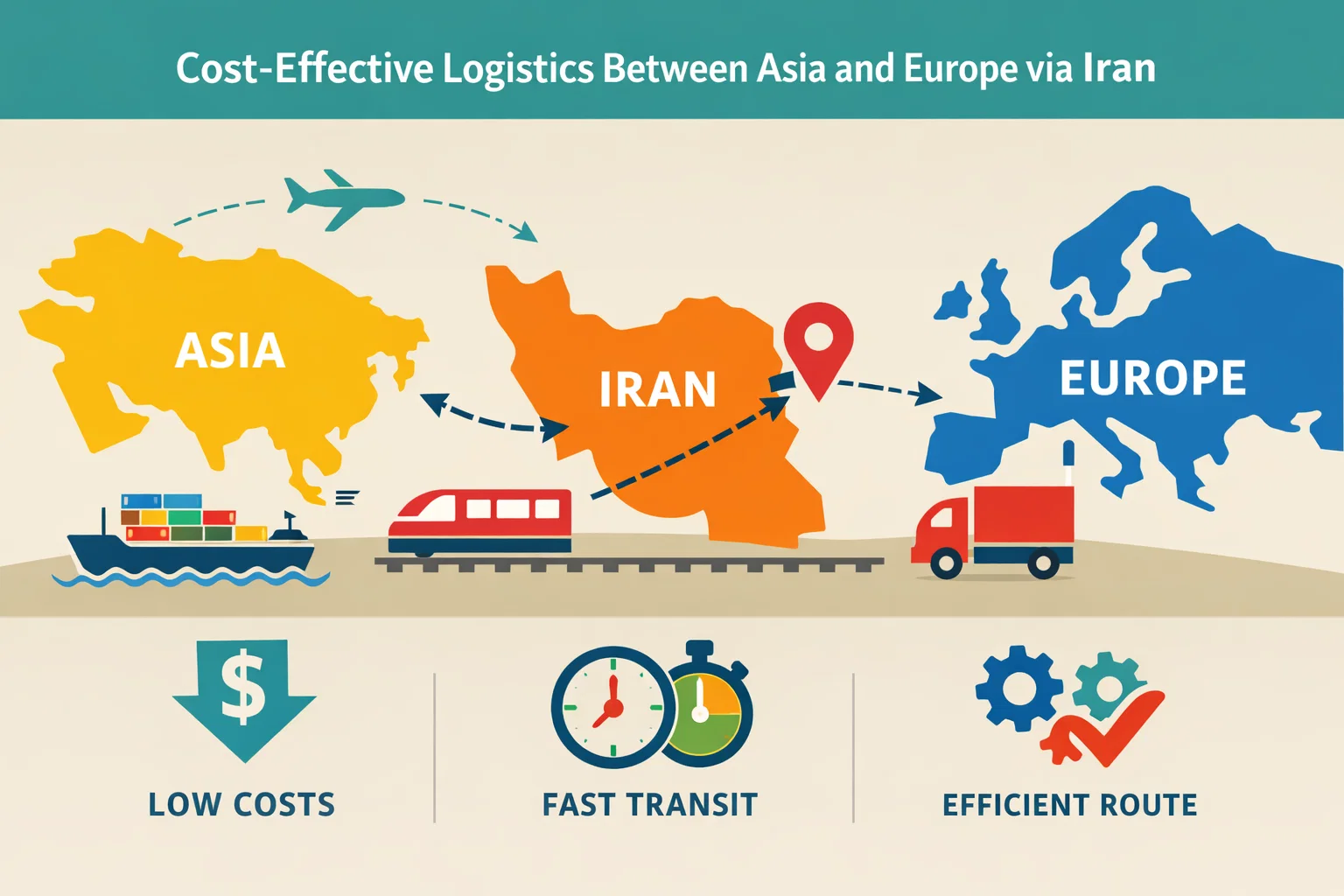
The real cost advantage of Asia–Europe logistics corridors via Iran comes from using a multimodal transport service that combines sea, rail, and road options.
- Sea–Rail Hybrid: Cargo arriving at Bandar Abbas or Chabahar from major Asian ports (e.g., Shanghai, Nhava Sheva, Mundra) is transferred to Iran’s rail network for onward shipment to Turkey or Caspian borders, reducing both costs and environmental impact.
- Sea–Road Hybrid: Shipments offloaded at southern ports can be trucked directly to Europe, bypassing congested Suez routes. This route is ideal for urgent cargo despite higher road costs.
- Caspian Sea Ro-Ro Services: Northern ports like Anzali or Amirabad allow cargo to cross the Caspian via Ro-Ro vessels, avoiding land bottlenecks and connecting efficiently to Russia or Kazakhstan.
For most Asia–Europe trade flows, the Sea-to-Rail option via Bandar Abbas currently offers the most stable cost-per-TEU ratio, particularly for non-perishable industrial goods.
Cost Analysis: Iran Transit Corridor vs. Traditional Sea Routes (INSTC vs. Suez)
Determining the financial viability of cost-effective logistics between Asia and Europe via Iran requires grounding claims in observable data regarding transit times, modal costs, and distance differentials.
1. Transit Time and Distance Efficiency
The geographical advantage of the Iranian route is most evident when comparing the International North–South Transport Corridor (INSTC) to traditional maritime loops:
- Distance: The INSTC spans roughly 7,200 km via multimodal legs (sea, rail, road), whereas traditional sea routes from South Asia to Europe via the Suez Canal can exceed 19,500 km.
- Time Savings: Industry data indicates that the INSTC can reduce transit time to approximately 19–23 days for routes like Mumbai–Moscow, compared to 30+ days via the Suez Canal. For Asia–Europe logistics, this reduction of nearly 30% in transit time directly translates to faster market entry and improved cash flow.
2. Comparative Freight Benchmarks
While sea freight often offers the lowest nominal "port-to-port" rate, the total cost-efficiency changes when looking at the broader supply chain:
- Rail vs. Sea: Rail freight from China to Europe typically ranges between $2,500–$3,500 per 40-ft FCL (Tonlexing Logistics). In contrast, while standard sea freight for a 20-ft container may start lower, the cost-per-day of transit and seasonal volatility often bridge this gap for high-value goods.
- The "INSTC Advantage: Overall transport costs via the INSTC can be 20–30% lower than equivalent sea routes when factoring in fuel savings, avoidance of Suez Canal tolls, and reduced port handling fees at intermediate hubs.
3. Tariffs and Duty-Free Transit
A key factor in maintaining cost-effective Asia–Europe logistics corridors via Iran is the fiscal treatment of cargo:
- Duty Exemptions: Goods moving as "Transit Cargo" through Iranian customs are exempt from import duties and are subject only to minimal administrative fees.
- Landed Cost Reduction: This duty-free status, combined with the avoidance of cumulative maritime surcharges (such as Piracy or War Risk surcharges often applied in narrow waterways), helps in lowering the Total Landed Cost for the end consignee.
|
criteria |
Iran Transit Corridor INSTC |
Traditional Sea Route (Suez) |
|
Distance |
~7,200 km (sea + rail + road) |
>19,500 km (sea only) |
|
Transit Time |
19–23 days |
30+ days |
|
Freight Cost |
$2,500–$3,500 per 40-ft FCL |
Lower nominal sea rates, but total cost higher due to longer transit |
|
Total Cost Advantage |
20–30% lower (fuel, Suez tolls, port fees) |
N/A |
|
Customs & Duties |
Transit cargo duty-free; minor administrative fees |
Standard maritime duties and fees apply |
|
Schedule Reliability |
Medium–high; affected by seasonal cargo or unfinished rail segments |
Low; prone to canal congestion and port delays |
|
Risk & Insurance |
Requires sanction checks and local insurance; generally stable |
Higher maritime risk, security, and delay exposure |
|
Flexibility / Door-to-Door |
High; multimodal options allow direct delivery |
Limited; requires additional inland transport |
Key Operational and Regulatory Considerations
While cost-effective logistics between Asia and Europe via Iran offer significant advantages, navigating this corridor requires careful attention to regulatory and operational factors. Decision-makers must evaluate compliance, customs, transit times, and risk management to maintain supply chain efficiency.
1. Sanctions and Legal Compliance
The primary consideration for firms using Iran transit routes for Asia–Europe trade is adherence to international sanctions:
- Due Diligence: Ensure shipments avoid restricted entities or SDNs through rigorous KYC (Know Your Customer) protocols.
- Permissible Transit: Non-sanctioned commercial goods (food, medicine, retail) can move through Iran, provided that payment for logistics services follows compliant, non-sanctioned financial channels.
- Compliance Support: Partnering with experienced freight forwarders ensures transparent Certificates of Origin and GPS route tracking, maintaining cost-effective Asia–Europe logistics.
2. Streamlining Customs Procedures
Iran simplifies transit for cargo, but accuracy and coordination remain critical for Asia–Europe logistics corridors via Iran:
- Documentation Accuracy: Error-free transit entries, packing lists, and weight declarations are essential to prevent secondary inspections and unplanned detention fees.
- Border Coordination: Major crossings like Bandar Abbas, Chabahar, and Bazargan utilize the ASYCUDA system, which is optimized for transit shipments.
- Bonded Warehousing: Using Special Economic Zones (SEZs) helps manage cargo flow and reduces customs-related risks during multimodal transfers.
3. Transit Time Variability and Infrastructure
Transit schedules can fluctuate due to operational or infrastructure factors within the logistics routes between Asia and Europe:
- Bottlenecks: Seasonal cargo surges (e.g., during regional harvests) may slow border crossings at the Turkish-Iranian border.
- Infrastructure Gaps: Pending rail segments, such as the Rasht–Astara link, currently require truck-to-rail transfers, which should be factored into the lead-time buffer.
- Weather & Terrain: Winter conditions in northwest Iran can impact road speeds; planning for a 2-3 day buffer is recommended during colder months.
4. Insurance and Risk Management
- Policy Verification: A cargo insurance service should be verified to ensure that international cargo insurance policies do not contain exclusion clauses for Iranian territory during the transit leg.
- Local Partnerships: Utilizing local insurance partners for the transit segment can facilitate faster claims and ensure full coverage.
- Risk Diversification: Strategic shippers use Iran as a transit hub for Asia and Europe to balance their total supply chain risks, rather than relying on a single corridor.
By proactively managing sanctions, customs, and transit time variability, companies can fully leverage the Iranian corridor as a reliable and cost-effective alternative to traditional maritime routes.
When Does the Iran Corridor Make Economic Sense?
There is no one-size-fits-all solution. Using cost-effective logistics between Asia and Europe via Iran depends on cargo type, urgency, and market conditions:
- High-Value, Time-Sensitive Goods: For electronics, machinery, or automotive parts, reducing maritime transit by 15–20 days through Iran can save significant inventory carrying costs, making rail or multimodal options worthwhile.
- Avoiding Maritime Choke Points: When Suez Canal congestion or Red Sea risks disrupt traditional shipping, Iran offers a predictable land route that bypasses delays and extra “war risk” surcharges.
- India to Russia/Central Europe Flows: The INSTC via Bandar Abbas or Chabahar cuts distance by up to 40% compared to long maritime routes, offering the most cost-effective Asia–Europe logistics for these origins and destinations.
- Small-to-Medium Shipments (LCL) via Road: For urgent or partial loads, Iran’s road network enables flexible door-to-door delivery, balancing speed and cost between air and sea freight.
The Iranian corridor is ideal when speed, predictability, or multimodal optimization outweigh the absolute lowest freight rate. For low-value bulk goods, traditional maritime shipping remains competitive.
The Role of a Reliable Logistics Partner in Iran
While a transit through Iran service for Asia–Europe trade offers distinct cost and time advantages, leveraging its full potential requires specialized local expertise. An experienced partner acts as a bridge between international expectations and regional operational nuances, ensuring supply chain resilience.
Key Benefits of a Local Logistics Partnership:
- Regulatory Guidance: In-depth understanding of Iranian customs (ASYCUDA), transit documentation, and evolving compliance requirements reduces the risk of costly delays.
- Operational Coordination: Seamless multimodal transfers—from sea to rail or road—require real-time knowledge of port schedules at Bandar Abbas and rail availability across the INSTC.
- Risk & Cost Optimization: By proactively managing seasonal bottlenecks and optimizing handling fees, a trusted partner ensures the Iranian corridor remains a truly cost-effective logistics option.
Strategic Implementation
For companies seeking to integrate these benefits, partnering with an established firm like SASCO can be a decisive factor. By combining localized infrastructure knowledge with a commitment to international compliance and transparent tracking, SASCO helps global shippers transform the Iranian transit potential into a reliable, long-term competitive advantage.
Final Thought: The Iranian corridor is more than just a path on a map; it is a dynamic logistics ecosystem. Success depends not just on the route chosen, but on the expertise of the team managing the cargo.