


Dubai to Iran Shipping at a Glance
The table below compares the main freight options. Transit times in this guide are stated as port-to-port, airport-to-airport or door-to-door where applicable.
|
Shipping option |
Best for |
Rate basis |
Indicative freight |
|
LCL sea freight |
Pallets and smaller commercial shipments |
Per W/M |
USD 230- 300 / W/M |
|
FCL sea freight |
Larger or container-load shipments |
Per container |
About 250-550 USD |
|
Air freight |
Urgent, valuable or time-sensitive cargo |
Per chargeable kg |
USD 8.00- 9.50 / kg |
|
40' Reefer FCL |
Perishable and temperature-controlled cargo |
Per container |
About 1100 USD |
The rates above are approximate and provided for general planning purposes only. Final shipping costs depend on the cargo details, route, carrier availability and required services. For an accurate and up-to-date rate, please request a quotation from SASCO.
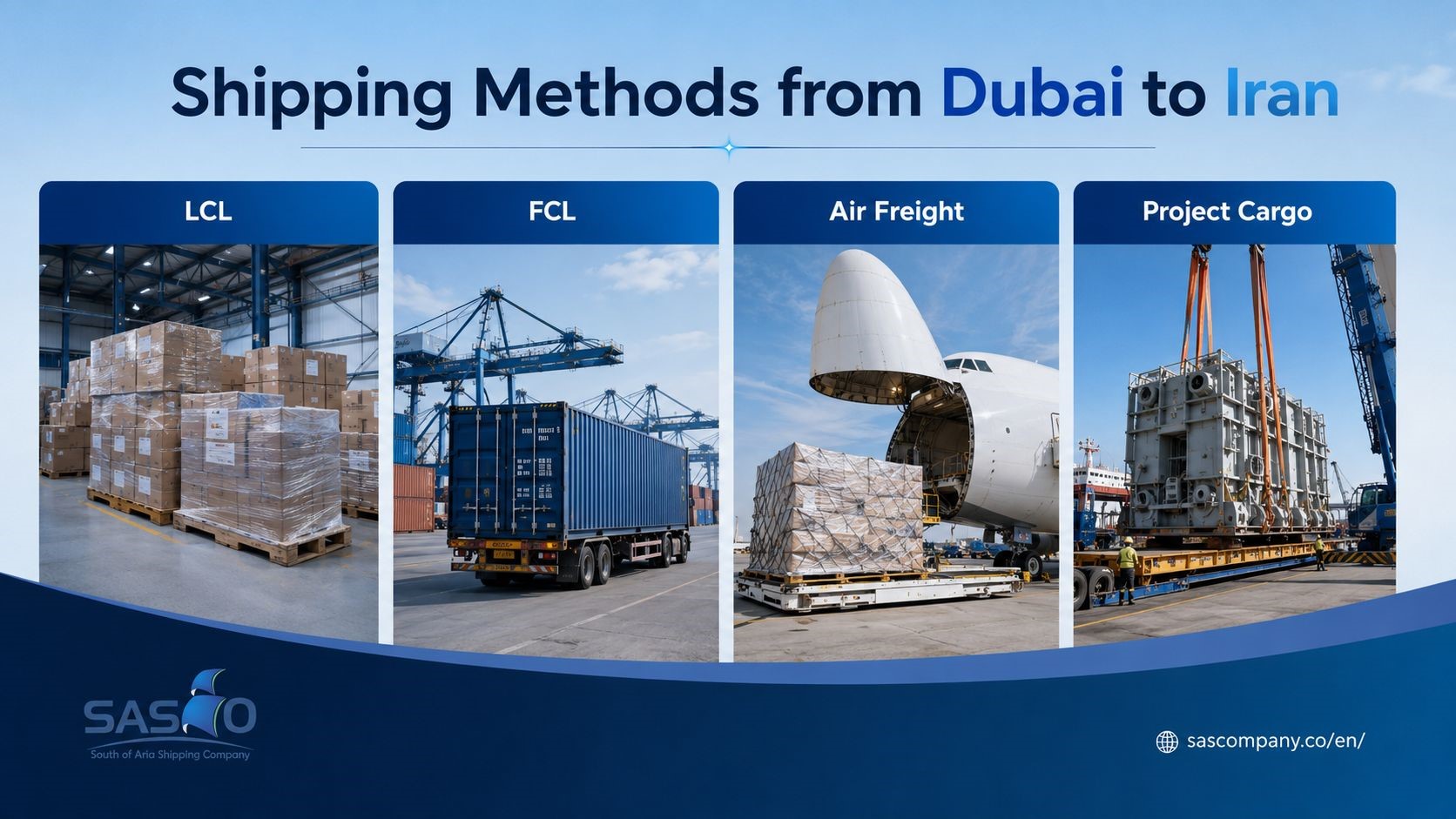
Shipping Methods from Dubai to Iran
The right method for shipping from Dubai to Iran depends on cargo volume, weight, urgency, handling requirements and the final delivery point. Commercial shipments generally move by sea or air, while door-to-door delivery combines several services into one coordinated solution.
Sea Freight from Dubai to Iran
Sea freight service from Dubai to Iran is usually the most practical option for heavy, bulky or non-urgent cargo. Jebel Ali is the main departure point for containerized shipments, while Shahid Rajaee Port in Bandar Abbas is the principal destination for many commercial cargo movements into Iran. Service to other Iranian ports may be available depending on carrier schedules, cargo type, equipment availability and operating conditions.
Importers should distinguish between sailing time and total transit time. Sailing time only covers the vessel’s movement between ports. Total transit time may also include collection, export documentation, terminal handling, consolidation, waiting time, unloading, customs clearance and inland delivery.
LCL Shipping from Dubai to Iran
LCL shipping from Dubai to Iran is suitable when the cargo does not require a full container. Rates are normally calculated by CBM or on a weight/measurement basis, known as W/M. The chargeable amount is based on whichever produces the higher freight value under the carrier’s tariff.
An LCL quotation may also include:
- Consolidation
- Deconsolidation
- CFS handling
- Documentation charges
Minimum billing rules often apply even when the shipment occupies less than one cubic metre. Because groupage freight is handled at several stages, handling costs and delay risks may be higher than with a full container. Once cargo volume reaches a certain level, FCL may become more economical than paying LCL charges per CBM.
FCL Shipping from Dubai to Iran
FCL shipping from Dubai to Iran gives one shipper dedicated use of a container and is generally suitable for larger shipments, sensitive goods or cargo requiring greater control during transport.
A 20GP is often suitable for dense or medium-volume cargo, while a 40GP provides more internal space. A 40HC offers additional height and is useful for lightweight but voluminous goods.
Reefer containers are designed for temperature-controlled cargo. Open Top and Flat Rack equipment may be required for machinery and oversized cargo that cannot be loaded through standard container doors.
Container selection should not be based only on carton count. Total CBM, gross weight, stackability, dimensions, weight distribution and payload limits must all be reviewed before booking.
Air Freight from Dubai to Iran
Air freight service from Dubai to Iran is best for urgent spare parts, equipment, commercial samples and high-value cargo. Pricing is based on chargeable weight, which is the greater of actual gross weight and volumetric weight.
Airport-to-airport service covers transport between airports, while door-to-door service also includes:
- Pickup
- Export handling
- Customs clearance
- Final delivery
Restricted, hazardous or regulated goods may require permits or airline approval.
Door-to-Door Delivery
Door-to-door shipping from Dubai to Iran is not a separate transport mode. It combines:
- Pickup in Dubai
- Export handling
- Sea or air freight
- Customs clearance service in Iran
- Inland delivery to the consignee’s final address
How Much Does Shipping from Dubai to Iran Cost?
There is no single fixed rate for shipping from Dubai to Iran. The final cost depends on the transport method, cargo volume and weight, route, equipment type, pickup location, export status and services required at destination.
For an accurate comparison, importers should examine the complete quotation rather than selecting the lowest headline freight rate. A low ocean or air freight rate may exclude:
- Pickup
- Terminal handling
- Export documentation
- Destination charges
- Customs clearance
- Inland delivery
Indicative planning rates — updated July 29, 2026. These approximate rates cover the main port-to-port or airport-to-airport freight only. Additional services and charges are quoted separately. Contact SASCO for an exact quotation.
|
Service |
Cargo range |
Rate basis |
Typical route |
Indicative freight |
|
LCL sea freight |
1–5 CBM |
Per W/M |
Jebel Ali–Bandar Abbas |
USD 300 / W/M |
|
LCL sea freight |
5–15 CBM |
Per W/M |
Jebel Ali–Bandar Abbas |
USD 230 / W/M |
|
20GP FCL |
Full container |
Per container |
Jebel Ali–Bandar Abbas |
About 250 USD |
|
40GP/40HC FCL |
Full container |
Per container |
Jebel Ali–Bandar Abbas |
About 550 USD |
|
40' Reefer FCL |
Full container |
Per container |
Jebel Ali–Bandar Abbas |
About 1100 USD |
|
Air freight |
100–299 kg |
Per chargeable kg |
DXB/DWC → Tehran (IKA) |
USD 9.50 / kg |
|
Air freight |
300 kg and above |
Per chargeable kg |
DXB/DWC → Tehran (IKA) |
USD 8.00 / kg |
For LCL shipping, W/M means weight or measurement. Freight is commonly calculated using either one cubic metre or one metric tonne, whichever produces the higher charge under the applicable tariff. Air cargo is priced by chargeable weight rather than gross weight alone.
Additional Charges to Check in a Dubai-to-Iran Shipping Quote
In addition to the main port-to-port or airport-to-airport freight rate shown above, a Dubai-to-Iran shipping quotation may include separate charges for origin handling, destination services, customs clearance and final delivery. The table below lists the main cost items that should be checked before confirming a shipment.
|
Cost item |
Typical treatment |
Important note |
|
Pickup in Dubai |
Quoted separately |
Depends on the pickup address, cargo size and vehicle required |
|
Export or re-export declaration |
Quoted separately |
The procedure depends on the cargo’s customs status in the UAE |
|
Origin terminal or CFS charges |
May be separate |
Particularly important for LCL consolidation and warehouse handling |
|
Carrier surcharges |
Rate-dependent |
May be included in the freight rate or listed separately |
|
Documentation fees |
May be separate |
Can include B/L, AWB and document-handling charges |
|
Destination port or airport charges |
Usually separate |
Payable after arrival unless specifically included |
|
Customs duties and taxes |
Paid separately |
Assessed by customs and not part of the freight rate |
|
Customs clearance in Iran |
Optional service |
Included only when stated in the quotation |
|
Inland delivery in Iran |
Optional service |
Depends on the destination city, cargo size and vehicle type |
|
Cargo insurance |
Optional service |
Based on cargo value, commodity and required coverage |
A useful quotation should identify both included and excluded charges, the applicable rate basis, currency, validity period and payment terms. It should also clarify whether the quoted service ends at the port or airport or includes delivery to the final destination.
Dubai to Iran Shipping Routes and Transit Times
The main route for container shipping from Dubai to Iran connects Jebel Ali with Bandar Abbas, particularly Shahid Rajaee Port. Service to other Iranian destinations is subject to current carrier or feeder schedules.
For air cargo, the departure airport may be DXB or DWC depending on the airline, handling arrangement and available capacity. Dubai Airports identifies both airports as cargo facilities, so the origin airport should be confirmed before quoting the shipment.
|
Origin |
Destination |
Mode |
Indicative transit |
|
Jebel Ali |
Bandar Abbas / Shahid Rajaee Port |
FCL or LCL sea freight |
1–3 days port-to-port |
|
Jebel Ali |
Bushehr |
Sea freight, subject to confirmed schedule |
2–4 days port-to-port |
|
DXB or DWC |
Tehran / IKA |
Air freight |
1–2 days airport-to-airport |
Sailing Time vs Total Transit Time
Sailing time refers only to the period during which the vessel travels between the departure and destination ports. For air freight, the comparable term is airport-to-airport transport time.
Total transit time begins earlier and ends later. Depending on the agreed service, it may include cargo pickup, warehouse receiving, export documentation, consolidation, terminal handling, waiting for departure, the main sea or air movement, unloading, customs clearance and inland delivery.
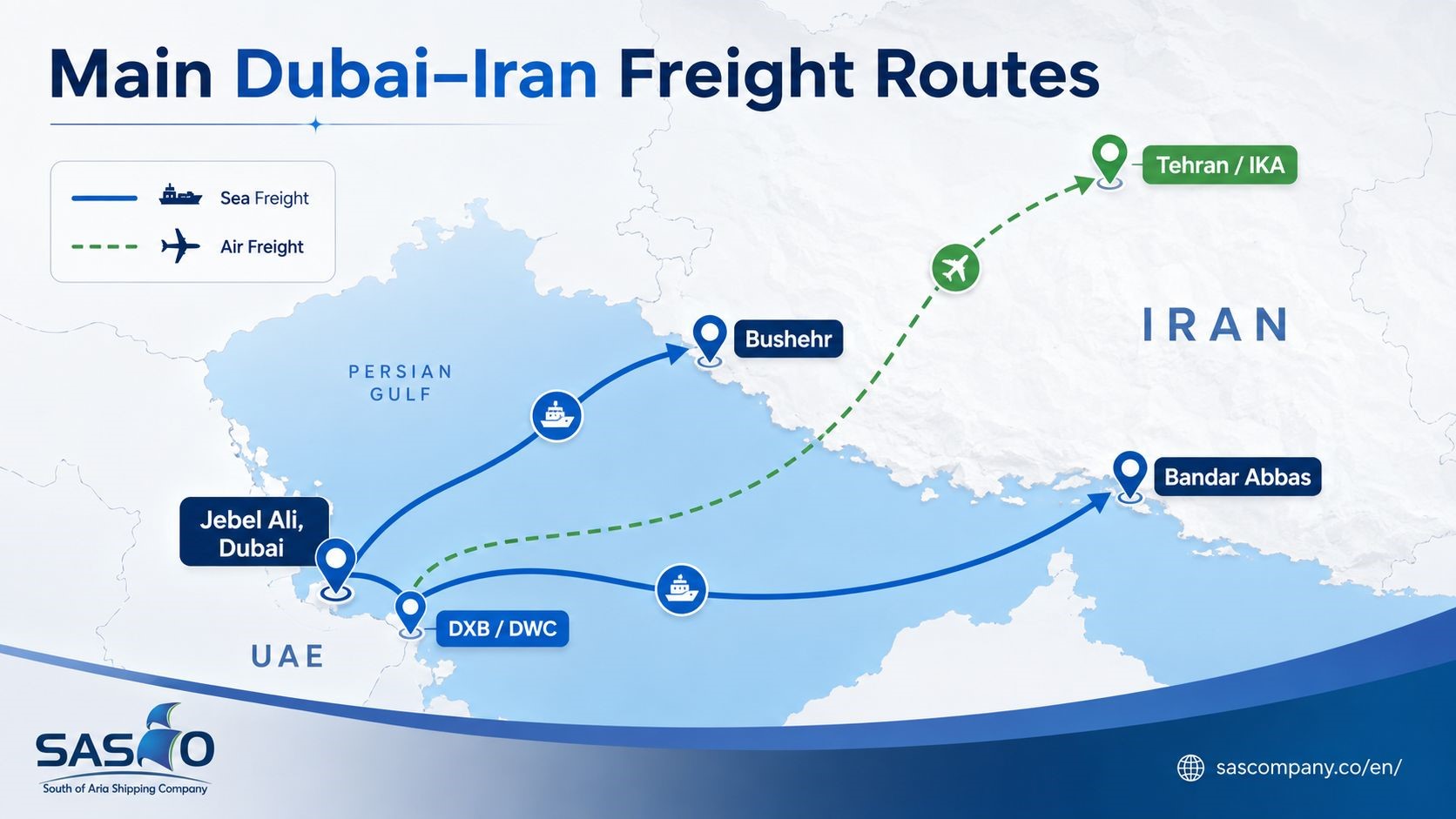
Illustrative route map. Actual ports, airports and services are subject to current carrier schedules and cargo acceptance.
Dubai Re-export and Cross-Stuffing for Iran-Bound Cargo
Dubai is frequently used as a purchasing, storage and redistribution point for Iran-bound commercial cargo. However, the correct shipping and customs procedure depends on how the goods entered Dubai and where they are stored before departure.
Goods purchased from a supplier in the UAE may be locally manufactured or may have previously been imported from another country. The seller’s location alone does not determine the origin or customs status of the cargo. The invoice, certificate of origin and declaration should reflect the actual transaction and movement of the goods.
A different process may apply when cargo from China, India, Europe or another origin first enters Dubai and is then shipped to Iran. Depending on the arrangement, the goods may be:
- Imported into the UAE for subsequent re-export
- Stored in a Dubai free zone
- Held in a customs warehouse
- Moved through Dubai under a transit procedure
- Transferred to another container before onward shipment
Dubai Customs treats export, import for re-export, re-export and free-zone transit as distinct customs procedures. The appropriate declaration depends on the cargo’s customs status, location and previous declaration rather than simply on its final destination.
Cross-Stuffing and Container Change
Cross-stuffing means unloading cargo from one container and placing it into another container before onward shipment. It may be required when the original carrier or container cannot continue to Iran, when shipments are being consolidated, or when a different container type is needed.
Container change, repacking or temporary storage in Dubai does not by itself change the origin of the goods. Dubai Chambers describes a certificate of origin as the document used to determine the origin of exported or re-exported goods and requests supporting documents for transshipment cases.
Cross-stuffing may create additional costs and handling requirements, including:
- Container unloading and reloading
- Warehouse or yard handling
- Cargo inspection
- New seals and tally records
- Storage or detention
- Amendment or reissuance of shipping documents
- Export, re-export or transit formalities
For cargo purchased from several suppliers, consolidation can reduce the number of separate shipments. However, each supplier’s invoice, packing details, cargo description, HS code and origin information must remain traceable. The consolidated packing list and shipping instructions should reconcile with the individual supplier documents.
Before booking, the shipper should confirm:
- Whether the cargo is in mainland Dubai, a free zone or a customs warehouse
- How the goods originally entered Dubai
- Whether the shipment is an export, re-export or transit movement
- Whether cross-stuffing or repacking is required
- Who will appear as shipper and consignee
- Whether product-specific permits are required
- Whether all invoices, packing lists and origin documents contain consistent information
SASCO service note:
SASCO provides re-export handling, free-zone pickup, cross-stuffing, multi-supplier consolidation and related documentation support for Iran-bound cargo. The service scope is coordinated according to the cargo’s location, customs status, supplier arrangements and shipping requirements.
Documents Required for Shipping from Dubai to Iran
According to the Dubai Customs Customer Guide, document requirements vary according to the cargo type, customs procedure and the goods’ status in Dubai. The following list provides a practical overview for export and re-export shipments rather than a complete legal checklist.
Dubai Export or Re-export Documents
- Commercial invoice: Identifies the seller, buyer, cargo description, quantity, value, currency and agreed trade terms.
- Packing list: Shows package count, packaging type, net and gross weight, dimensions and cargo marks.
- Certificate of origin: Confirms the declared origin of the goods where required.
- Export, re-export or transit declaration: Selected according to the cargo’s customs status and location in Dubai.
- Product permit or approval: Required for restricted or regulated cargo where applicable.
- Shipping instructions: Provide the carrier or freight forwarder with the details required to prepare the transport document.
- B/L or AWB information: Includes the shipper, consignee, notify party, cargo details, ports or airports and handling instructions.
- Previous import or transit documents: May be required when the cargo was originally imported into Dubai or moved through a free zone.
Iran Import and Customs Clearance Documents
- Commercial invoice
- Packing list
- Bill of lading or air waybill
- Certificate of origin
- HS code and accurate product description
- Import order registration, where applicable
- Product-specific permits and approvals
- Iranian importer or consignee information
- Commercial Card and broker authorization, where required
- Insurance certificate, when applicable
- Additional inspection, conformity, health or technical certificates for regulated goods
All key details should remain consistent across the invoice, packing list, transport document, certificate of origin and import file. Differences in product descriptions, package quantities, weights, values, HS codes or consignee information may result in document amendments or customs delays.
For a detailed pre-shipment explanation, see SASCO’s guide to Required Documents for Shipping to Iran. A separate Customs Clearance Checklist for Importing to Iran covers importer readiness, import registration, permits, customs value and arrival documentation in greater detail.
Step-by-Step Dubai to Iran Shipping Process
The process of shipping from Dubai to Iran can be divided into five main stages. An experienced freight forwarder for Dubai-to-Iran shipping can coordinate these stages according to the cargo type, customs status and required delivery scope.
1. Submit the Shipment Details
Provide the cargo description, package count, gross weight, dimensions, total CBM, pickup location and final destination. The HS code, cargo value, ready date and any special handling requirements should also be provided when available.
These details allow the shipment to be assessed and the appropriate route and equipment to be selected.
2. Confirm the Service Scope and Quotation
SASCO reviews the cargo’s location and customs status in Dubai and prepares a quotation based on the requested service.
The quotation should clearly state whether the shipment is:
- Port-to-port
- Airport-to-airport
- Door-to-door
Any separately quoted services, such as pickup, export handling, customs clearance, insurance or inland delivery, should also be identified before booking.
3. Book and Prepare the Cargo
Once the quotation is approved, the selected sea or air service is booked. The required shipping documents are checked, and pickup, warehouse delivery, consolidation or container loading is arranged as applicable.
Cargo that requires permits, special equipment or carrier approval must be cleared for acceptance before departure.
4. Complete Export Handling and Main Transport
The appropriate export, re-export or transit procedure is completed in Dubai. The cargo is then delivered to the nominated port, airport or carrier facility and shipped to Iran according to the confirmed schedule.
Shipment tracking and operational updates can be provided during the main transport stage.
5. Arrange Cargo Release and Final Delivery
After arrival in Iran, the importer or appointed customs broker completes the required customs procedures and obtains cargo release.
If inland delivery is included, the shipment is collected from the port, airport or terminal and transported to the agreed destination.
Request a Dubai-to-Iran Freight Quote
Send your cargo description, weight, dimensions, total CBM, pickup location and destination to receive a tailored quotation from SASCO.
Frequently Asked Questions
How much does shipping from Dubai to Iran cost?
Dubai to Iran shipping cost depends on the transport method, cargo volume, chargeable weight, route and required services. LCL is priced by W/M, FCL by container and air freight by chargeable kilogram. Confirm whether duties, clearance, destination charges and inland delivery are included.
How long does sea freight from Dubai to Iran take?
Transit time depends on the port, carrier schedule, cargo readiness, consolidation and customs clearance. Port-to-port sailing time is shorter than the complete door-to-door transit time from Dubai to Iran; refer to the verified route table for current estimates.
What is the cheapest way to ship cargo from Dubai to Iran?
Sea freight from Dubai to Iran is usually the most economical option for heavy or non-urgent cargo. LCL suits smaller shipments, while FCL may offer better value for larger volumes. Compare total charges, not only the base freight rate.
Can I ship LCL cargo from Jebel Ali to Bandar Abbas?
LCL shipping from Dubai to Iran may be available between Jebel Ali and Bandar Abbas, subject to the consolidation schedule, commodity type and cargo acceptance. The quotation should specify the W/M basis, minimum charge and CFS fees.
Is air freight available from Dubai to Tehran?
Air freight from Dubai to Iran can be arranged for suitable commercial cargo to Tehran’s Imam Khomeini International Airport, subject to airline capacity, schedules and regulatory requirements.
What documents are required for Dubai-to-Iran shipping?
Common documents include the commercial invoice, packing list, certificate of origin, export or re-export declaration and bill of lading or air waybill. Permits, import registration or technical certificates may also be required.
Can SASCO arrange customs clearance and inland delivery in Iran?
SASCO can arrange customs clearance and inland delivery in Iran as part of a tailored quotation, subject to the shipment details, entry point and final destination.
Can goods imported into Dubai be re-exported to Iran?
Goods imported into Dubai may be re-exported to Iran when the correct customs procedure, documents and approvals are in place. The cargo’s entry method, storage location, origin information and previous declarations must remain consistent.