

Main Transit Corridors Across Iran
Iran’s geography provides several high-demand cargo routes, each optimized for efficiency, speed, and compliance. SASCO operates on the key corridors below, ensuring customs coordination and careful control at entry and exit points.
China → Iran → Europe
Cargo enters Iran through eastern borders or southern ports. Following customs verification, shipments move across Iran via road or rail toward Turkey or the Balkan region. This corridor is widely used for industrial machinery, electronics, consumer goods, and general cargo, offering predictable transit times for European-bound shipments.
|
Item |
Details |
|
Typical Transit Time |
14–22 days |
|
Main Route |
China → Incheboron / Sarakhs → Tehran → Bazargan / Razi → Turkey → Europe |
|
Popular Cargo |
Electronics, Industrial Machinery, Consumer Goods, Textiles |
Central Asia → Iran → Persian Gulf Ports
Shipments from Kazakhstan, Uzbekistan, and Turkmenistan are routed through Iran to southern ports for onward shipment via maritime networks and sea freight services in Iran. This route is suitable for metals, grains, raw materials, and bulk cargo, with reliable transit times.
|
Item |
Details |
|
Typical Transit Time |
4–8 days |
|
Main Route |
Kazakhstan / Uzbekistan / Turkmenistan → Sarakhs / Lotfabad / Incheboron → Bandar Abbas / Chabahar |
|
Popular Cargo |
Grains, Metals, Minerals, Fertilizers, Cotton |
Turkey → Iran → Gulf States
This corridor facilitates cargo movement from Turkey through Iran to Gulf destinations such as the UAE, Oman, Qatar, and Saudi Arabia. Its robust road infrastructure supports less-than-truckload (LTL) and full-truckload shipments.
|
Item |
Details |
|
Typical Transit Time |
5–9 days |
|
Main Route |
Bazargan / Gürbulak → Tehran → Bandar Abbas → UAE, Qatar, Oman, Saudi Arabia |
|
Popular Cargo |
FMCG, Foodstuff, Construction Materials, Chemicals |
International North–South Transport Corridor (INSTC)
Spanning approximately 7,200 km, the INSTC connects India and the Gulf region through Iran to Russia and Europe. This corridor handles containerized goods, bulk commodities, and industrial products, reducing transit times compared to maritime alternatives. SASCO facilitates efficient border-to-border movement along this corridor.
|
Item |
Details |
|
Total Corridor Length |
~7,200 km |
|
Iran Section Transit Time |
4–7 days (Bandar Abbas → Astara / Rasht) |
|
Time Saving vs Suez |
Up to 40–50% |
|
Key Rail Link |
Bandar Abbas – Rasht – Astara corridor, with the Rasht–Astara section under development as a strategic INSTC link |
Islamabad–Tehran–Istanbul Freight Corridor
Reviving a historic link, this rail corridor connects Pakistan through Iran to Turkey and beyond, supporting diverse cargo like textiles, agricultural products, and machinery.
Other Emerging Corridors
Iran also plays a central role in corridors like the East-West (Silk Road revival), TRACECA, and the Ashgabat Agreement. The Chabahar-based South Asia Corridor provides Afghanistan and India with direct access to Central Asia. These corridors highlight Iran’s strategic role in regional transit.
Transit Services Provided by SASCO
SASCO offers end-to-end transit through Iran services, covering the complete operational workflow. Our solutions ensure that cargo moves efficiently, securely, and while reducing unnecessary dependency on multiple intermediaries, providing businesses with predictable transit times and costs.
Road Transit
Our road transit services cover Iran’s entire highway network, including eastern, northern, and western border entry points. Suitable for FTL, LTL, standard container shipments, and general cargo. Road transit ensures timely delivery for Turkey- and CIS-bound shipments.
Rail Transit
Rail transit service is optimal for heavier cargo, including 20- and 40-foot containers, or shipments requiring predictable costs. Iran’s railway network spans east–west and north–south corridors, making it ideal for long-haul inland transport. Choosing rail transit minimizes handling risks and enhances scheduling reliability.
Cross-Border Coordination
Our teams coordinate closely with customs authorities at both entry and exit points, verify seals and containers, and provide step-by-step updates to cargo owners. This proactive coordination ensures smooth border-to-border transit.
Transit Cargo Handling / Temporary Holding
Short-term storage and strategically located loading hubs, supported by warehousing in Iran, allow palletizing, reloading, and cargo consolidation, maintaining uninterrupted flow for onward transportation.
Transit Documentation
SASCO manages all necessary documentation for safe and legal transit through Iran, including:
- TIR carnet
- Transit declarations
- Rail consignment notes
- Port documentation
- Border transfer documents
Our operational expertise ensures minimal documentation errors, reducing the risk of delays, fines, or cargo hold-ups.For companies that need support before shipment execution, SASCO also provides import and export consulting in Iran to help review trade requirements, documentation, permits, and route preparation before cargo enters the transit process.
Transit Times (Typical Ranges)
SASCO provides realistic transit time estimates based on route and mode of transport:
- China → Iran → Europe: 14–22 days
- Central Asia → Iran → Persian Gulf: 4–8 days
- Turkey → Iran → Gulf States: 5–9 days
- Internal Multimodal Routes: 2–4 days
Transit times may vary due to border traffic, seasonal conditions, and cargo type.
Cargo Types Supported
SASCO accommodates a wide range of non-restricted cargo types:
- Industrial machinery and production equipment
- Standard 20’/40’ containerized cargo
- Metals, minerals, and raw materials
- Automotive parts, CKD/SKD components
- Electronics, appliances, and high-value general cargo
- Textiles and FMCG shipments
- Bulk and break-bulk cargo (grains, fertilizers, industrial inputs)
- Packaging materials and industrial consumables
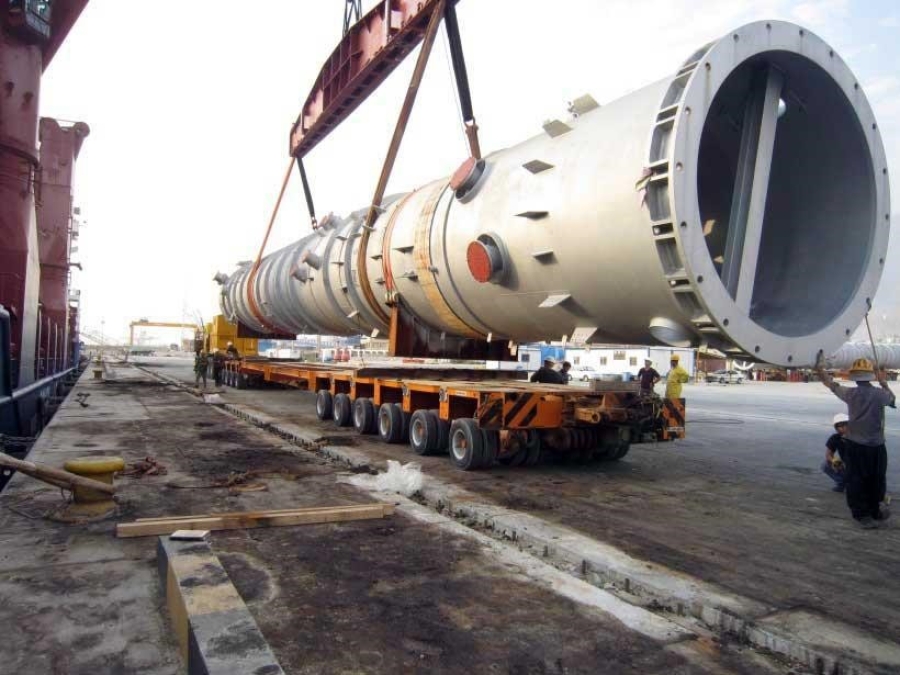
- Heavy-lift and project cargo transport in Iran
- OOG (Out-of-Gauge) shipments with route feasibility assessment
- Temperature-controlled cargo
- Permitted dangerous goods (DG) in compliance with Iranian transit regulations
- Limited hazardous materials that fall within Iran’s approved transit categories
- Perishable and refrigerated goods (fruits, dates, frozen seafood, foodstuff, pharmaceuticals) – transported in SASCO-owned reefer containers.
- RO-RO shipments (vehicles, rolling stock)
Each cargo type undergoes evaluation for packaging, documentation, and customs compliance to ensure smooth entry into Iran.
Operational Advantages
SASCO’s operational advantages are grounded in process reliability rather than marketing phrases:
Shorter East–West Routing
Iran offers faster transit than some long maritime routes or northern land corridors.
Direct Access to Southern Ports
Southern port access enables rapid connection to international shipping lines.
Reduced Delays Through Pre-Coordination
Pre-arranged coordination with customs and border teams minimizes unnecessary hold-ups.
Multilingual Operational Teams
Teams fluent in English and Russian facilitate seamless documentation and communication.
Heavy Cargo Capability
Technical assessments and route planning are available for oversized and heavy shipments.
Customs and Compliance Workflow
Iranian transit requires strict adherence to regulations. SASCO handles all compliance stages in coordination with Iran customs clearance:
- Cargo type verification prior to entry
- Entry documentation and approval
- Submission of transit declarations
- Seal verification along the route
- Final delivery at exit points
This approach minimizes the risk of returns or extended delays.
Risks and Route Considerations
Transit through Iran is influenced by border conditions, internal transport infrastructure, and seasonal regulations. Key considerations managed by Sasco include:
- Monitoring high-traffic borders
- Compliance with packaging requirements
- Restrictions on sensitive goods
- Adherence to international transport standards
Providing transparent information reassures clients searching for “Iran transit safety” and route reliability.
Frequently Asked Questions
Is Iran a reliable transit route?
Yes. Major East–West and North–South corridors are stable, provided cargo preparation and correct entry points are observed.
How are Transit through Iran costs calculated?
Based on cargo type, transport mode, route, and timing. Quotations are issued after evaluating entry and exit points.
Can multimodal transit be arranged by SASCO?
Yes. For combined sea-rail-road solutions, please see our Multimodal Transport via Iran page.
Are restricted goods accepted?
Only items permitted under Iranian transit regulations. Approval is confirmed prior to booking.
Contact for Transit Services
For transit quotations, route planning, or cross-border cargo coordination:
- Email: This email address is being protected from spambots. You need JavaScript enabled to view it.
- Phone: +98-21-86034763
- Transit Department – Sasco