

What Is Vessel Chartering?
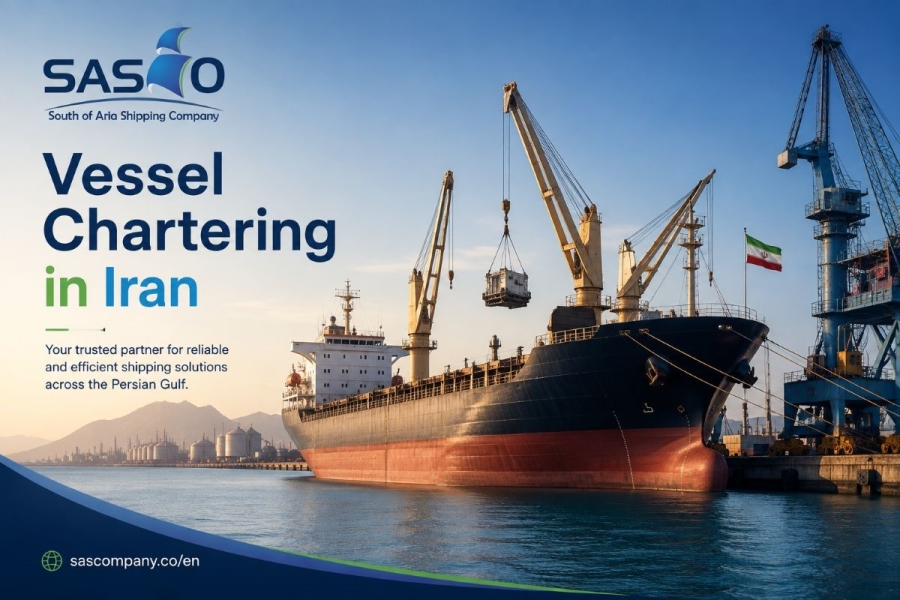
Vessel chartering is the process of hiring a vessel or a specific portion of its capacity to transport cargo by sea. Instead of booking space through a regular shipping line service, a cargo owner or freight operator arranges transportation directly through a charter agreement with a vessel owner or operator.
A chartered vessel is commonly used when cargo requirements cannot be efficiently handled through standard container shipping. This includes large quantities of bulk commodities, heavy industrial equipment, oversized machinery, project cargo, and other specialized shipments that require dedicated vessel planning.
The main difference between vessel chartering and liner shipping is flexibility. Liner shipping follows predetermined routes, schedules, and container-based services, while chartering allows parties to negotiate transportation terms according to the cargo, route, vessel type, and operational requirements.
Companies may choose a ship charter when they need:
- transportation capacity for large-volume cargo;
- a vessel suitable for oversized or heavy cargo;
- flexibility in loading and discharge arrangements;
- access to ports or routes not regularly served by liner operators;
- customized solutions for industrial or project shipments.
Vessel chartering can involve different agreements, including voyage charter, time charter, and other charter arrangements depending on the level of control, duration, and responsibility required by the parties.
For shipments through Iran, selecting the right charter solution requires understanding cargo characteristics, port capabilities, vessel availability, and regional maritime conditions.
Types of Vessel Chartering Services in Iran
The type of charter agreement selected depends on cargo requirements, shipment frequency, vessel availability, and the level of operational control required. In Iran, different chartering models are used for bulk cargo, project shipments, industrial equipment, and other specialized maritime transportation needs.
Voyage Charter
A voyage charter is an agreement where a vessel is hired for a specific voyage between an agreed loading port and discharge port. The freight is calculated based on the transportation of cargo for that particular journey.
This charter type is widely used for bulk cargo, break bulk shipments, and project cargo where dedicated vessel capacity is required. Commodities such as minerals, steel products, raw materials, and heavy industrial equipment are commonly transported through voyage charter arrangements.
Under a voyage charter, the vessel owner generally remains responsible for vessel operation, crew, and technical management, while the charterer provides cargo details and coordinates loading and discharge requirements.
For oversized and industrial shipments, voyage chartering can offer greater flexibility than standard shipping solutions. SASCO supports specialized cargo movements through project cargo & OOG transport in Iran, where cargo dimensions, weight, and handling conditions require customized maritime planning.
Time Charter
A time charter allows a company to use a vessel for an agreed period rather than for only one voyage. During the charter period, the charterer can utilize the vessel capacity according to the conditions defined in the charter agreement.
This option is generally suitable for companies with continuous transportation requirements or regular large-volume shipments. Businesses involved in commodity trading, industrial supply chains, and long-term cargo movements may benefit from the flexibility of time charter arrangements.
In a time charter, the vessel owner usually manages technical matters, including crew and maintenance, while the charterer has greater control over commercial decisions such as voyage planning and cargo operations.
For efficient vessel movements in Iranian ports, coordination with local maritime and port service providers is essential. SASCO supports these requirements through shipping agency services in Iran, helping coordinate operational communication and port-related activities.
Bareboat Charter
A bareboat charter transfers a higher level of operational responsibility to the charterer. Under this arrangement, the charterer takes control of the vessel without receiving crew or technical management services from the vessel owner.
The charterer becomes responsible for areas such as crew management, maintenance, insurance, and vessel operation. Due to the level of responsibility involved, bareboat chartering is mainly used by experienced maritime companies with the necessary operational capabilities.
For most cargo owners, voyage charter or time charter solutions are usually more practical unless long-term control of vessel operations is required.
Slot Charter
A slot charter allows a company to reserve a specific amount of vessel capacity without chartering the entire ship. This model is commonly used in container shipping networks where companies require additional capacity while relying on an existing carrier’s vessel operation.
Slot charter arrangements can provide flexibility for containerized cargo, especially when regular services have limited available space. Depending on cargo requirements and route availability, slot arrangements may complement sea freight services in Iran for international shipments.
What Types of Cargo Require Vessel Chartering in Iran?
Not every shipment is suitable for standard container shipping. When cargo exceeds normal container limitations due to its weight, dimensions, volume, or handling requirements, companies may need a dedicated maritime solution through vessel chartering in Iran.
Chartering is commonly selected for cargo that requires specific vessel capacity, specialized loading arrangements, or more flexibility than regular liner services can provide.
The most common cargo categories requiring vessel chartering solutions include bulk cargo, break bulk cargo, project cargo, and RoRo cargo.
Bulk Cargo
Bulk cargo is one of the main categories transported through chartered vessels, especially when companies need to move large quantities of commodities that are not suitable for standard container solutions.
Typical bulk cargo includes:
- minerals and mining products;
- grain and agricultural commodities;
- industrial raw materials.
For large-volume shipments, container shipping may create limitations related to capacity, handling efficiency, and overall transportation cost. A suitable bulk carrier allows cargo owners to move higher quantities while considering factors such as loading facilities, port conditions, and voyage requirements.
Break Bulk Cargo
Break bulk cargo refers to goods transported as individual units rather than inside standard containers. These shipments often require suitable vessel space, lifting capability, and careful coordination during loading and discharge operations.
Common examples include:
- steel products;
- industrial machinery;
- manufacturing equipment.
Large industrial cargo often cannot be transported efficiently through standard container services because of unusual dimensions, heavy weight, or special handling requirements. In these situations, selecting the right vessel type becomes critical to ensure safe and efficient transportation.
Project Cargo
Project cargo includes complex shipments related to industrial, energy, and infrastructure projects. These shipments usually involve high-value equipment that requires detailed planning before transportation.
Typical examples include:
- power plant equipment;
- oversized machinery;
- heavy industrial components.
Unlike ordinary cargo, project shipments require evaluation of several factors, including cargo dimensions, lifting requirements, port infrastructure, route limitations, and delivery schedules.
RoRo Cargo
RoRo (Roll-on/Roll-off) cargo includes vehicles and rolling equipment that can be driven onto and off a vessel. This method is widely used when cargo mobility is a key requirement.
Typical RoRo cargo includes:
- passenger vehicles;
- trucks and trailers;
- construction and agricultural machinery.
For vehicle and rolling equipment shipments, selecting the appropriate vessel and understanding port handling capabilities are important factors in achieving smooth loading, discharge, and delivery operations.
Main Vessel Types Used for Chartering in Iran
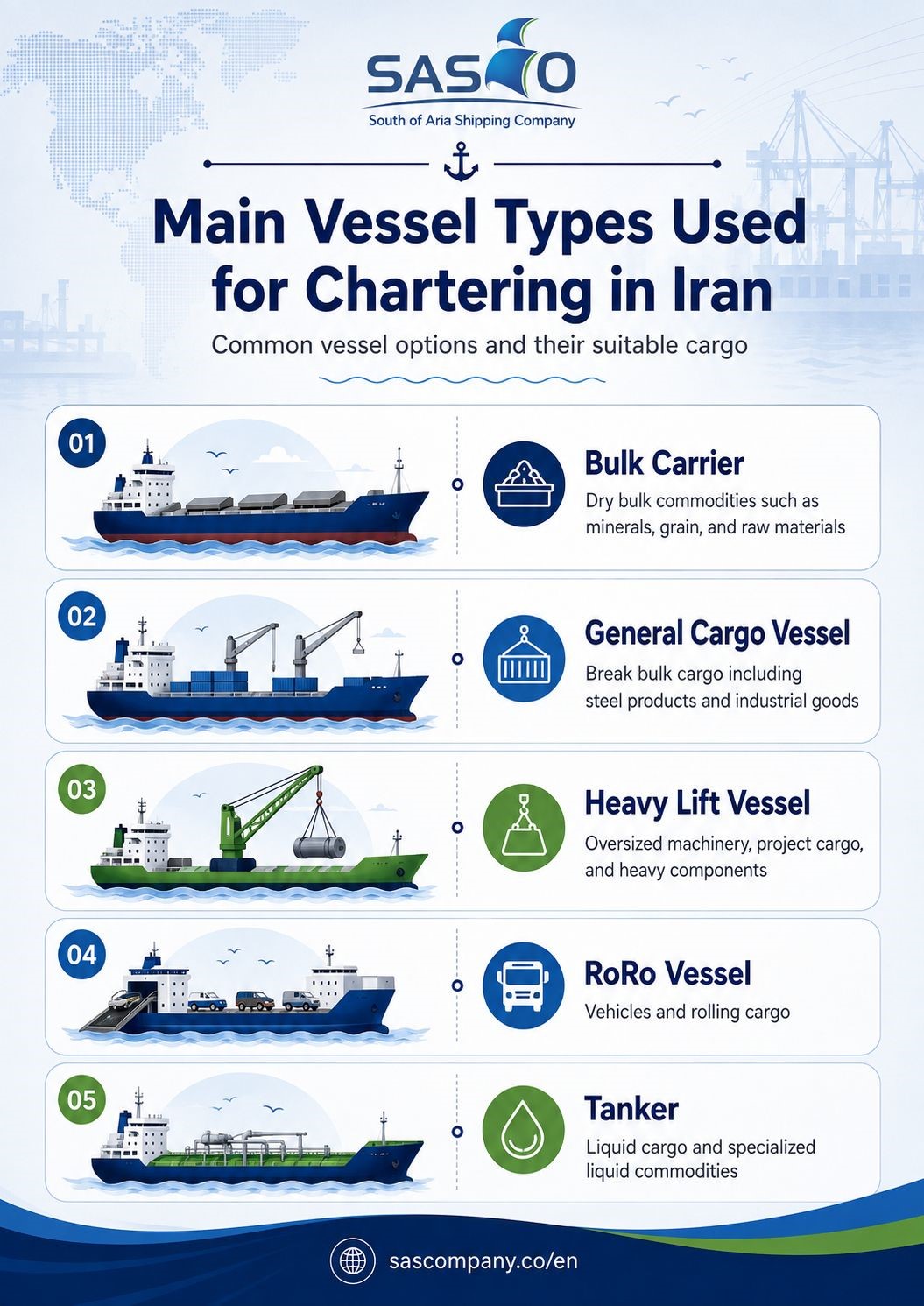
Selecting the correct vessel is one of the most important steps in vessel chartering. The suitable vessel depends on cargo type, weight, dimensions, volume, loading method, and port requirements.
|
Vessel Type |
Suitable Cargo |
|
Bulk Carrier |
Dry bulk commodities such as minerals, grain, and raw materials |
|
General Cargo Vessel |
Break bulk cargo including steel products and industrial goods |
|
Heavy Lift Vessel |
Oversized machinery, project cargo, and heavy components |
|
RoRo Vessel |
Vehicles and rolling cargo |
|
Tanker |
Liquid cargo and specialized liquid commodities |
Each vessel type is designed for specific cargo requirements. Bulk carriers are suitable for high-volume dry commodities, while heavy lift vessels are selected when cargo requires specialized lifting capability, large deck space, or careful handling procedures.
Before selecting a vessel, cargo characteristics should be reviewed together with loading conditions, port limitations, and voyage requirements. SASCO evaluates shipment details such as cargo type, dimensions, weight, and operational requirements to identify suitable maritime solutions for different cargo profiles.
Vessel Chartering Process in Iran
Arranging a vessel charter requires detailed planning before the cargo is loaded. Unlike standard shipping services, chartering decisions depend on several factors, including cargo specifications, vessel availability, port conditions, and transportation requirements.
A successful vessel chartering process in Iran starts with understanding the cargo requirements and continues through vessel selection, freight negotiation, contract arrangement, and operational coordination until loading and departure.
1. Cargo Requirement Review
The first step in vessel chartering is collecting complete information about the cargo. Accurate cargo details help determine the most suitable vessel type, loading method, and transportation plan.
Important information usually includes:
- cargo type and description;
- total weight and volume;
- dimensions of individual units;
- loading port and discharge port;
- required shipment date;
- special handling requirements.
For example, transporting heavy machinery or oversized components requires different planning compared with bulk commodities or general cargo. Missing or inaccurate cargo information can result in unsuitable vessel selection, additional costs, or operational delays.
A detailed cargo review allows the chartering team to evaluate transportation requirements before approaching vessel operators.
2. Vessel Selection
After cargo requirements are confirmed, the next step is identifying a suitable vessel. Vessel selection is not only based on available capacity but also on the compatibility between the vessel and the cargo.
Key factors include:
- vessel capacity;
- cargo handling capabilities;
- port limitations;
- loading and discharge conditions;
- voyage requirements.
For example, a Bulk Carrier may be suitable for large quantities of dry commodities, while project cargo may require a Heavy Lift Vessel with specialized lifting capability and sufficient deck space.
The selected vessel must also be suitable for the operational conditions of the origin and destination ports. Port depth, available cranes, terminal facilities, and local restrictions can all influence the final vessel choice.
3. Freight Negotiation
Once a suitable vessel option is identified, the commercial terms of the charter are negotiated between the involved parties.
Important elements may include:
- freight terms;
- loading and discharge conditions;
- port charges;
- waiting time and additional costs;
- responsibilities of each party.
Because vessel charter rates are affected by market conditions, route characteristics, vessel availability, and cargo requirements, each quotation needs to be prepared based on the specific shipment details.
A clear understanding of cost components helps cargo owners avoid unexpected expenses during transportation.
4. Charter Party Agreement
The charter party agreement is the formal contract that defines the terms and conditions of the vessel charter.
This agreement normally specifies:
- responsibilities of the owner and charterer;
- agreed freight terms;
- loading and discharge arrangements;
- operational conditions;
- other contractual requirements.
A properly prepared charter party helps establish clear responsibilities between the involved parties and reduces potential misunderstandings during the shipment process.
5. Loading and Port Coordination
The final stage of the chartering process involves preparing and coordinating the actual shipment operation. Successful loading requires communication between cargo owners, vessel operators, terminals, and port authorities.
Operational activities may include:
- coordination with ports;
- documentation follow-up;
- loading arrangements;
- operational communication during vessel movements.
For shipments through Iranian ports, local coordination and knowledge of port procedures are important factors in maintaining smooth operations. SASCO supports customers by coordinating maritime requirements, following operational details, and assisting with communication between different parties involved in the shipment.
Through proper planning and coordination, vessel chartering can provide a reliable solution for bulk cargo, project shipments, and other specialized maritime transportation needs.
Major Ports for Vessel Chartering in Iran
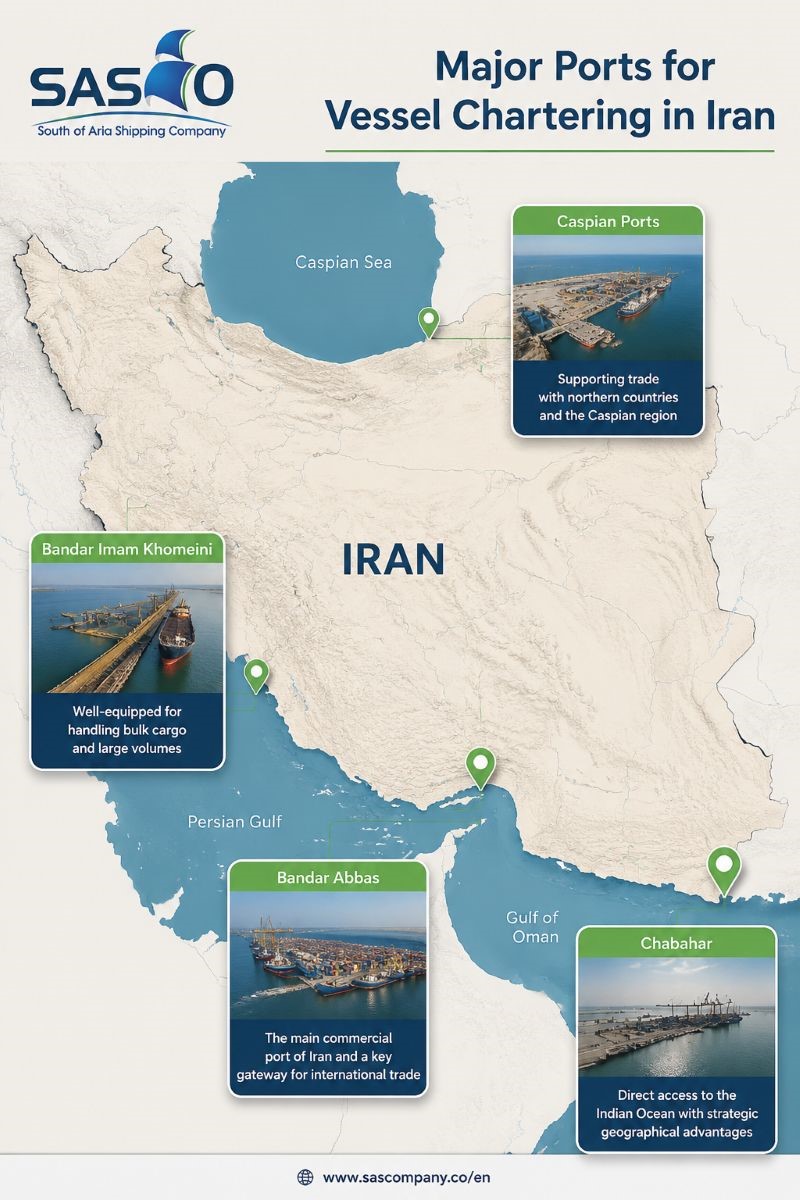
The choice of port is an important factor in successful vessel chartering operations. Port infrastructure, cargo handling capabilities, draft limitations, available terminals, and access to maritime routes can directly influence vessel selection and overall transportation planning.
Iran’s location along the Persian Gulf, the Gulf of Oman, and the Caspian Sea provides access to different maritime gateways, each serving different cargo requirements.
Bandar Abbas
Bandar Abbas is the most important commercial port in Iran and a major gateway for international maritime trade. Its strategic location near the Strait of Hormuz makes it a key point for containerized cargo, general cargo, and various industrial shipments.
For vessel chartering operations, Bandar Abbas offers access to established port facilities and connections with major international shipping routes. The port is commonly considered for cargo requiring efficient loading, discharge, and onward transportation planning.
Bandar Imam Khomeini
Bandar Imam Khomeini is one of Iran’s important ports for bulk cargo operations. Its facilities and location make it suitable for handling large-volume commodities and industrial cargo.
Bulk shipments such as agricultural products, minerals, and raw materials often require specialized vessel solutions, and port capabilities play an important role in selecting suitable vessels and planning charter operations.
Chabahar
Chabahar Port provides direct access to the Indian Ocean and offers strategic advantages for shipments connected to international trade routes outside the Persian Gulf.
Its geographical position can be beneficial for certain cargo flows, particularly when route planning and access to open-sea connections are important considerations.
Caspian Ports
Iran’s Caspian ports support maritime trade with northern destinations and countries around the Caspian Sea. These ports are relevant for cargo movements where regional sea transportation is required.
Port selection for vessel chartering depends on cargo origin, destination, vessel requirements, and operational conditions. A proper evaluation of port capabilities helps ensure that the selected vessel and transportation plan match the shipment requirements.
&&
Factors Affecting Vessel Chartering Cost in Iran
Vessel chartering costs are influenced by multiple operational and market factors. Unlike standard shipping services, charter rates are usually calculated based on the specific cargo, route, vessel requirements, and current market conditions.
The main factors affecting chartering costs include:
Vessel Size and Type
The required vessel type and capacity have a direct impact on charter costs. Larger vessels or specialized ships, such as heavy lift vessels, may involve different pricing structures compared with standard cargo vessels.
Cargo Volume and Characteristics
Cargo quantity, weight, dimensions, and handling requirements influence vessel selection and overall costs. Large-volume cargo may require dedicated capacity, while oversized or heavy cargo may require specialized equipment.
Route Distance
The distance between the loading and discharge ports affects voyage costs, fuel consumption, and operational planning. Longer routes generally involve higher transportation expenses.
Loading and Discharge Conditions
Cargo handling requirements, loading equipment, port facilities, and operational complexity can influence total costs. Difficult loading conditions or extended operations may create additional expenses.
Port Charges and Additional Costs
Port-related expenses, terminal charges, documentation requirements, and possible waiting costs should be considered when evaluating a charter quotation.
Fuel Prices and Market Conditions
Fuel prices and overall maritime market conditions can affect vessel operating costs and charter rates. Therefore, charter quotations should always be prepared based on updated market information and the specific shipment details.
A detailed assessment of these factors helps cargo owners select a suitable chartering solution while reducing unexpected costs during the transportation process.
Why Choose SASCO for Vessel Chartering in Iran?
Successful chartering requires more than finding an available vessel. The ship must match the cargo, route, port conditions, and loading and discharge requirements. SASCO combines vessel chartering services in Iran with local maritime coordination to support this process.
During operations, SASCO can coordinate communication between cargo owners, vessel owners or operators, terminals, and ports, while supporting documentation follow-up and operational requirements.
For companies looking for a ship chartering company in Iran, SASCO provides local knowledge of Iranian ports together with coordinated support from cargo assessment through vessel and port operations.
Customers can request a shipping quotation by providing their cargo, route, ports, and preferred shipment date.
Frequently Asked Questions About Vessel Chartering in Iran
What is vessel chartering in Iran?
Vessel chartering means arranging an entire vessel or part of its capacity for specific cargo and transportation requirements. The arrangement may include voyage charter, time charter, or other charter structures.
When should a company charter a vessel instead of using container shipping?
Chartering may be suitable when cargo is too large, heavy, or voluminous for efficient container shipping, requires specialized handling, or needs dedicated vessel capacity.
What cargo types require chartered vessels?
Common examples include bulk commodities, steel products, industrial machinery, project cargo, oversized equipment, vehicles, and rolling cargo.
How is vessel chartering cost calculated?
Vessel chartering cost in Iran depends on vessel type and size, cargo volume, route, vessel availability, fuel prices, port charges, loading and discharge terms, and waiting time.
Can SASCO arrange project cargo vessel chartering in Iran?
SASCO can assess project and oversized cargo requirements and coordinate suitable vessel solutions based on cargo dimensions, weight, lifting requirements, ports, route, and available tonnage.