

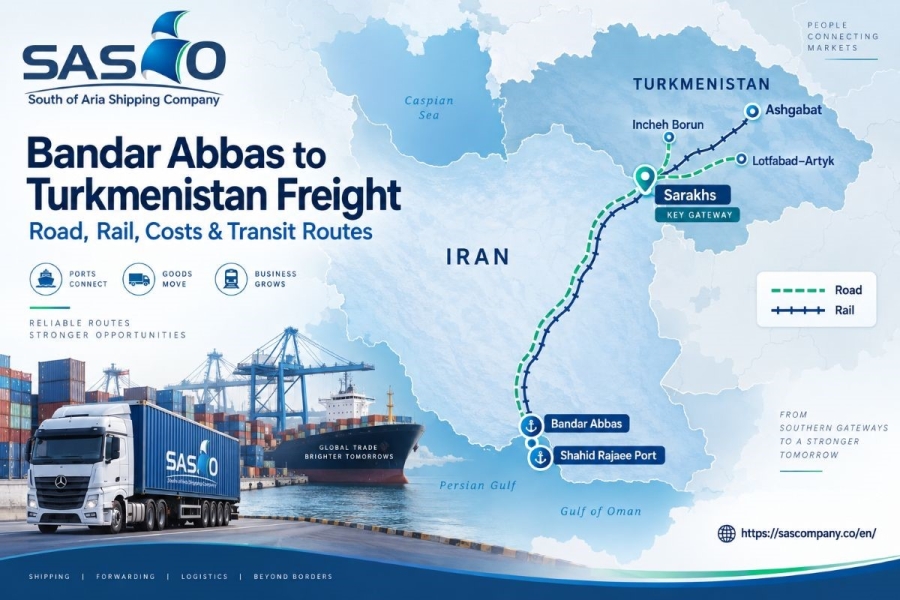
Bandar Abbas to Turkmenistan Freight at a Glance
The main planning variables are the transport mode, border crossing, final destination and cargo specifications. The figures below are indicative benchmarks for initial budgeting; actual schedules and rates should be confirmed for each shipment.
|
Factor |
Typical Planning Benchmark |
|
Iran gateway |
Bandar Abbas / Shahid Rajaee Port |
|
Main modes |
Road / Rail / Multimodal |
|
Key border options |
Sarakhs / Lotfabad–Artyk / Bajgiran–Howdan / Incheh Borun |
|
Main destinations |
Ashgabat, Mary, Turkmenabat, Balkanabat, Turkmenbashi |
|
Typical cargo |
Containers, FTL, industrial and project cargo |
|
Indicative transit time |
Inland to Ashgabat: about 5–10 days; rail to Turkmenistan: about 10–15 days |
|
Indicative cost |
Approx. USD 2,100–3,000 to Ashgabat; other routes on request |
How Does Freight Move from Bandar Abbas to Turkmenistan?
For seaborne cargo, the movement usually begins at Shahid Rajaee Port in Bandar Abbas. After discharge and port handling, cargo destined for Turkmenistan is generally placed under an Iranian customs-transit procedure rather than cleared for consumption in Iran. The shipment then moves north by truck, rail or a multimodal combination toward the border crossing selected for the destination and transport mode. Sarakhs is important for both road and rail traffic; Lotfabad–Artyk and Bajgiran–Howdan are relevant road gateways, while Incheh Borun provides another rail-linked option.
After Iranian exit formalities and the corresponding Turkmen border procedures, the cargo continues to Ashgabat, Mary, Turkmenabat, Balkanabat, Turkmenbashi or another final destination. Cargo imported into Iran follows a different customs process: it is cleared into the Iranian market and becomes subject to import requirements. By contrast, transit cargo remains under customs control while crossing the country. SASCO’s transit through Iran services cover coordination of this cross-border movement, including transit documentation, inland transport and border handling.
Main Freight Routes from Bandar Abbas to Turkmenistan
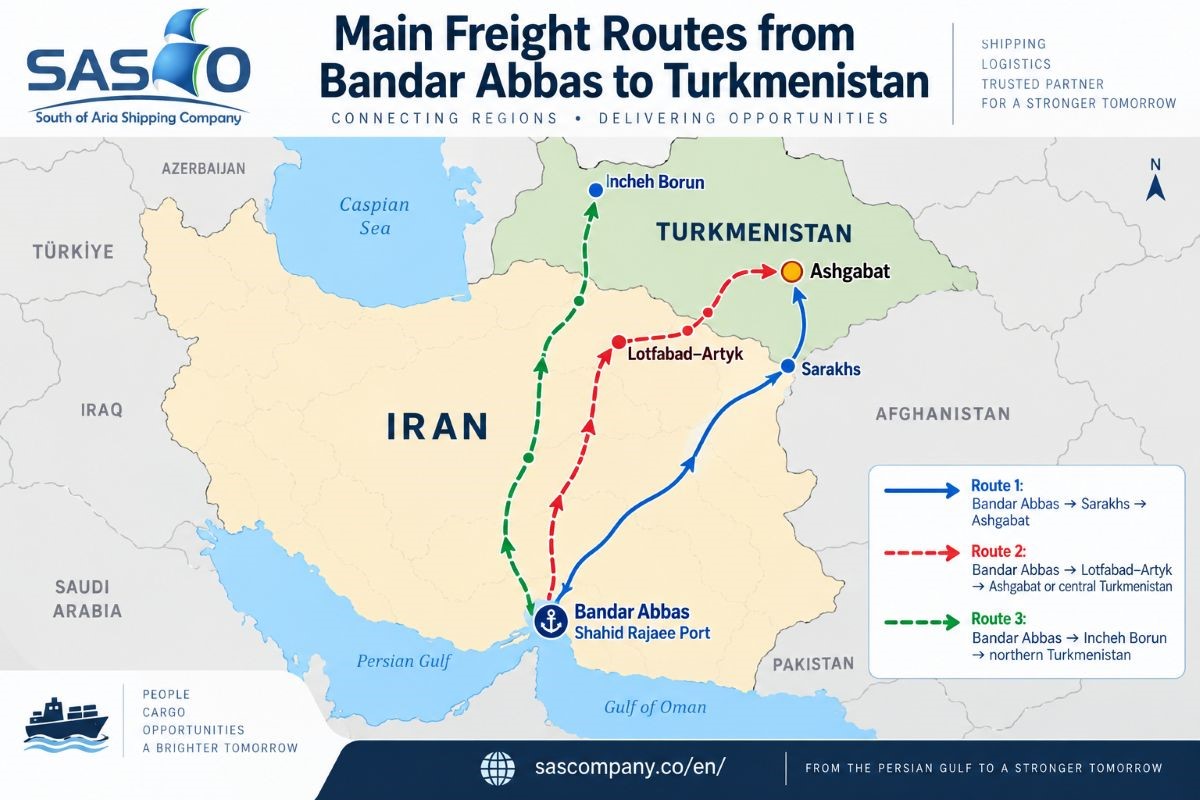
Freight from Bandar Abbas to Turkmenistan can move through several northeastern gateways, but the most suitable route depends on the transport mode, final destination, cargo profile, available equipment and current border capacity. Sarakhs is particularly important because it supports both road and rail movements, while Lotfabad–Artyk is primarily relevant to trucking and Incheh Borun provides an alternative northern rail connection.
Bandar Abbas → Sarakhs → Turkmenistan
The Bandar Abbas–Sarakhs corridor is one of the main route families for cargo moving from southern Iran into Turkmenistan and onward CIS markets. Road cargo can cross through Sarakhs, while Bandar Abbas to Sarakhs rail freight connects the southern port with the Turkmen rail network. A key operational issue is the break of gauge: Iran uses 1,435 mm standard-gauge track, while Turkmenistan and the wider Central Asian network use 1,520 mm gauge. This requires appropriate transshipment, wagon or bogie exchange, or other terminal arrangements at the interface (UNESCAP break-of-gauge reference).
Sarakhs is also receiving additional container-handling capacity. In August 2026, official Turkmen transport reporting stated that construction of the Sarakhs rail terminal in Iran was about 60% complete, including an 18-hectare specialized container-loading area intended to support container flows between Iran, Central Asia and China (official Sarakhs terminal update). For suitable shipments, SASCO’s rail freight services in Iran can support rail-route planning, terminal coordination and cross-border movements through this corridor.
Bandar Abbas → Lotfabad–Artyk → Turkmenistan
Lotfabad–Artyk is an important alternative for Bandar Abbas to Turkmenistan road freight, particularly when truck routing and the final Turkmen destination make this crossing operationally practical. In September 2026, Iranian and Turkmen representatives discussed simplifying border-crossing procedures, improving freight transshipment and expanding road-transport activity at Artyk–Lotfabad (official Artyk–Lotfabad border update) SASCO’s road freight transport in Iran can be combined with transit documentation and border coordination for cargo using this route.
Bandar Abbas → Incheh Borun → Turkmenistan
Incheh Borun is a northern rail gateway on the Kazakhstan–Turkmenistan–Iran railway and can be considered for selected Turkmenistan cargo transit, especially when northern routing, available rail capacity or onward network connections favor it. Railway infrastructure data presented by Iran to UNECE identifies both standard-gauge and broad-gauge tracks at Incheh Borun, supporting interchange with the Turkmen rail network (UNECE Incheh Borun rail infrastructure data).
No single border crossing is automatically the fastest or cheapest. The route should be selected according to the final destination, road or rail capacity, equipment availability, cargo requirements and current border operating conditions.
Road Freight from Bandar Abbas to Turkmenistan
For shippers prioritizing flexible delivery, Bandar Abbas to Turkmenistan road freight is usually planned as a full-truckload or container-on-truck movement after discharge at Shahid Rajaee Port. Standard general cargo, palletized goods, industrial machinery and suitable containerized cargo can move north by truck, while oversized units may require specialized trailers, route surveys and permits. SASCO’s project cargo and OOG transport in Iran is relevant when cargo dimensions or weight exceed standard trucking limits.
For Bandar Abbas to Ashgabat freight, the road plan should be built around the final delivery point rather than a fixed border. Sarakhs and Lotfabad–Artyk are important options, while Bajgiran–Howdan may also be considered depending on the carrier plan and current border conditions. In March 2026, Turkmenistan Customs reported that vehicle and cargo traffic through Sarahs, Artyk and Howdan was operating in regular mode, although throughput remains subject to each checkpoint’s capacity.
FTL to Turkmenistan can reduce intermediate handling and support direct inland delivery when a suitable truck and cross-border arrangement are available. In other cases, the container or cargo may require carrier handover, chassis change or transloading at the border. Truck availability, permits, cargo dimensions and receiving-carrier acceptance should therefore be confirmed before dispatch. For buyers comparing trucking from Bandar Abbas to Turkmenistan, the practical question is not only the line-haul rate, but the total cost to the final consignee.
Rail Freight from Bandar Abbas to Turkmenistan
Bandar Abbas to Turkmenistan rail freight is most relevant when the shipment can use Iran’s national railway network efficiently and the cargo volume justifies terminal and border handling. Shahid Rajaee Port has rail-linked container infrastructure connected to the national network, allowing suitable cargo to move inland toward the northeastern rail gateways. Sarakhs is a principal connection for Turkmenistan-bound rail movements, while Incheh Borun provides a second Iran–Turkmenistan rail crossing on the Kazakhstan–Turkmenistan–Iran corridor.
Containerized cargo, minerals, bulk commodities and selected heavy or industrial shipments can be suitable for rail, but equipment must be checked before booking. Wagon type, container ownership, loading method, train schedule and available capacity can all affect whether rail freight from Bandar Abbas to Turkmenistan is commercially practical. Rail should therefore not be assumed to be automatically cheaper than road for every shipment.
As noted in the route section above, rail movements through Sarakhs involve specific border-terminal and gauge-change procedures, while ongoing capacity development may affect operational planning. For sea-arriving cargo, SASCO’s multimodal transport via Iran can connect Bandar Abbas with the rail leg and any required first- or last-mile trucking. The viability of Iran–Turkmenistan rail freight ultimately depends on shipment volume, wagon availability, schedules, cargo type and final destination.
Road vs Rail: Which Is Better for Turkmenistan Freight?
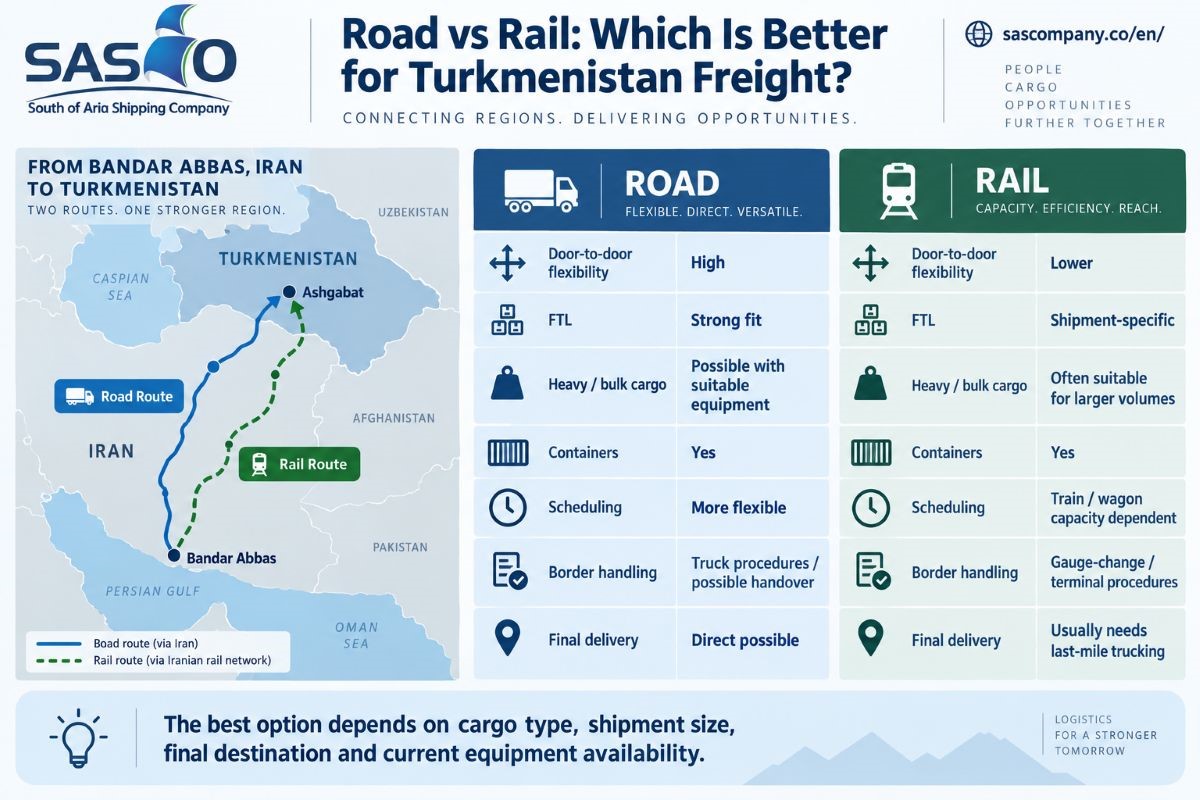
For Bandar Abbas to Turkmenistan shipping, road and rail solve different logistics problems. Road is generally more flexible when the buyer needs an FTL movement, direct delivery to Ashgabat or another inland consignee, or a schedule that cannot wait for wagon allocation. Rail becomes more attractive to evaluate when cargo is containerized, heavy, bulk or moving in larger regular volumes. However, rail adds terminal, schedule and gauge-change considerations, while roads can face truck availability, permits and border-handover requirements.
|
Factor |
Road |
Rail |
|
Door-to-door flexibility |
Higher |
Lower; often needs last-mile trucking |
|
FTL |
Strong fit |
Shipment-specific |
|
Heavy / bulk cargo |
Possible with suitable equipment |
Often suitable for larger volumes |
|
Containers |
Yes |
Yes, subject to rail equipment |
|
Scheduling |
More dispatch flexibility |
Train / wagon capacity dependent |
|
Border handling |
Truck procedures; handover or transloading may apply |
Gauge-change and terminal procedures |
|
Final delivery |
Direct delivery may be possible |
Usually requires a road last mile |
|
Cost structure |
Truck, border and route dependent |
Rail + terminal + possible last-mile costs |
The comparison should therefore be based on total delivered cost and operational fit, not on the line-haul rate alone. A lower rail rate can be offset by terminal handling or last-mile trucking, while a higher road rate may buy simpler door-to-door execution. For time-sensitive shipments, current operational availability can matter more than theoretical modal advantages.
Main Turkmenistan Destinations from Bandar Abbas
Bandar Abbas connects efficiently with several major commercial destinations across Turkmenistan, but routing varies depending on geography and the selected transport mode. Ashgabat is one of the main inland destinations and is commonly served by road through northeastern Iran. Mary is well positioned for routes via Sarakhs, while Turkmenabat requires a longer eastbound movement inside Turkmenistan. Western destinations such as Balkanabat and Turkmenbashi follow a different inland pattern and may require alternative road or multimodal planning.
|
Destination |
Typical Planning Consideration |
|
Ashgabat |
Major commercial destination; strong road option and direct inland delivery planning |
|
Mary |
Northeastern/eastern destination; Sarakhs routing is particularly relevant |
|
Turkmenabat |
Farther east; inland distance and onward routing become more important |
|
Balkanabat |
Western Turkmenistan; road routing may differ from Ashgabat-bound cargo |
|
Turkmenbashi |
Western/Caspian destination; road or multimodal options may be considered |
These destination differences affect border selection, inland mileage, equipment planning and final delivery arrangements. As a result, Bandar Abbas to Ashgabat freight, Bandar Abbas to Mary freight, freight to Turkmenabat and shipping to Turkmenbashi may follow different operational plans even when they originate from the same port.
What Cargo Can Be Shipped?
A wide range of cargo can move from Bandar Abbas to Turkmenistan by road, rail or multimodal transport. Standard 20-foot and 40-foot containers, general cargo, palletized goods, construction materials and industrial machinery are common options, provided the cargo is accepted for transit and suitable equipment is available.
Heavy machinery, transformers, steel structures and other non-standard units may require specialized handling. SASCO’s heavy equipment transport in Iran covers machinery requiring route assessment or dedicated trailers, while breakbulk cargo transit through Iran is relevant where individual units cannot be containerized.
Project cargo and OOG shipments may require permits, escorts, lifting plans or special border arrangements. Selected dangerous goods may also be accepted subject to commodity classification, carrier approval, Iranian transit rules and Turkmenistan entry requirements
How Long Does Bandar Abbas to Turkmenistan Freight Take?
Transit time from Bandar Abbas to Turkmenistan varies mainly by transport mode, border crossing and final destination. For road freight to Ashgabat, a practical range is typically around 5–10 days from the time cargo is ready for inland transit, assuming normal border and equipment conditions. Rail movements to major destinations such as Ashgabat, Mary and Turkmenabat generally require around 10–15 days, depending on wagon availability, terminal handling and train schedules.
The total journey includes several stages: discharge and port handling at Shahid Rajaee Port, Iranian transit formalities, inland movement across Iran, Iran–Turkmenistan border procedures, onward transport inside Turkmenistan and final delivery to the consignee.
Transit can take longer when trucks or wagons are unavailable, documentation is incomplete, border traffic is heavy or special cargo requires additional handling. Sarakhs is frequently used for both road and rail traffic, while alternative crossings may be selected according to destination and operating conditions.
For shipments arriving by sea, vessel schedule and port dwell time are additional factors. SASCO’s sea freight services in Iran can be coordinated with the onward road or rail movement from Bandar Abbas.
How Much Does Freight from Bandar Abbas to Turkmenistan Cost?
The Bandar Abbas to Turkmenistan freight cost depends on the final destination, transport mode, container or equipment type, cargo weight and service scope. For initial planning, a standard container movement from Bandar Abbas to Ashgabat can be budgeted at approximately USD 2,100–3,000, with the final rate varying according to container size, gross weight, border handling and delivery requirements
|
Route / Service |
Indicative Rate |
Basis |
|
Bandar Abbas → Ashgabat, road/container |
Approx. USD 2,100–3,000 |
20GP / 40GP / 40HC; weight-dependent |
|
Bandar Abbas → Ashgabat, rail |
Live quote required |
Container/wagon + terminal handling |
|
Bandar Abbas → Mary |
Live quote required |
Route, equipment and final delivery |
|
Bandar Abbas → Turkmenbashi |
Live quote required |
Road or multimodal movement |
The shipping cost from Bandar Abbas to Turkmenistan also changes with COC versus SOC equipment. COC containers may involve detention, free-time and empty-return conditions, while SOC containers have different positioning and acceptance costs. FTL and conventional cargo are normally priced according to truck type, payload and route; rail pricing depends on wagon availability, train schedules and terminal arrangements.
Weight, dimensions and equipment requirements can change the rate quickly. OOG cargo may require low-bed or modular trailers, permits, escorts and route surveys. Border handling, transit documentation, storage, detention, loading/unloading and insurance may also sit outside the basic freight rate. SASCO’s cargo insurance services in Iran can be coordinated separately where cargo coverage is required.
For commercial comparison, total delivered cost is more useful than the headline freight rate. A quotation should therefore specify the final city, container size, COC/SOC status, gross weight, dimensions, cargo type and included border and delivery services.
What Documents Are Required?
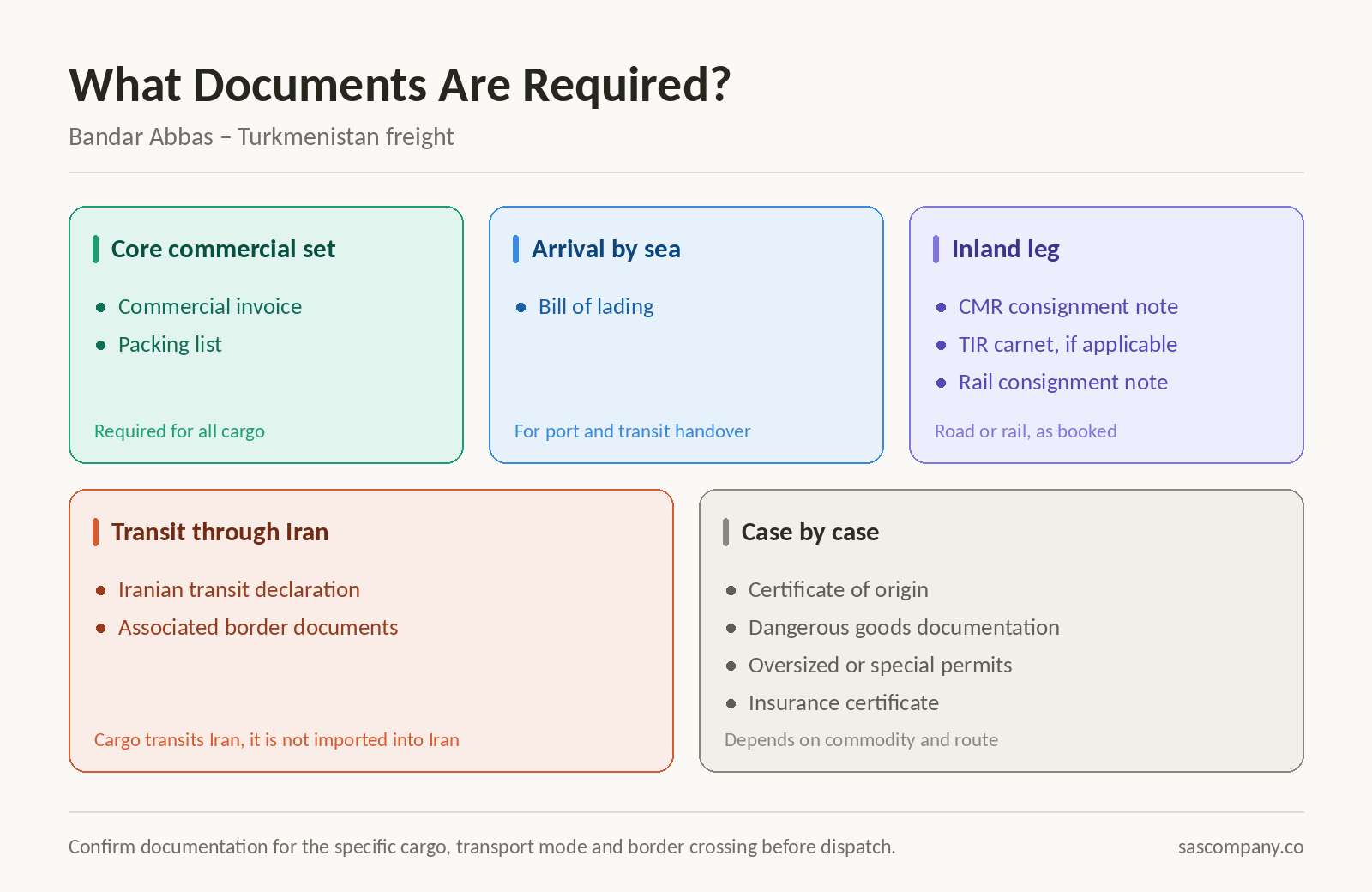
Documents for Bandar Abbas–Turkmenistan freight vary by transport mode, cargo and border procedure. The core set generally includes a Commercial Invoice, Packing List and, for sea-arriving cargo, a Bill of Lading.
Road shipments may require a CMR consignment note and TIR documentation, while rail cargo uses the relevant rail consignment document. A Certificate of Origin, Iranian transit declarations and border documents may also be required. SASCO’s transit through Iran services cover transit-document and cross-border coordination.
Dangerous goods, controlled commodities and oversized cargo may need additional permits or certificates. Turkmenistan continued developing eTIR and digital customs procedures in 2026, but document requirements should still be confirmed for each shipment and route.
What Can Delay Bandar Abbas–Turkmenistan Freight?
The main causes of delay include port dwell time, incomplete transit documents, truck or wagon shortages, border congestion, inspections and special handling requirements. OOG and project cargo may take longer because of permits, route restrictions or additional inspections. Weather and temporary operating restrictions can also affect final delivery.
For container transit through Iran, early document checks and equipment booking can reduce avoidable delays, although border and terminal conditions may still change.
Route Conditions — Updated September 2026
Sarakhs, Artyk and Howdan were reported operating in regular mode in 2026. Border throughput, carrier acceptance, equipment availability and road or rail schedules may change at short notice. Current routing and transit time should be confirmed before booking.
Why Choose SASCO for Bandar Abbas–Turkmenistan Freight?
SASCO can coordinate Shahid Rajaee Port handling, Iranian transit procedures, road or rail planning and movements toward Sarakhs and other northeastern border crossings. Services can cover standard containers, FTL, industrial cargo and project or OOG shipments, with multimodal planning where sea, road and rail legs connect.
For current routing and pricing, shippers can submit cargo details through SASCO’s Request a Shipping Quote page.
Frequently Asked Questions About Bandar Abbas to Turkmenistan Freight
How much does freight from Bandar Abbas to Turkmenistan cost?
For a standard container to Ashgabat, an initial planning range of about USD 2,100–3,000 can be used. Final pricing depends on weight, equipment, mode, border costs and delivery scope.
How long does shipping from Bandar Abbas to Turkmenistan take?
Road freight to Ashgabat is commonly planned at about 5–10 days once cargo is ready for inland transit. Rail movements to major Turkmen destinations often require around 10–15 days.
What is the best route from Bandar Abbas to Ashgabat?
There is no single best route. Sarakhs, Lotfabad–Artyk and, in some cases, Bajgiran–Howdan may be considered for truck transport to Ashgabat depending on equipment, border conditions and delivery requirements.
Can containers move from Bandar Abbas to Turkmenistan by rail?
Yes. Suitable 20-foot and 40-foot containers can move through Iran’s rail network toward Sarakhs or Incheh Borun, subject to wagon availability, terminal arrangements and carrier acceptance.
Which Iran–Turkmenistan border is used for freight?
Sarakhs, Lotfabad–Artyk, Bajgiran–Howdan and Incheh Borun are relevant crossings. The choice depends on road versus rail, final destination, cargo type and current operating conditions.
Can SASCO arrange door-to-door freight to Turkmenistan?
Yes, subject to route, cargo and destination feasibility. SASCO can coordinate the Iranian transit leg, border handling and onward delivery planning for door-to-door freight to Turkmenistan.