

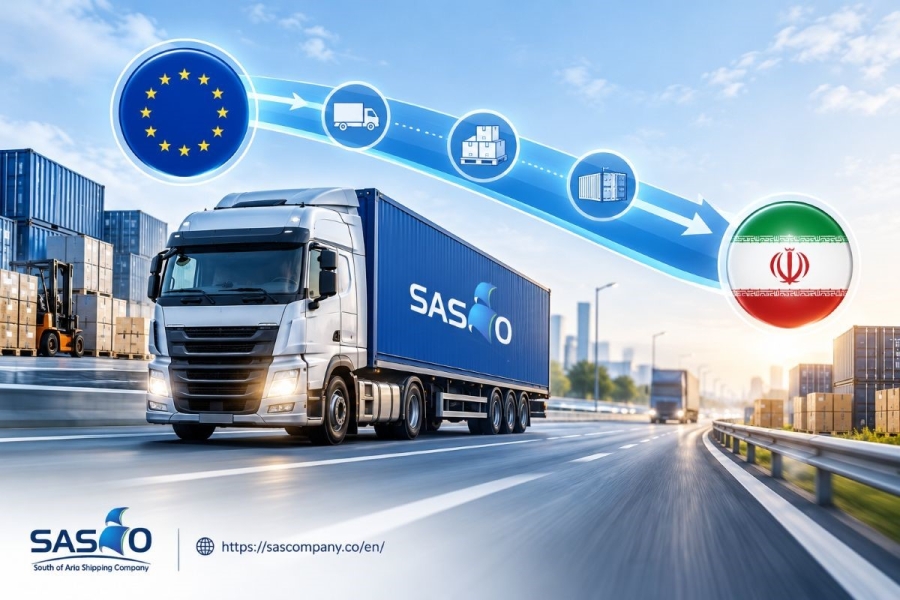
Europe to Iran Road Freight at a Glance
Europe to Iran road freight can be arranged as FTL, LTL or groupage, with routing and service scope adjusted to the shipment’s origin, destination and cargo requirements.
|
Item |
Planning Reference |
|
Main mode |
International road freight |
|
Services |
FTL, LTL and groupage |
|
Main corridor |
Europe → Balkans → Türkiye → Iran |
|
Main Iran gateway |
Gürbulak–Bazargan |
|
Common origins |
Germany, Italy, Benelux, France, Poland, Austria |
|
Common destinations |
Tehran, Tabriz, Karaj, Qazvin, Isfahan |
|
Equipment |
Curtainsider, box, reefer, flatbed |
|
Pricing |
Per truck for FTL; weight, volume or loading space for LTL |
|
Main documents |
Commercial Invoice, Packing List, CMR and applicable transit/customs documents |
Main Road Freight Routes from Europe to Iran
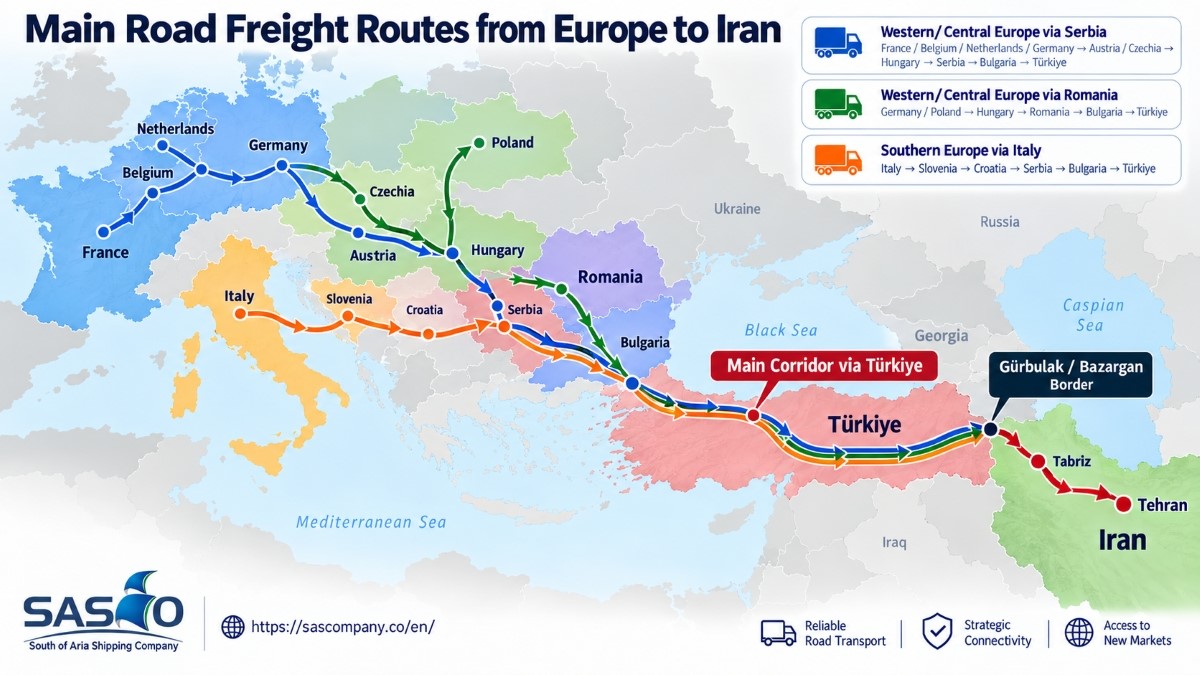
For road transport from Europe to Iran, the main land corridor generally crosses Central or Southeast Europe, the Balkans and Türkiye before entering Iran. The exact transit countries are not fixed and may change according to the pickup location, carrier arrangement, permits, congestion, road restrictions and cargo requirements.
Western and Central Europe via the Balkans and Türkiye
Cargo collected in Germany, the Netherlands, Belgium, France and other Western or Central European countries may move through Austria or Czechia, Hungary, Serbia or Romania, Bulgaria and Türkiye before reaching the Iranian border. From there, the main inland corridor continues through northwestern Iran toward Tabriz, Tehran and other destinations.
For Germany to Iran road freight, for example, either Serbia- or Romania-based Balkan routings may be used depending on operating conditions and carrier planning. The final itinerary should therefore be confirmed for each shipment rather than assumed from a standard route map.
Shipments from Italy and other Southern European origins typically connect with the same eastbound Balkan–Türkiye corridor through the most practical route for the pickup location. Direct FTL can continue without consolidation, while LTL or groupage cargo may first move through a consolidation hub.
The final international leg uses the same Türkiye–Iran corridor covered in SASCO’s road freight from Turkey to Iran operations.
Entry into Iran via the Gürbulak–Bazargan Border
Gürbulak on the Turkish side and Bazargan on the Iranian side form the principal road gateway for this corridor. The International Road Transport Union (IRU) identifies Gürbulak–Bazargan as an important regional road freight link connecting Türkiye, Europe and Iran. Border queues, customs inspections and operating conditions can affect schedules, so alternative crossings such as Razi–Kapıköy should be considered shipment-specific options rather than equivalent default routes.
How Much Does Road Freight from Europe to Iran Cost?
There is no reliable fixed Europe-to-Iran trucking tariff that applies to every shipment. Europe to Iran road freight cost changes with the loading city, Iranian destination, truck type, cargo profile, market capacity and the exact services included in the quotation. A rate from Frankfurt to Tehran, for example, should not be used as a benchmark for a pickup in Madrid or a reefer shipment to Isfahan. Current Europe to Iran trucking rates should therefore be quoted against a specific cargo and loading date rather than treated as a permanent tariff.
FTL Europe to Iran Cost
For FTL Europe to Iran, the core rate is normally built around a dedicated vehicle for the international movement. The origin city and final destination determine distance and routing, while trailer type, gross weight and commodity can affect both equipment availability and operating cost. A standard curtainsider movement is not priced the same way as reefer, ADR, flatbed or oversized cargo. Market capacity and the requested loading date also matter, particularly around holidays, periods of border congestion or when only limited suitable equipment is available.
Special permits, escorts, temperature control, waiting time or unusual loading requirements can add to the final price. For this reason, a full truckload Europe to Iran quote should state the route, equipment and service scope rather than only a single headline number.
LTL / Groupage Cost
LTL Europe to Iran is priced differently because the shipper pays for part of the vehicle rather than a dedicated truck. Depending on the forwarder and consolidation arrangement, groupage from Europe to Iran may be calculated by gross weight, cubic metres (CBM), loading metres, pallet positions or a combination of these factors. Density matters: a light but bulky shipment can use substantial trailer space even when its gross weight is low.
Pickup location, delivery point and the consolidation hub can also change the rate. Additional handling, collection from a remote supplier, non-stackable pallets or cargo requiring special treatment may increase the charge.
What Is Included in the Freight Rate?
A useful quotation should separate the international trucking price from customs, taxes and optional or conditional charges. In particular, Iranian import duties and taxes are not freight charges, and SASCO's customs clearance in Iran should only be treated as included when the quotation explicitly says so.
|
Cost Component |
Included / May Be Extra |
|
European pickup |
Depends on quote |
|
Export customs |
May be separate |
|
Main trucking |
Normally included |
|
Consolidation |
Relevant to LTL |
|
Transit/border costs |
Confirm in quote |
|
Iran customs clearance |
Normally separate unless stated |
|
Duties & taxes |
Not freight |
|
Final delivery |
Confirm destination and scope |
|
Waiting/detention |
Conditional |
|
Cargo insurance |
Separate/optional |
|
ADR, reefer or OOG requirements |
Additional |
For an accurate comparison, provide the pickup and delivery cities, commodity, package count, gross weight, dimensions, equipment requirements and cargo-ready date when you request a shipping quote.
Europe to Iran Road Freight Transit Time
Europe to Iran transit time varies with the pickup location, Iranian destination, service type and current border conditions. For FTL shipments to Tehran, cargo from Central Europe generally has a shorter road leg than shipments originating in Western or Southern Europe, while LTL and groupage usually require additional time for collection and consolidation.
As a practical planning reference, standard FTL movements from many European origins to Tehran may require roughly 9–14 days of road transit under normal operating conditions. The actual schedule can be longer when border queues, customs inspections, driver-hour restrictions, public holidays, severe weather or special cargo requirements affect the route.
|
Origin |
Destination |
Indicative FTL Road Transit |
|
Germany |
Tehran |
about 10–12 days |
|
Netherlands / Belgium |
Tehran |
about 11–13 days |
|
France |
Tehran |
about 11–13 days |
|
Italy |
Tehran |
about 10–12 days |
|
Poland / Central Europe |
Tehran |
about 9–11 days |
|
Spain |
Tehran |
about 12–14 days |
These ranges are intended for preliminary planning rather than guaranteed delivery schedules. Final transit time should be confirmed against the actual pickup point, cargo-ready date, selected route and border conditions at the time of booking.
Road Transit Time vs Door-to-Door Lead Time
Road transit time should not be confused with total door-to-door lead time. A truck may complete the international road leg within the estimated transit window, while the complete shipment can take longer if the service also includes supplier pickup, LTL consolidation, export formalities, border waiting, Iranian customs clearance and final delivery.
The difference is particularly important when comparing FTL with groupage. A dedicated FTL truck can normally depart once the cargo and documentation are ready, whereas an LTL shipment may need to wait for consolidation and a scheduled departure.
For road freight to Tehran or other Iranian destinations, SASCO therefore confirms transit time on a shipment-specific basis rather than applying one fixed Europe-wide delivery time.
FTL vs LTL and Groupage from Europe to Iran
Choosing between FTL and LTL/groupage depends mainly on shipment size, urgency, handling sensitivity and whether the cargo requires dedicated equipment. FTL is generally better when speed, control and direct movement matter, while Europe to Iran groupage is more suitable when the shipment is too small to justify a full vehicle. Bulky or non-stackable freight also needs to be assessed by the trailer space it occupies, not by weight alone. The wider operational differences are covered in SASCO’s FTL vs LTL freight in Iran guide.
FTL Europe to Iran
FTL Europe to Iran uses a dedicated truck or trailer for one shipment. It is generally preferred for larger loads, urgent shipments, high-value or sensitive cargo, and goods requiring a specific trailer type. Because the vehicle does not have to wait for European groupage consolidation, departure can usually be arranged more flexibly once the cargo, vehicle and documents are ready.
LTL / Groupage Europe to Iran
Less than truckload Europe to Iran allows pallets, spare parts and smaller commercial consignments to share vehicle capacity. The shipper pays for the space used rather than an entire truck, making LTL Europe to Iran attractive for smaller or regular shipments. Collection, consolidation and additional handling can, however, extend the departure and overall transit schedule compared with a dedicated FTL movement.
|
Factor |
FTL |
LTL / Groupage |
|
Vehicle |
Dedicated |
Shared |
|
Best for |
Larger, urgent or sensitive shipments |
Smaller commercial shipments and pallets |
|
Departure |
More flexible |
Consolidation-dependent |
|
Handling |
Usually lower |
Usually higher |
|
Transit |
Usually faster |
May require additional consolidation time |
|
Pricing |
Normally per truck |
Weight, volume, loading metres or occupied space |
Equipment should match the cargo rather than the service label alone. Standard freight commonly moves in curtainsider/tautliner or box trailers; temperature-sensitive cargo may require reefer equipment, while ADR cargo needs compliant vehicles and procedures. Flatbed or low-bed equipment may be required for machinery and non-standard loads, with more complex movements requiring the route, permit and equipment planning used for heavy equipment transport in Iran. For containerized or multimodal cargo, SASCO’s container types and dimensions overview covers standard, reefer, open-top, flat-rack and other equipment options.
Main European Origins for Road Freight to Iran
The main European origins for road freight to Iran include Germany, Italy, the Netherlands, Belgium, France, Austria, Poland, the Czech Republic and Spain. Germany to Iran road freight is one of the main Central European lanes, with cargo connecting efficiently to the Balkan–Türkiye corridor. Italy to Iran road freight normally joins the same eastbound corridor from Southern Europe. Cargo from the Netherlands and Belgium may move directly as FTL or through a consolidation arrangement for smaller shipments. France and Spain involve longer western collection legs, while Austria, Poland and Czechia provide relatively direct access to the Central European and Balkan road network. Final routing depends on the actual pickup city, service type, carrier plan and current operating conditions.
Documents, TIR and Customs for Europe-to-Iran Road Freight
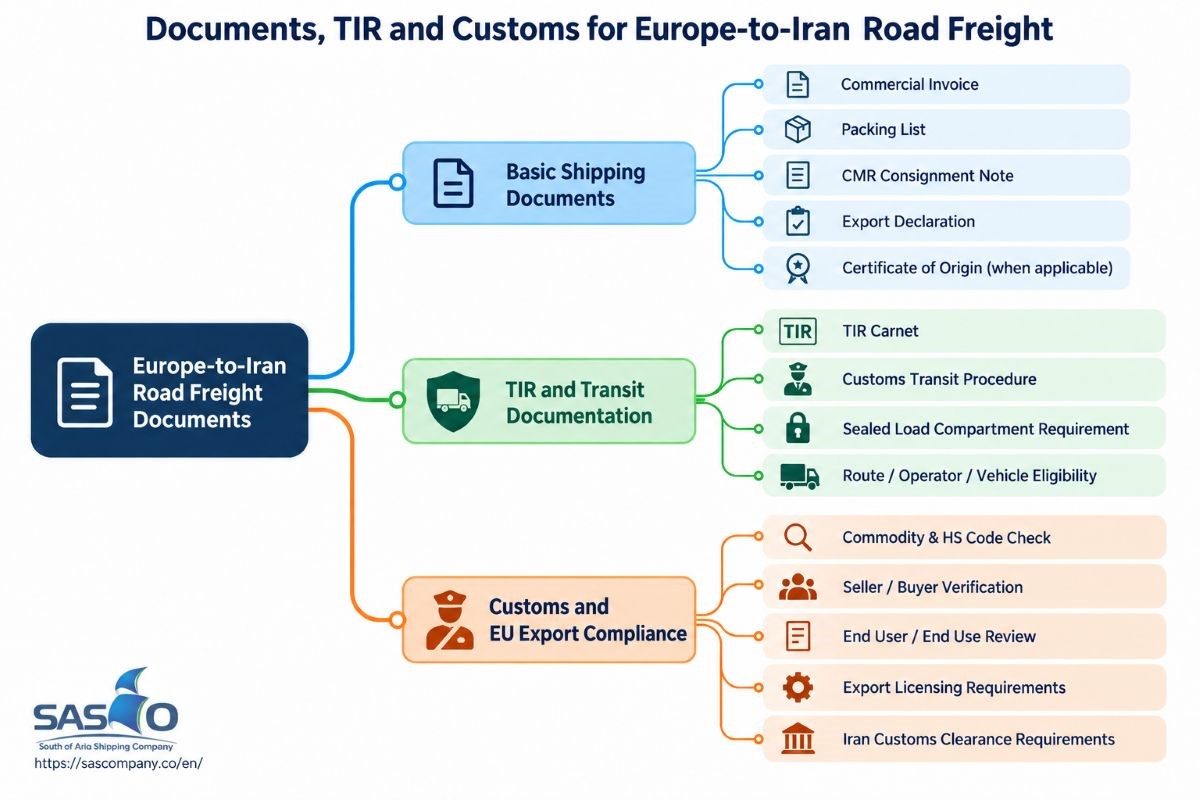
International road transport to Iran requires commercial documents as well as transport and customs paperwork appropriate to the specific cargo and route. The final document set should be confirmed before dispatch, particularly where customs transit, controlled goods, dangerous cargo or special permits are involved.
Basic Shipping Documents
A typical shipment requires a Commercial Invoice and Packing List identifying the seller, buyer, goods, quantities, values, weights and package details. The CMR consignment note documents the international road carriage and the contractual relationship between the relevant parties. An export declaration is normally required at origin, while a Certificate of Origin may be needed depending on the commodity, customer requirements or import procedure. Product certificates, ADR documentation, licences or other permits should be added where applicable.
TIR and Transit Documentation
For eligible movements, a TIR Carnet can facilitate customs transit across several countries. Under the TIR system, goods can travel in approved sealed load compartments under a mutually recognised international customs guarantee, reducing the need for separate transit guarantees in each country on the route. TIR does not replace the Commercial Invoice, Packing List, CMR or destination import documentation, and its use depends on the authorised operator, vehicle or load compartment, route and customs procedure selected for the shipment.
Customs and EU Export Compliance
Road availability does not mean that every commodity can legally be exported from Europe to Iran. Before dispatch, the commodity and HS code, seller and buyer, end user, intended use and applicable licensing requirements should be checked. The EU trade and sanctions framework for Iran continues to include restrictions affecting certain goods, technologies, persons and entities. The European Commission also adopted a 2026 update to the EU dual-use control list on 14 September 2026, covering additional advanced technologies and industrial items. The applicable legal status and licensing requirements should therefore be verified at the time of export. Iran customs clearance requirements must also be checked separately, because permission to export from Europe does not by itself establish that the cargo can be imported and cleared in Iran.
Door-to-Door Freight from Europe to Iran
Door-to-door freight from Europe to Iran can combine supplier pickup, export coordination, international trucking, border handling, Iran customs coordination and final delivery to the agreed warehouse or destination. The exact scope should be stated in the quotation, particularly where LTL collection, customs services or inland delivery are involved.
Door-to-door does not automatically mean that import duties, taxes, inspections, storage, waiting charges or every customs-related cost are included. These items, together with the agreed Incoterm and importer responsibilities, should be confirmed before booking.
What Can Delay Europe-to-Iran Road Freight?
Several operational factors can extend Europe-to-Iran road freight transit time. Border congestion and customs inspections are among the most important, particularly on the Türkiye–Iran corridor. Incomplete or inconsistent documents can also lead to amendments, customs queries or additional inspections.
Other possible delays include export-control checks, limited truck availability, European or Turkish public holidays, winter weather and road conditions, and permits required for ADR or non-standard cargo. LTL shipments may also wait for collection and consolidation before international departure.
Border conditions should therefore be checked close to the loading date.
How to Get an Accurate Europe-to-Iran Road Freight Quote
An accurate Europe-to-Iran road freight quote requires more than an origin and destination. Provide the pickup city, delivery city, commodity, HS code where available, number of packages or pallets, gross weight, dimensions and CBM. Also specify whether the shipment requires FTL or LTL, temperature control, ADR handling, flatbed or other special equipment, and the cargo-ready date.
For Europe to Iran trucking, complete cargo information helps determine the appropriate vehicle, routing and service scope. Request a Europe-to-Iran Road Freight Quote with SASCO once these details are available.
Why Choose SASCO for Europe-to-Iran Road Freight?
For truck transport from Europe to Iran, SASCO coordinates the Iranian side of the movement with road freight planning, border follow-up, customs coordination and onward inland delivery. This is particularly relevant for shipments entering through the Türkiye–Bazargan corridor, where international trucking must connect efficiently with Iranian customs and final-destination requirements.
SASCO’s completed logistics projects also include inbound road-freight operations in Iran, including a two-truck MDF import, as well as temperature-controlled road movements through the Bazargan–Türkiye corridor. These operations support SASCO’s practical experience with cross-border trucking, specialized equipment and Iran-side coordination.
Each shipment is planned around the actual European origin, Iranian destination, cargo specifications, equipment requirements and service scope rather than a fixed Europe-wide transport package.
Frequently Asked Questions About Road Freight from Europe to Iran
How much does road freight from Europe to Iran cost?
There is no fixed Europe to Iran freight cost for all shipments. FTL pricing depends on origin, Iranian destination, equipment, cargo and loading date, while LTL/groupage pricing may depend on weight, CBM, loading metres or pallet space. Customs, duties and final delivery should be checked separately.
How long does road freight from Europe to Iran take?
For preliminary planning, standard FTL movements from major European origins to Tehran may generally require about 9–14 days of road transit. Actual timing varies by origin, route, border queues, customs checks, weather and cargo requirements. LTL/groupage normally requires additional time for consolidation.
What is the main road freight route from Europe to Iran?
Most road freight via Turkey to Iran uses a Central or Southeast European and Balkan corridor before crossing Türkiye and entering Iran through Gürbulak–Bazargan. The exact European transit countries vary according to the origin, carrier plan and current operating conditions.
Is FTL or LTL better for Europe-to-Iran freight?
FTL is generally better for larger, urgent, sensitive or equipment-specific cargo because the vehicle is dedicated to one shipment. LTL/groupage is normally more economical for smaller consignments, but collection and consolidation can add handling stages and extend the departure schedule.
Can I ship one or a few pallets from Europe to Iran?
Yes, subject to suitable consolidation availability. Europe to Iran groupage can accommodate pallets, spare parts and other smaller commercial shipments without paying for an entire truck. Pricing and departure timing depend on origin, dimensions, weight, consolidation arrangements and final destination.
What documents are required for road freight to Iran?
Common documents include the Commercial Invoice, Packing List, CMR Consignment Note and export declaration. A Certificate of Origin, TIR Carnet, ADR documents, licences or product-specific certificates may also apply. The exact required documents for shipping to Iran depend on the commodity and customs procedure.