

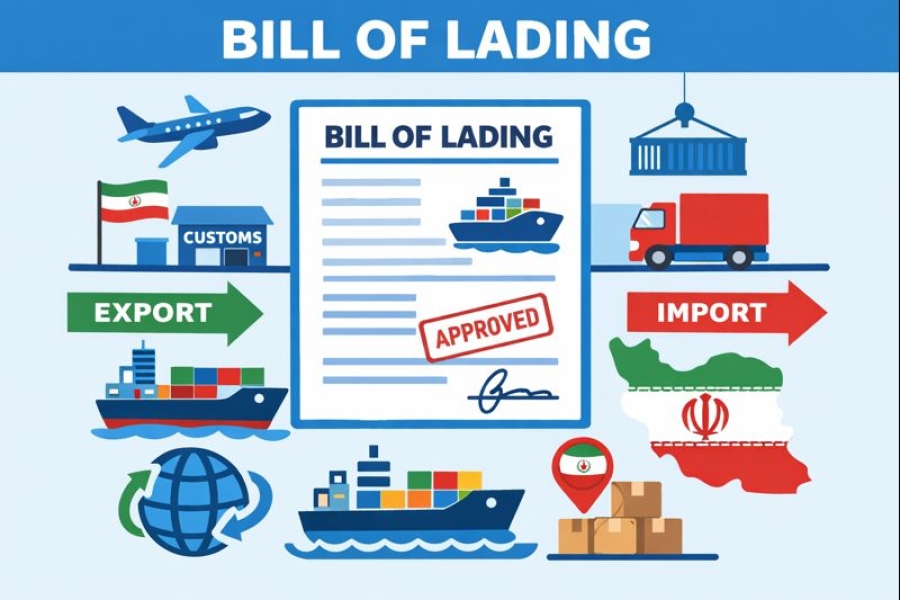
What is a Bill of Lading (B/L)?
Strictly speaking, a Bill of Lading is mainly a maritime or multimodal transport document. Air, road, and rail shipments use waybills such as AWB, CMR, or rail waybills. These documents can prove the contract of carriage and receipt of goods, but they are usually not negotiable documents of title like an original negotiable ocean B/L.
In the context of Iran international shipping documents, the B/L serves three primary functions:
- Evidence of Contract: It proves that a contract of carriage exists between the shipper and the carrier.
- Receipt of Goods: It acts as a signed receipt from the carrier, confirming that the goods were loaded in the described condition.
- Document of Title: A negotiable original Bill of Lading can function as a document of title when it is properly issued and, where required, endorsed. However, not every transport document transfers ownership. Sea waybills, AWBs, CMRs, and most rail waybills are generally non-negotiable. In Iran, the original B/L, telex release, or surrender release is especially important for obtaining the delivery order and completing customs clearance for maritime shipments.
Common Bill of Lading and Transport Documents in Iran Trade
Choosing the right transport mode is the first step in successful trading. Depending on the logistics route, the required bill of lading or transport document in Iran may vary significantly. Here are the four most critical documents used in Iran international shipping:
1. Ocean Bill of Lading (B/L)
As Iran is home to strategic maritime gateways, the Ocean Bill of Lading is the most widely used document for a sea freight service. It is essential for Iran’s major ports, particularly Shahid Rajaee Port (Bandar Abbas) and Bushehr Port.
- Best for: Bulk shipments, containers, and heavy machinery.
- Key Note: For exporters in Iran, a "Clean Shipped on Board" B/L is usually required to ensure the goods were received by the shipping line without any visible defects.
2. Air Waybill (AWB)
For high-value or time-sensitive cargo, the Air Waybill is the standard. This is the primary document for fast-tracking imports via IKA (Imam Khomeini International Airport) in Tehran.
- Key Difference: Unlike a sea B/L, an AWB is not a document of title, meaning it doesn't represent ownership of the goods but serves as a contract for carriage and a receipt.
3. CMR (Road Waybill)
Iran’s strategic location makes it a hub for road transit. The CMR is critical for Iran-Turkey and Iran-Europe transit corridors.
- Function: It governs the legal responsibilities of the road carrier. If you are importing consumer goods from Europe or exporting petrochemicals to neighboring countries via truck, the CMR is your primary export documentation in Iran.
4. Rail Waybill
With the revival of the "Middle Corridor" and the International North-South Transport Corridor (INSTC), rail transport is gaining momentum. The Rail Waybill is the key to navigating the Silk Road trade, connecting Iran to Central Asia, Russia, and China.
- Advantage: It offers a cost-effective and secure alternative for large-scale land transport, especially for minerals and agricultural products.
The Importance of B/L in International Trade
The bill of lading for exporters in Iran is more than just a piece of paper; it is a shield against financial and legal risks. Its importance in the international arena cannot be overstated for several reasons:
- Financial Security: Banks often require a B/L to release payments under a Letter of Credit (L/C). Without a correctly issued bill of lading in Iran, an exporter might face significant payment delays.
- Customs Clearance: Iranian customs (IRICA) requires a valid transport document matching the shipment mode, such as an ocean B/L, AWB, CMR, or rail waybill. For maritime shipments, the B/L and the related delivery order are central to the release process.
- Accountability: If goods are damaged or lost during transit, the B/L is the legal basis for filing a claim against the shipping company.
- Transfer of Ownership: A negotiable original B/L can allow goods to be sold while they are still in transit through proper endorsement, providing flexibility for traders in fast-moving global markets.
Guide for Exporters in Iran
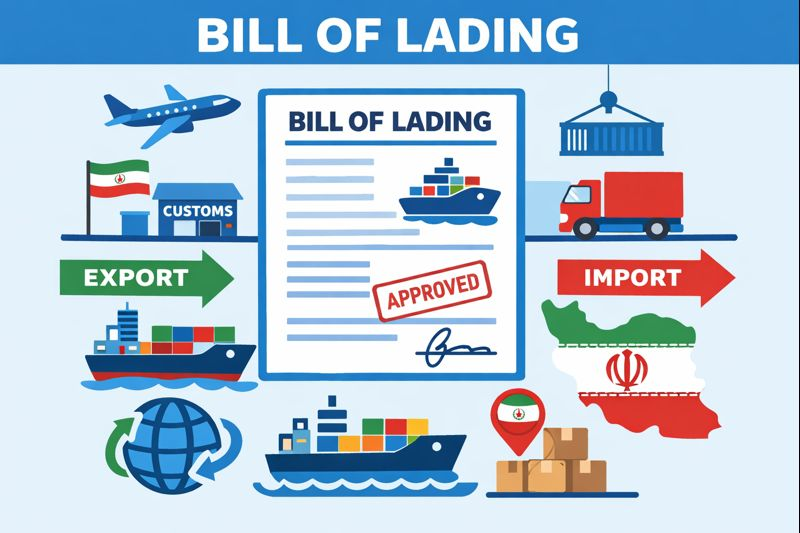
For any business looking to expand globally, mastering the paperwork is as important as the quality of the product itself. Below is a practical breakdown of how to handle the bill of lading for exporters in Iran and the accompanying paperwork.
Step-by-Step: Obtaining a Bill of Lading for Export
The process of securing a bill of lading in Iran follows a specific regulatory path. Follow these steps to ensure your cargo is legally documented:
- Booking Request: Once your cargo is ready, send a booking request to a shipping line or an experienced freight forwarder.
- Container Release & Loading: After the booking is confirmed, you receive a "container release order." The goods are loaded and sealed at your warehouse or the port.
- Customs Declaration (EPL): Your customs broker must declare the shipment through Iran Customs’ EPL / e-customs system and ensure the transport document details match the invoice, packing list, and HS Code.
- Draft Review: The shipping line will provide a "Draft B/L." Check every detail (consignee, weight, HS Code) carefully.
- Final Issuance: Once the vessel departs from an Iranian port (like Shahid Rajaee), and all local charges are paid, the original Bill of Lading is issued.
2026/1405 Local Charges for Bill of Lading in Iran
Port, agency, delivery order, B/L issuance or amendment, container demurrage, and other local shipping charges in Iran may change each year. Before finalizing freight quotations or clearance budgets, exporters and importers should check the latest 1405 tariff circulars issued by the relevant shipping and port authorities.
Essential Export Documentation in Iran
While the B/L is the "King of Documents," it cannot work alone. To complete your export documentation in Iran, you must prepare:
- Commercial Invoice: Detailing the price and terms of sale (Incoterms).
- Packing List (P/L): Specifying the dimensions, weight, and type of packaging for each item.
- Certificate of Origin (C/O): Issued by the Iran Chamber of Commerce, Industries, Mines and Agriculture (ICCIMA) to prove the goods were produced in Iran.
- Inspection Certificate: Often required by the buyer to ensure quality standards (e.g., SGS or local equivalents).
- Health or Phytosanitary Certificates: Essential for exporting Iranian food products, saffron, or nuts.
Guide for Importers in Iran
For an importer, the Bill of Lading is the "Key to the Warehouse." Without managing this document correctly, you cannot claim ownership of your goods once they reach Iranian soil.
The Process of Releasing Goods with a B/L
The journey from the arrival of the ship to the delivery of goods at your warehouse involves several critical legal steps:
- Arrival Notice: When the vessel nears ports like Bandar Abbas or Imam Khomeini, the shipping line sends an "Arrival Notice" to the consignee listed on the B/L.
- Surrendering the Original B/L: To start the clearance, the importer must present the Original Bill of Lading to the shipping line’s local agent in Iran.
- Obtaining the Delivery Order (Tarkhisieh): Once the B/L is surrendered and local port fees are paid, the agent issues a Delivery Order. This document is essential for the Iran international shipping documents package required by Customs.
- EPL Declaration: Your customs broker then submits the shipment data through Iran Customs’ EPL / e-customs system to begin the customs clearance service, including customs control, inspection, duty calculation, and cargo release.
- Digital Registration and Transfer of Transport Document: In current Iranian import procedures, the carrier or freight forwarder may need to register the international transport document through Iran’s digital trade systems, including the Comprehensive Trade System / Barfarabaran process where applicable. The bill of lading in Iran must also be properly transferred or endorsed to the cargo owner before customs declaration and clearance.
Endorsement and Transfer of Title
When a bill of lading in Iran is issued as a negotiable original B/L, it can function as a document of title and support the transfer of cargo rights through endorsement.
- Negotiable B/L: If the B/L is issued "To Order," the ownership can be transferred to another party (like a bank or a second buyer) through Endorsement (Posht-nevisi).
- The Process: The current owner signs and stamps the back of the original B/L. In Iranian trade, this is frequently used when goods are sold while still at sea or when a bank is financing the import via a Letter of Credit (L/C).
- Security: Always ensure the endorsement is clear and matches the company's official signatures registered with the Chamber of Commerce.
Bill of Lading for Transit Goods via Iran: A Guide for International Traders
Iran’s strategic position as a "land bridge" makes it a vital link in the International North-South Transport Corridor (INSTC) and the Silk Road routes. For businesses transporting goods from countries like India or China to Russia, Central Asia, or Europe, understanding how the bill of lading in Iran works for transit is essential.
Through Bill of Lading (TBL) for Transit
When goods are passing through Iran to a third-party destination, a Through Bill of Lading is typically used. This document covers the entire journey from the port of origin (e.g., Mumbai) to the final destination (e.g., Moscow), with Iranian ports like Bandar Abbas or Anzali listed as "Transit Points."
Other Documents for Transit via Iran
Since transit through Iran often involves shifting from sea to land, several other documents complement the original bill of lading in Iran:
- CMR (Road Waybill): If your cargo is unloaded at an Iranian port and moved by truck to borders like Bazargan (Turkey) or Dogharoon (Afghanistan), the CMR becomes the primary document for customs control.
- TIR Carnet: For international road transit, the TIR Carnet allows goods to travel through Iran under customs seal without the need for extensive inspections or paying duties at every border.
- SMGS (Rail Waybill): For rail transit via the Sarkhas or Incheh-Borun borders (connecting to Turkmenistan and beyond), the SMGS rail waybill is the mandatory legal document.
Digital TIR / eTIR:
In addition to the traditional TIR Carnet, traders should also pay attention to digital TIR and eTIR developments. Electronic pre-declaration and digital guarantee processes are becoming increasingly relevant for transit service through Iran, especially on INSTC-related routes. These tools can reduce border delays and improve data coordination between customs authorities, carriers, and freight forwarders.
Technical Details of a Bill of Lading
Precision is everything when it comes to export documentation in Iran. A single typo can lead to your cargo being held at the port for weeks. Here is the technical breakdown of what makes a B/L valid and the difference between "Clean" and "Dirty" documents.
Key Information Required on an Iranian B/L
For a bill of lading in Iran to be accepted by IRICA (Iran Customs) and the Central Bank (CBI), it must contain the following accurate data:
- Shipper/Consignor: The legal name and address of the entity sending the goods.
- Consignee: For Iranian imports, this is often the buyer or a bank (if using an L/C). If it is "To Order," it must be correctly endorsed.
- Notify Party: Usually the customs broker or the importer who needs to be informed when the ship reaches the port.
- Description of Goods: This must match the HS Code and the Proforma Invoice exactly. Avoid vague terms; be specific (e.g., "Industrial Spare Parts" instead of just "Parts").
- Gross/Net Weight & Measurement: Must be consistent with the Packing List.
- Port of Loading & Discharge: For example, Loading: Shanghai / Discharge: Bandar Abbas.
- Freight Status: Clearly stated as "Freight Prepaid" (paid by shipper) or "Freight Collect" (to be paid by the importer in Iran).
Conclusion: Mastering the Bill of Lading in Iran
The bill of lading in Iran is far more than a logistical necessity; it is a legal instrument that governs ownership, payment security, and customs compliance. Whether you are navigating the complex export documentation in Iran for the first time or managing a large-scale transit operation through the INSTC corridor, precision remains your best strategy.
Working with an experienced freight forwarder such as SASCO ensures that the bill of lading is structured, issued, and coordinated correctly with carriers and customs authorities, reducing documentary risk across import, export, and transit shipments through Iran.
Frequently Asked Questions (FAQ)
1. Can I use a copy of the Bill of Lading for customs clearance in Iran?
No. To obtain the Delivery Order (Tarkhisieh) and release maritime cargo in Iran, the importer usually needs the original Bill of Lading, telex release, or surrender release accepted by the carrier’s local agent.
2. What happens if the B/L is lost?
Losing an original bill of lading in Iran is a serious issue. Usually, the carrier will require a bank guarantee (often for 100-150% of the cargo value) and a legal process that can take months before issuing a replacement.
3. Does Iran accept Electronic Bills of Lading (e-B/L)?
Iran is moving toward digital trade and electronic customs processes. From 1 May 2026, the UN Convention on the Use of Electronic Communications in International Contracts enters into force for Iran, supporting the legal recognition of electronic communications in international contracts. However, this does not yet mean full legal equivalence for negotiable electronic bills of lading. For most Iran international shipping documents, paper original B/Ls, telex release, or surrender release remain the safer standard unless the carrier, bank, platform, and local agent clearly accept an e-B/L process.
4.Is a switch bill of lading legal in Iran?
A switch bill of lading is not inherently prohibited in Iran, but it must be handled carefully and transparently. The original set of bills should be fully surrendered before a switched B/L is issued to avoid double endorsement or duplicate title risks. Traders must also ensure compliance with carrier rules, international maritime practice, sanctions regulations, and Iran Ports and Maritime Organization (PMO) requirements, especially on sanction-sensitive routes.