

How Does Transit to Uzbekistan via Iran Work?
Cargo transit to Uzbekistan via Iran follows:
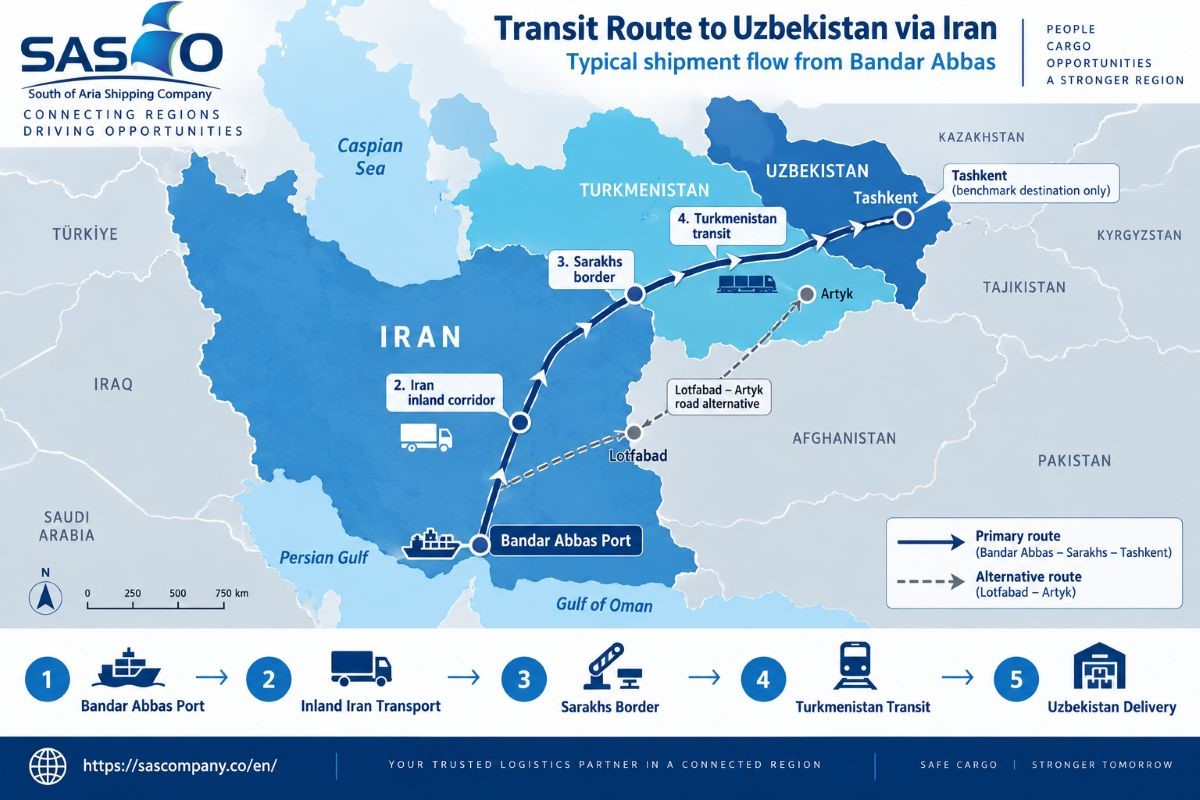
Origin → Iranian port/border → inland transport across Iran → Iran–Turkmenistan border → Turkmenistan → Uzbekistan → final destination
The Iran to Uzbekistan transit route depends on origin, destination, cargo type, mode, equipment, and border conditions. Seaborne cargo can enter through Bandar Abbas; freight may enter western Iran. Road, rail, or multimodal transport is selected per shipment within the Iran–Turkmenistan–Uzbekistan corridor.
Main Transit Routes to Uzbekistan via Iran
Bandar Abbas → Sarakhs → Turkmenistan → Uzbekistan
For many Uzbekistan-bound shipments entering Iran through Bandar Abbas, particularly Shahid Rajaee Port, one of the main overland connections continues through Iran’s inland transport network toward Sarakhs, then crosses Turkmenistan before reaching Uzbekistan. Uzbekistan’s Ministry of Transport recognizes the Bandar Abbas–Turkmenistan route as part of its international transport corridor network. Due to its location at the connection point between Iran’s railway system and the Central Asian rail network, Sarakhs serves as a key gateway for rail freight moving between Iran and Uzbekistan.
At Sarakhs, the Iranian and Central Asian railway systems meet at a gauge break: Iran uses 1,435 mm standard gauge, while Turkmenistan and the wider former Soviet network use 1,520 mm gauge. Cargo therefore requires an appropriate transshipment or wagon/bogie arrangement before continuing north. For road cargo, the route can continue through Turkmenistan toward Turkmenabat and Farap before entering Uzbekistan at Alat.
Bandar Abbas → Lotfabad–Artyk → Turkmenistan → Uzbekistan
Lotfabad–Artyk provides an important road alternative for cargo moving from Iran into Turkmenistan. Its suitability depends on the origin and destination, truck and permit arrangements, cargo characteristics, and current border conditions. Turkmen authorities identify Artyk among the Iran–Turkmenistan checkpoints handling significant transit volumes to Uzbekistan, and in 2026 the crossing has been the subject of measures to simplify cargo procedures and increase capacity. Recent modernization has expanded the checkpoint and increased the use of digital customs systems.
Transit via Incheh Boroun
Incheh Boroun is another Iran–Turkmenistan gateway, with particular importance for rail traffic on the Kazakhstan–Turkmenistan–Iran corridor. Iran’s railway infrastructure at Incheh Boroun includes both standard- and broad-gauge tracks, supporting interchange with the Turkmen network. It can be relevant for cargo moving toward northern Turkmenistan and Kazakhstan, depending on the final destination and available service. For Uzbekistan-bound cargo, it is best treated as an alternative northern rail gateway rather than the primary route from Bandar Abbas.
Bandar Abbas to Uzbekistan Cargo Transit
For companies shipping cargo from overseas markets to Uzbekistan, Bandar Abbas to Uzbekistan freight provides a multimodal connection between Persian Gulf ports and Central Asian inland destinations. Cargo arriving at Shahid Rajaee Port normally goes through terminal handling, transit documentation, customs procedures, and cargo release before moving into Iran’s inland transport network.
Depending on shipment requirements, containers and general cargo can continue by road, rail, or a combination of transport modes. The next stages include inland movement inside Iran, border procedures, transit through Turkmenistan, entry into Uzbekistan, and final delivery to the destination city.
The suitable transport arrangement depends on several factors, including cargo type, container availability, destination, required delivery schedule, and operational conditions at border crossings. For example, Bandar Abbas to Tashkent freight may require different planning compared with shipments moving to western Uzbekistan or industrial locations such as Navoi.
Real Corridor Example : India → Bandar Abbas → Uzbekistan
A real corridor example demonstrating the operational use of the Bandar Abbas–Iran–Turkmenistan–Uzbekistan corridor was reported in 2024. A multimodal container movement connected Indian ports, including Mundra, Nhava Sheva, and Chennai, with Uzbekistan through Bandar Abbas.
The cargo was transported by sea to Bandar Abbas and then continued through Iran’s railway network toward Sarakhs before crossing Turkmenistan and reaching Uzbekistan. The first train consisted of 20 twenty-foot containers, and the reported route distance was 2,673 km with a transit time of 20 days, according to UzTemirYulKonteyner.
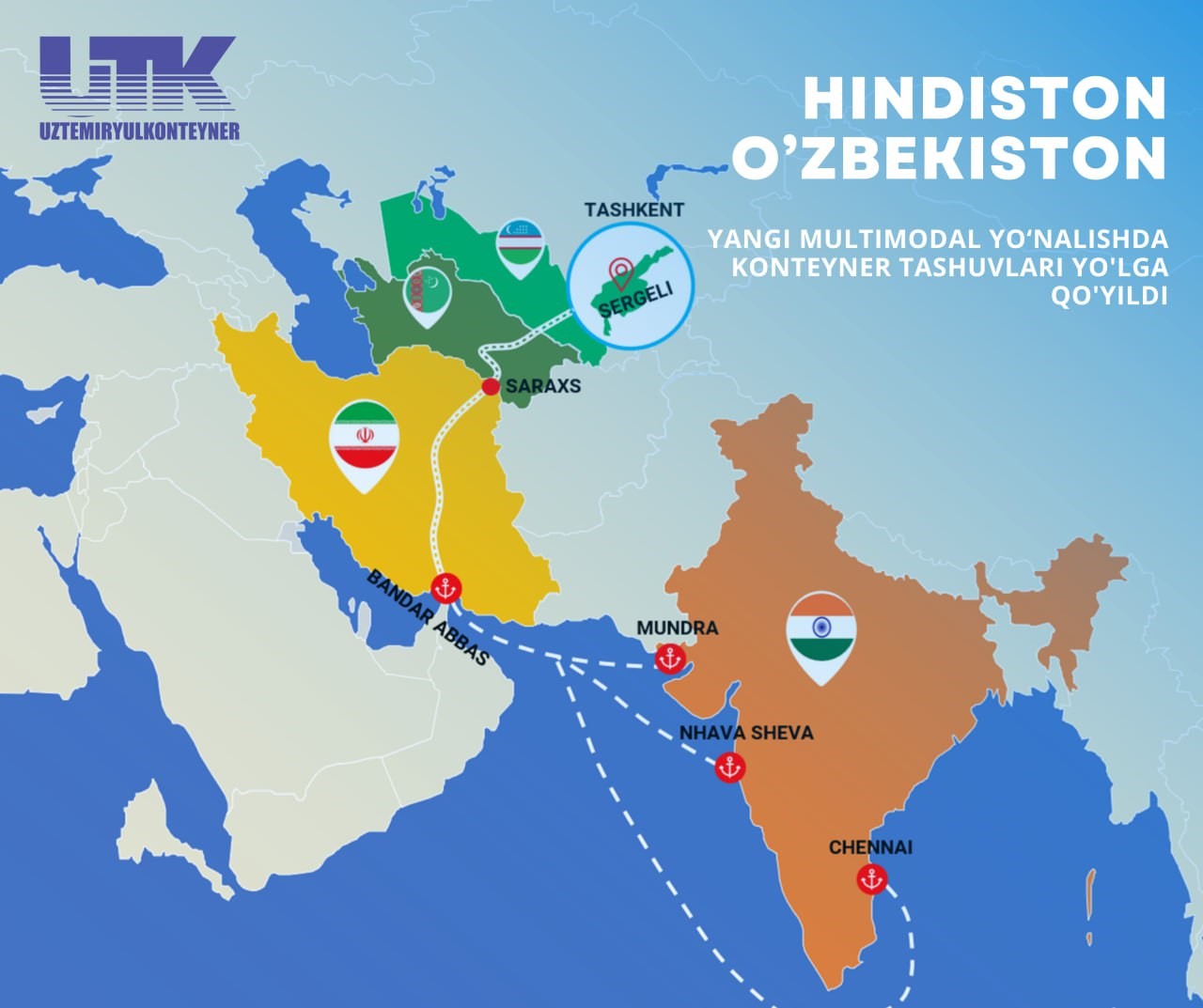
This shipment demonstrates that the corridor can be used for international container transport. However, the reported transit time should not be considered a standard delivery time for all shipments, as actual performance depends on cargo type, transport mode, border procedures, and operational conditions.
|
Destination |
Main Consideration |
|
Tashkent |
Main commercial destination requiring inland distribution planning |
|
Bukhara |
Western Uzbekistan destination with different inland delivery requirements |
|
Samarkand |
Important commercial destination in central Uzbekistan |
|
Navoi |
Industrial and logistics hub requiring project-specific planning |
|
Fergana Valley |
Requires additional inland distribution after border entry |
Road vs Rail Freight to Uzbekistan via Iran
Choosing between road freight to Uzbekistan via Iran and rail freight to Uzbekistan via Iran depends mainly on cargo characteristics, shipment frequency, delivery requirements, and operational priorities. Road transport is often selected when flexibility and direct delivery are important, while rail becomes more suitable for containerized cargo, heavy shipments, and regular high-volume movements.
For many shipments, multimodal transport to Uzbekistan via Iran can combine the advantages of both modes, using rail for the main distance and trucks for first-mile or last-mile delivery where required.
|
Factor |
Road |
Rail |
|
Flexibility |
Higher |
Lower |
|
Door-to-door ability |
Strong |
Usually requires first/last-mile trucking |
|
Regular high volumes |
Moderate |
Strong |
|
Heavy cargo |
Shipment-specific |
Often advantageous |
|
Border dependency |
Truck queues, permits, and road conditions |
Rail interface, schedules, and capacity |
|
Typical fit |
Flexible FTL and commercial cargo |
Containers and regular volumes |
Road Freight to Uzbekistan via Iran
Road freight provides greater flexibility for cargo owners that need direct delivery, route adjustments, or full truckload (FTL) solutions. It is suitable for commercial cargo where delivery timing and destination access are important.
However, road shipments require careful planning around truck availability, border procedures, permits, and Turkmenistan transit requirements. Border congestion and operational conditions can affect overall performance.
Rail Freight to Uzbekistan via Iran
Rail freight is commonly considered for containerized cargo, heavy commodities, and regular shipment programs. One important operational factor is the difference in railway gauges: Iran uses 1,435 mm standard gauge, while Turkmenistan and Uzbekistan use the 1,520 mm gauge system. Therefore, cross-border rail operations may require transshipment, wagon exchange, platform transfer, or other technical arrangements.
Recent rail operations demonstrate continued activity on regional corridors. In December 2025, a 40-wagon Iranian freight train moved from Sarakhs through Turkmenistan to Bukhara, Uzbekistan. In September 2026, a 55-container block train from China to Iran also passed through Kazakhstan, Uzbekistan, and Turkmenistan before entering Iran via Sarakhs.
These examples confirm corridor activity but should not be used as standard transit-time benchmarks for Bandar Abbas–Uzbekistan shipments.
How Long Does Transit to Uzbekistan via Iran Take?
For planning purposes, a standard road shipment released at Bandar Abbas can typically be budgeted at about 7–12 days to Tashkent under normal operating conditions. Tashkent is used here as a practical benchmark rather than as the shortest or longest destination in Uzbekistan. Western destinations such as Bukhara or Navoi may require less inland travel after entry, while eastern destinations such as Andijan or the Fergana Valley usually need additional delivery time.
A typical road schedule may include 1–3 days for port handling and release, 3–4 days for inland movement across Iran, 12–36 hours for Iran–Turkmenistan border procedures, 1–2 days across Turkmenistan, 12–24 hours for Uzbekistan entry, and about 1 day for final delivery to Tashkent.
The Bandar Abbas to Tashkent transit time is most affected by port dwell, border queues, transit permits, document readiness, cargo type and equipment availability. Under less favorable conditions, road transit can extend toward 15–20 days. Rail normally requires more time, with a practical planning range of about 18–35 days. These figures are planning ranges, not guaranteed delivery times.
Route Conditions — Updated September 2026
Operating conditions affecting Bandar Abbas and the Strait of Hormuz remain subject to disruption. Port access, carrier acceptance, insurance terms, border operations and transit schedules may change at short notice. For the latest information on current route conditions and estimated transit times, contact SASCO before booking your shipment.
How Much Does Transit to Uzbekistan via Iran Cost?
There is no fixed tariff for the transit cost to Uzbekistan via Iran, but current market benchmarks provide a useful starting point for budgeting. For a standard 40HC container, the Bandar Abbas to Tashkent freight cost by road may start at around USD 2,700. For cargo moving from Jebel Ali to Tashkent via Bandar Abbas, a 40HC COC movement can be around USD 5,800, excluding local charges at destination in Uzbekistan.
These figures should be treated as indicative market benchmarks rather than fixed rates. The final quotation depends on the actual transport arrangement and the cost components involved in the shipment.
|
Cost Component |
Main Variables |
|
Sea freight to Iran |
Origin, carrier, container type |
|
Port handling |
Terminal, dwell time, handling |
|
Iran inland transport |
Road/rail, weight, distance |
|
Transit formalities |
Documentation, cargo requirements |
|
Turkmenistan transit |
Route, vehicle, permits |
|
Border/interface handling |
Mode, selected gateway |
|
Uzbekistan inland delivery |
Final city |
|
Container costs |
SOC/COC, detention, empty return |
|
Special cargo |
DG, OOG, reefer, permits |
Container Note — SOC vs COC
COC (Carrier-Owned Container) is equipment supplied by the shipping line, while SOC (Shipper-Owned Container) is owned or controlled by the shipper and moves independently of the carrier’s container fleet. This distinction matters because ownership affects empty-return requirements, detention exposure, carrier acceptance and sometimes the practical routing options available.
With COC equipment, empty-return location, detention terms and carrier acceptance can affect both total cost and route feasibility. SOC equipment may offer greater flexibility for some shipments, particularly where empty return is difficult. However, SOC acceptance must be confirmed with the selected rail operator, terminal and destination facility before booking.
Information Required for an Accurate Quote
To calculate the actual freight cost from Bandar Abbas to Uzbekistan, provide the origin, final destination, commodity, gross weight, dimensions, container or equipment type, number of units, Incoterm, preferred transport mode and expected shipment date. Special cargo should also include any DG, temperature-control, lifting or handling requirements.
Send SASCO your shipment details for a route-specific Uzbekistan transit quotation.
Documents Required for Transit to Uzbekistan via Iran
The final set of Uzbekistan transit documents depends on the cargo, origin country, transport mode and customs procedure used. Different shipments may require different supporting documents, so the document package should be prepared according to the actual route and cargo requirements.
Standard Commercial and Transport Documents
Most shipments normally require a Commercial Invoice, Packing List and the relevant transport document, such as a Bill of Lading, CMR or rail consignment document. A Certificate of Origin may also be required depending on the shipment and destination requirements. For shipments moving under customs transit procedures, transit declarations and supporting cargo information are prepared for the relevant customs authorities.
For additional guidance on transit procedures and documentation management through Iran, see SASCO’s guide on transit through Iran.
Mode- or Cargo-Specific Documents
Additional transit documents via Iran may be required depending on the transport mode and cargo type. These may include a TIR Carnet where the shipment is moved under the TIR system, dangerous goods documentation, phytosanitary or veterinary certificates for regulated commodities, rail waybills, and special permits for oversized or heavy cargo.
The exact document requirements should be confirmed before cargo departure. Consistency between the commercial invoice, packing list, transport documents and customs declarations is essential to reduce avoidable questions or delays at border points.
For customs-related documentation requirements, companies can also review SASCO’s customs clearance services and document support.
Main Operational Challenges on the Iran–Uzbekistan Transit Route
The Iran Uzbekistan freight route involves several operational factors that should be considered during shipment planning. These factors do not make the corridor unsuitable, but they require proper coordination before cargo movement.
Key Uzbekistan transit challenges may include:
- Turkmenistan transit procedures and operational requirements
- Border waiting times at key crossing points
- Availability of required permits for specific cargo types
- Documentation accuracy and customs coordination
- Carrier acceptance and service limitations
- Additional requirements for dangerous goods or special cargo
- Scheduling coordination between different transport operators
For Turkmenistan cargo transit, advance preparation is important because border procedures, documentation checks and operational arrangements can influence the overall shipment schedule.
These are planning factors, not reasons to avoid the corridor. Confirming the route, transport arrangements and documentation before cargo departure helps reduce avoidable border delays and unexpected costs.
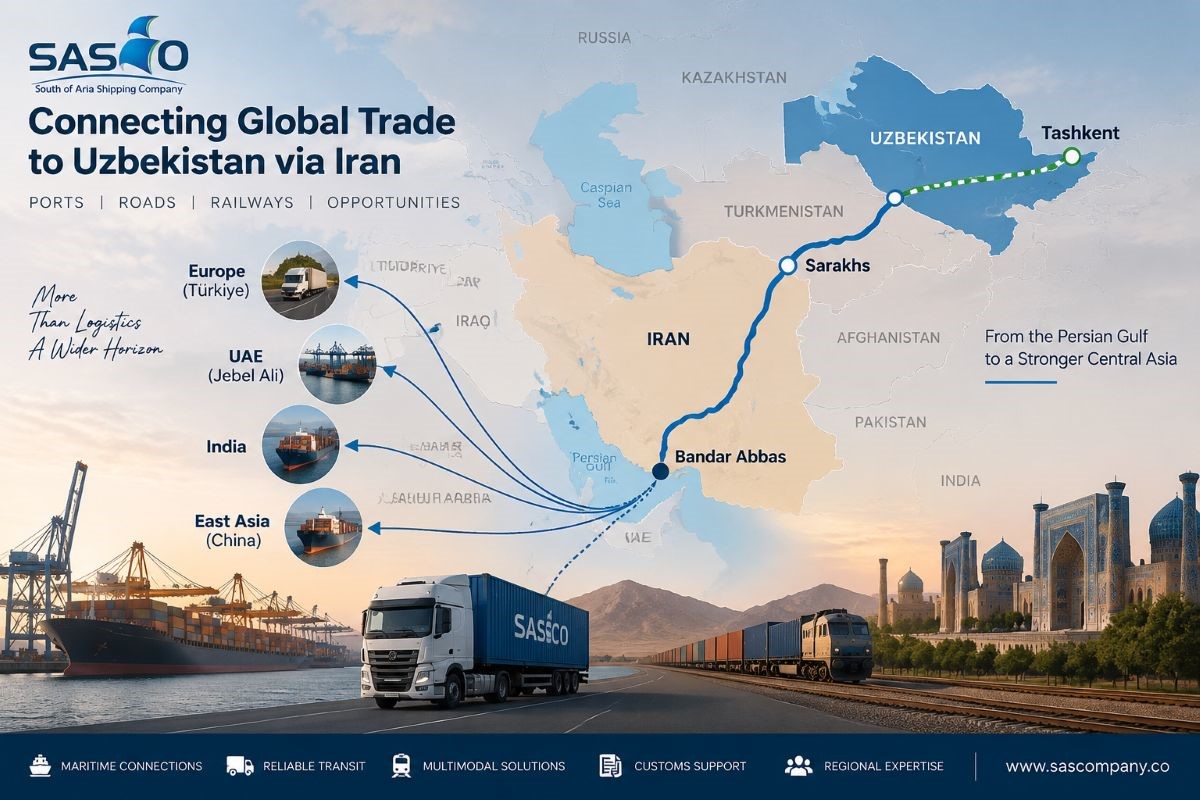
Which Cargo Origins Can Use Iran for Transit to Uzbekistan?
Different cargo origins can use Iran as a transit corridor to reach Uzbekistan, depending on the commercial route, cargo requirements and transport conditions.
For the UAE market, UAE to Uzbekistan via Iran is commonly structured as sea transport to Bandar Abbas followed by road or rail movement through Iran and onward transit.
For India, shipments can move from Indian ports to Bandar Abbas and continue through northeastern Iran, the Sarakhs border and Turkmenistan toward Uzbekistan.
For China and East Asia, a sea-to-Iran multimodal option may be considered depending on origin, transit schedule and available Central Asian alternatives.
Turkey and European origins may use road connections into western Iran before moving toward northeastern Iran and Central Asia.
The suitability of each route depends on cargo type, timing, operational requirements and the final destination in Uzbekistan.
When Is Iran a Suitable Route to Uzbekistan?
Iran can be a suitable transit option to Uzbekistan when the cargo flow matches the available logistics network and operational conditions.
This corridor may be considered when:
- Cargo originates from Persian Gulf markets and can access Iranian ports;
- The shipment comes from India, UAE or other maritime trade routes;
- Bandar Abbas offers a commercially suitable gateway;
- Iran’s road or rail transit options match the cargo requirements.
However, Iran is not automatically the best option for every shipment. Alternative corridors should also be evaluated when the origin already has a shorter direct connection to Central Asia, when carrier or insurance limitations affect feasibility, or when border and maritime conditions create significant uncertainty.
Route selection should be based on total transit time, cost, operational reliability and cargo requirements.
Why Choose SASCO for Transit to Uzbekistan via Iran?
SASCO supports Uzbekistan transit via Iran by coordinating key stages of the corridor, from Iranian port access to final Central Asian delivery planning.
The company’s route-specific capabilities include Bandar Abbas coordination, Iranian customs and transit procedures, road and rail transport planning, multimodal solutions and coordination with northeastern border gateways. SASCO also supports containerized and project cargo movements where route planning, documentation and operational coordination are required.
With experience in Central Asia-bound cargo, SASCO helps customers evaluate suitable transport options based on cargo type, destination, timing and operational requirements.
For transit shipments through Iran, SASCO coordinates the required parties to support smoother cargo movement from origin to final destination.
Frequently Asked Questions About Transit to Uzbekistan via Iran
How much does transit to Uzbekistan via Iran cost?
The cost depends on the origin, transport mode, cargo type, equipment, destination and required transit services. Road, rail and multimodal options can have different cost structures. For an accurate quotation, provide your cargo details, and SASCO can evaluate the suitable route and pricing.
How long does cargo take from Bandar Abbas to Uzbekistan?
Transit time depends on port handling, selected transport mode, border procedures, Turkmenistan transit arrangements and final destination in Uzbekistan. Road and rail schedules can vary, so transit times should be considered as planning ranges rather than guaranteed delivery dates.
What is the main transit route from Iran to Uzbekistan?
The common route is Bandar Abbas → Iranian inland corridor → northeastern Iran → Turkmenistan → Uzbekistan. The Sarakhs border is a key gateway for this corridor, connecting Iran with Turkmenistan and onward Central Asian destinations.
Is road or rail better for Uzbekistan-bound cargo?
Road transport usually provides more flexibility for delivery planning and smaller or time-sensitive shipments. Rail can be suitable for containers, heavier cargo and regular-volume movements. The preferred option depends on cargo characteristics, schedule, destination and overall logistics requirements.
Which Iran–Turkmenistan border is used for Uzbekistan transit?
Sarakhs is one of the main gateways for Iran–Turkmenistan transit toward Uzbekistan. Lotfabad–Artyk is also an important road alternative, while Incheh Boroun may be considered for certain routes and transport modes depending on operational requirements.
What documents are required for Uzbekistan transit via Iran?
Common documents include a Commercial Invoice, Packing List, transport document and transit declaration. Additional documents may be required depending on the transport mode and cargo type, such as dangerous goods documents, certificates or special permits