

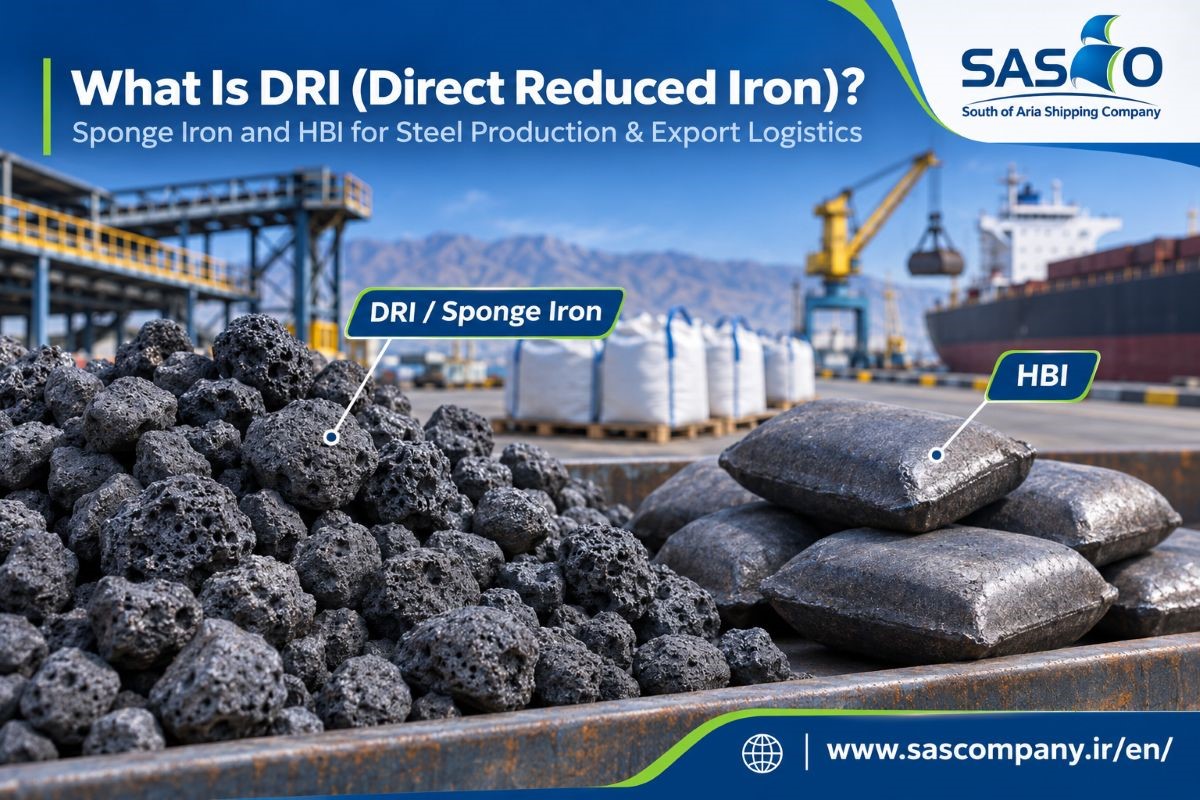
What Is DRI (Direct Reduced Iron)?
Direct Reduced Iron (DRI), often called sponge iron, is iron ore reduced in a solid state without melting it. Steelmakers use it as a metallic feedstock, particularly in electric arc furnaces. Its porous structure makes many DRI grades more reactive than conventional iron ore, so storage, exposure to moisture and maritime transport require cargo-specific safeguards.
DRI Types and Their Shipping Requirements
The shipping description must match the tested cargo, not merely the sales term “sponge iron.” The International Maritime Solid Bulk Cargoes (IMSBC) Code distinguishes four DRI schedules:
|
Type |
Cargo form |
Bulk-sea-carriage implications |
|
DRI (A) |
Hot-moulded briquettes (HBI) |
Group B; prescribed surface ventilation |
|
DRI (B) |
Lumps, pellets, cold-moulded briquettes |
Group B; dry loading and inerted holds |
|
DRI (C) |
Low-moisture by-product fines |
Group B; strict moisture and gas controls |
|
DRI (D) |
By-product fines with at least 2% moisture |
Groups A and B; TML and additional safety controls |
Hot-briquetted iron (HBI) is denser than ordinary cold DRI and follows a different carriage schedule; the two are not interchangeable. DRI (D), introduced as a mandatory category in 2025, also presents liquefaction risk. Classification, test results and vessel suitability must be established before shipment.
How DRI Is Exported from Iran: Factory to Vessel
DRI exports start with the seller confirming product form, shipment volume, delivery term and the destination port's discharge capabilities. The movement plan then connects plant release, inland transport, terminal reception and vessel loading. Safety documentation should be prepared before the first dispatch, rather than after the cargo reaches the port.
Inland Transport from DRI Plants to Export Ports
Depending on plant location and available connections, road freight transport in Iran may be used for flexible plant pickups, while rail freight services may suit sustained, higher-volume movements.
Truck bodies, rail wagons or containers must be appropriate for the cargo and protected against water exposure. Dispatch timing should match terminal capacity, avoiding unnecessary stockpiling and repeated handling.
Port Handling, Inspection and Vessel Loading
Before loading, the terminal and vessel operator should confirm the cargo's declared DRI type, certificates, moisture and temperature conditions, handling equipment and loading sequence.
Covered storage or other approved protective arrangements may be needed while cargo awaits a berth. Sampling, screening and independent inspection can be arranged to match contractual and regulatory requirements.
The vessel's hold preparation, monitoring equipment, inerting or ventilation provisions and loading restrictions must be checked against the applicable schedule. Final handover depends on the master's acceptance and completion of export and shipping formalities.
DRI Export Packaging: Bulk, Jumbo Bags and Containers
DRI packaging for export is a handling decision, not a replacement for regulatory cargo classification. The practical choice depends on material form, shipment volume, discharge facilities and the shipping line's or vessel operator's acceptance.
Where loading is exposed to rain or extended storage, operators should reassess protective arrangements and scheduling before moving cargo to the berth.
Unpacked Bulk DRI
Loose material is transferred directly into a suitable ship's holds, potentially avoiding bagging costs on larger parcels.
However, Iran DRI bulk shipping requires cargo-specific checks of moisture, temperature, fines, weather exposure, hold cleanliness and the applicable IMSBC schedule.
Precautions can include inerting for DRI (B), while HBI follows different ventilation requirements. The IIMA's shipping and handling guidance provides further technical context for these controls.
Jumbo Bags and Container Loading
Jumbo bags can simplify counting, lifting and separation of smaller lots; liners may help reduce incidental moisture exposure during handling.
Container stuffing also requires checking bag weight, container payload, floor loading and cargo securing. Neither a bag nor a sealed container removes the material's potential to react, heat up or release gas.
Acceptance must be obtained for the specific DRI grade, packing method and route, with the applicable packaged-cargo requirements agreed before booking. Exporters should avoid assuming that standard container services will carry every type of sponge iron.
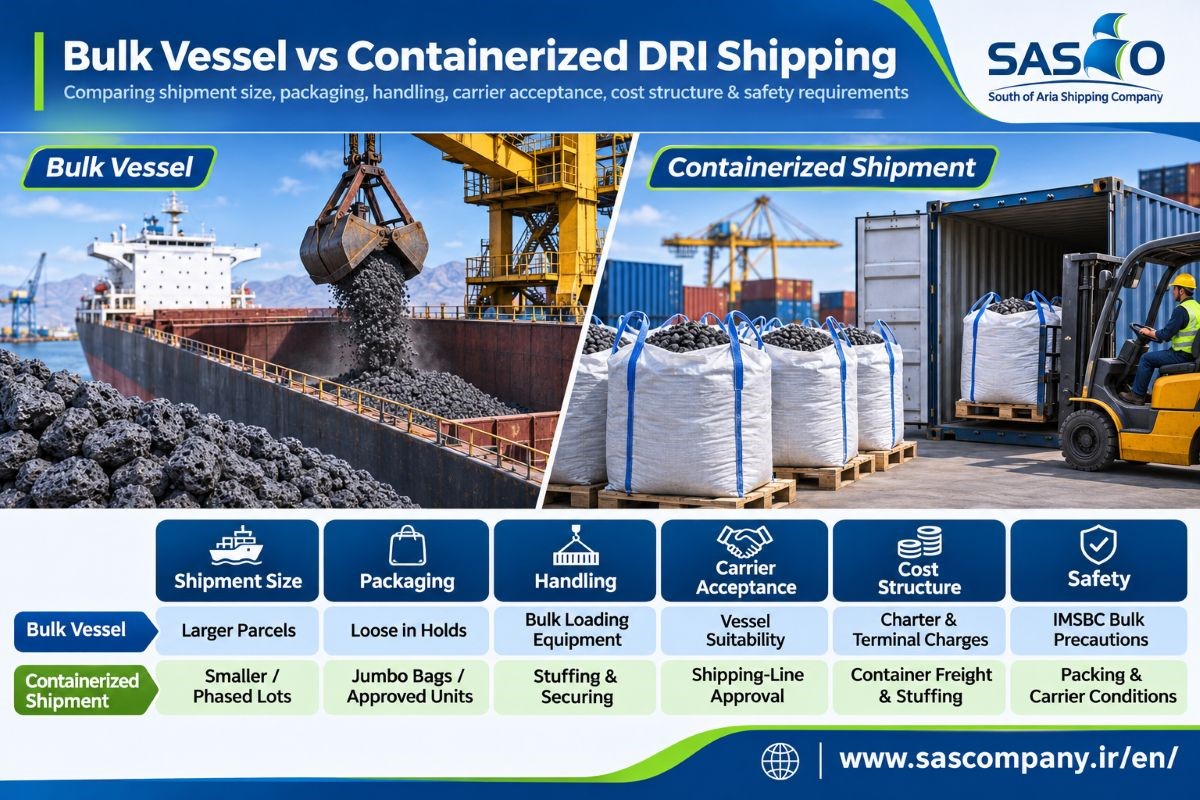
Bulk Vessel vs Containerized DRI Shipping
Containerized DRI shipping may suit smaller, packaged consignments when a carrier approves the commodity; a bulk vessel may suit larger parcels with appropriate holds and safety systems.
Neither option is automatically cheaper. Booking lead time, destination restrictions and the possibility of discharging cargo without repacking can also affect the decision.
|
Decision factor |
Bulk vessel |
Containerized shipment |
|
Shipment size |
Generally larger parcels |
Smaller or phased lots |
|
Packaging |
Loose in cargo holds |
Bagged or otherwise approved units |
|
Handling |
Bulk equipment and hold preparation |
Bag lifting, stuffing and securing |
|
Carrier acceptance |
Vessel suitability and IMSBC schedule |
Shipping-line approval and applicable packaged-cargo rules |
|
Cost structure |
Charter, terminal and hold-related charges |
Container freight, packaging and stuffing |
|
Safety requirements |
Cargo-specific IMSBC precautions |
Classification, packing and carrier conditions |
In bulk cargo transportation from Iran, “bulk” means loose material. “Breakbulk” instead describes separately handled, non-containerized cargo units, such as bags lifted individually.
Before choosing, compare all-in costs and confirm that both ports can handle the proposed shipment.
Major Iranian Ports for DRI Exports
Choosing among Iranian DRI export ports requires more than identifying the nearest coastline. Inland access, terminal equipment, protected storage, berth availability and acceptance of the declared DRI grade can all change the viable route.
Bandar Abbas and Shahid Rajaee Port
Bandar Abbas is a major southern gateway; Shahid Rajaee is a port complex in the Bandar Abbas area, not a separate port city. Its container facilities and road and rail connections make it worth evaluating for approved packaged shipments. For bulk cargo, confirm berth allocation, suitable loading equipment, storage conditions and the operator’s willingness to handle the specific DRI schedule before dispatching material from the plant.
Imam Khomeini Port and Alternative Gateways
Bandar Imam Khomeini offers another potential gateway, particularly for industrial and bulk parcels originating in southwestern Iran. Comparing inland distance and terminal arrangements may reveal a better total cost than selecting a port solely by sea route.
Chabahar can also be considered, but its suitability for DRI must be verified rather than assumed. SASCO can coordinate terminal enquiries and shipping agency services in Iran around vessel particulars and the planned loading window. No port should be treated as automatically accepting every DRI grade, packing method or ship type.
DRI Freight Costs from Iran: What Determines the Price?
DRI freight cost from Iran is a shipment-specific logistics figure, not the selling price of sponge iron. Plant location, DRI grade, tonnage, packing, destination and Incoterm all affect the quotation. FOB and CFR offers cover different transport responsibilities, so their totals cannot be compared without checking scope.
Inland Transport, Packaging and Port Charges
Factory-to-port charges may include truck or rail transport, loading equipment and protective handling. Bagging, liners, screening, sampling and laboratory certificates add costs when required. At the terminal, account for storage, weighing, inspection, cargo handling, customs formalities and ship loading. Extra waiting time may increase port handling costs.
Ocean Freight, Chartering and Additional Costs
Bulk carrier chartering depends on available suitable vessels, parcel size, voyage distance and loading and discharge rates. Container rates also depend on carrier approval, equipment, stuffing and surcharges. Cargo-specific safety arrangements may add surveys, gas-monitoring, inerting or ventilation expenses, depending on the applicable DRI schedule. Demurrage, detention and cargo insurance are not fixed charges on every shipment; their application depends on contract terms, delays and available cover.
Calculating the Total DRI Shipping Cost per Ton
Logistics cost per ton = Total payable logistics charges ÷ Net tons shipped.
|
Cost component |
What to include |
|
Inland leg |
Road or rail haulage and pickup |
|
Cargo preparation |
Packaging, testing and inspection |
|
Port services |
Storage, handling and loading |
|
Sea leg |
Freight or charter plus applicable surcharges |
|
Conditional items |
Insurance, waiting time and special safety services |
Request an itemized offer showing inclusions, exclusions and whether delivery ends at the loading port or destination. Provide the plant location, cargo test results, DRI type, tonnage, packaging, destination, ready date and Incoterm to obtain a comparable quotation.
DRI Shipping Safety and IMSBC Code Requirements
DRI shipping requirements depend on the material’s tested classification, not simply the trade name “sponge iron.” The IMSBC Code assigns different precautions to different forms of direct reduced iron.
Moisture, Self-Heating and Hydrogen Risks
DRI can oxidize and self-heat; contact with moisture may generate flammable hydrogen. Fine material can complicate handling and gas monitoring, while rain, seawater or condensation may change its condition before loading.
DRI (B), covering specified lumps and pellets, requires dry loading and carriage under the relevant inerting provisions. DRI (C) is also subject to an inerted-hold regime. DRI (D), however, covers by-product fines containing at least 2% moisture and belongs to both Groups A and B: besides reactivity, it presents liquefaction risk. Its measured moisture must remain below the certified transportable moisture limit (TML).
Cargo Declaration, Inerting and Vessel Acceptance
The shipper must provide the proper cargo declaration, representative tests and schedule-specific certificates before loading. For DRI (D), these include requirements concerning ageing, cargo temperature, moisture/TML, hydrogen monitoring and risk assessment. Unlike DRI (B), the DRI (D) schedule calls for controlled mechanical surface ventilation, not routine hold inserting.
The shipowner and master must confirm suitable cargo spaces, monitoring equipment, ventilation or inerting capability, and conditions of acceptance. The 2025 industry guidance on DRI (D) explains these differences; the mandatory IMSBC schedule remains authoritative. SASCO can coordinate vessel, terminal and documentation checks without replacing the shipper’s or carrier’s safety obligations.
Export Documents and Customs Requirements
DRI export documentation from Iran must satisfy commercial, customs and maritime safety requirements. The usual file includes a Commercial Invoice, Packing List, Certificate of Origin, Certificate of Analysis and export declaration. The Bill of Lading is issued through the shipping process, while bulk carriage also requires the relevant IMSBC cargo declaration, test certificates and schedule-specific evidence for the vessel and terminal.
Direct reduced iron generally falls under HS heading 7203, but the precise Iranian tariff subheading depends on product form and must be checked before filing. Export permissions, duties or an Iran Mercantile Exchange certificate may apply to particular products and dates; confirm current rules rather than assuming every DRI grade follows identical procedures.
SASCO can coordinate export customs clearance in Iran with documentation checks, inspection and port operations, reducing inconsistencies between factory records, customs filings and vessel declarations.
Shipping Routes and Transit Time Considerations
For sponge iron shipping from Iran, potential routes begin at Persian Gulf terminals and may serve nearby Gulf destinations, India and other South Asian markets, or farther ports, subject to vessel and receiver acceptance.
A direct bulk voyage follows a different timetable from container shipping involving transshipment. Planning therefore starts with the actual loading and discharge ports, cargo grade, available vessel capacity and terminal handling facilities.
Loading windows, berth congestion, weather interruptions, inspections and discharge restrictions may extend the overall lead time beyond the sea passage.
Before confirming a schedule, we check vessel availability, port calls and cargo acceptance. Without a defined route and booking, quoting a fixed transit time would be misleading.
Why Choose SASCO for Iran DRI Export Logistics?
At SASCO, we connect sea freight services with inland transport, port coordination, vessel agency and export customs support. For reactive cargo, we review material specifications and seek carrier and terminal acceptance before proposing a transport plan.
Our documented heavy-lift project moved three industrial process columns weighing 67, 186 and 240 tons by coastal barge from Imam Khomeini Port to Assaluyeh, demonstrating practical experience in vessel coordination and port handling—not a completed DRI export.
For a proposed sponge iron shipment, we assess the origin, destination, handling requirements and documentation, then coordinate the agreed logistics stages with the parties responsible for cargo safety and carriage.
Frequently Asked Questions
How much does DRI shipping from Iran cost per ton?
Rates vary with origin, tonnage, packaging, port charges, vessel availability and destination. Obtain an itemized quotation for the actual shipment rather than relying on advertised flat rates.
Can sponge iron be shipped in jumbo bags or containers?
Only where cargo classification, packaging arrangements and carrier approval permit it. Jumbo bags do not eliminate moisture or gas risks.
Which Iranian ports are suitable for DRI exports?
Bandar Abbas, including Shahid Rajaee, and Imam Khomeini are potential gateways. The terminal must approve the specific cargo, vessel and handling arrangements.
What IMSBC Code requirements apply to bulk DRI shipments?
Requirements vary by DRI category and may include declarations, testing, moisture limits, inerting, ventilation and gas monitoring. The applicable IMSBC cargo schedule governs.
What information is needed to request a DRI freight quote?
Provide the DRI grade and test results, tonnage, plant origin, destination, packaging, ready date and Incoterm.
Request a DRI Freight Quote from SASCO
Submit a DRI freight quote request with your cargo classification, laboratory results, shipment weight, factory location, destination port, packaging and preferred shipping date. Our team can review the proposed route, check operational feasibility and prepare a transport quotation based on the services required and carrier acceptance.