

Bandar Abbas to Tajikistan Freight at a Glance
Shahid Rajaee Port is the starting point for many overseas shipments. Road and rail share a regional corridor but require different border and terminal arrangements. Costs are shipment-specific.
|
Factor |
Freight Details |
|
Origin |
Bandar Abbas / Shahid Rajaee Port |
|
Destinations |
Dushanbe, Khujand, Bokhtar |
|
Transit countries |
Iran → Turkmenistan → Uzbekistan → Tajikistan |
|
Road crossings |
Sarakhs, Farap–Alat, Sariosiyo–Bratstvo or Oybek–Fotehobod |
|
Rail connection |
Sarakhs; destination-specific rail access |
|
Freight cost |
Based on mode, cargo, equipment and delivery terms |
Main Freight Routes from Bandar Abbas to Tajikistan
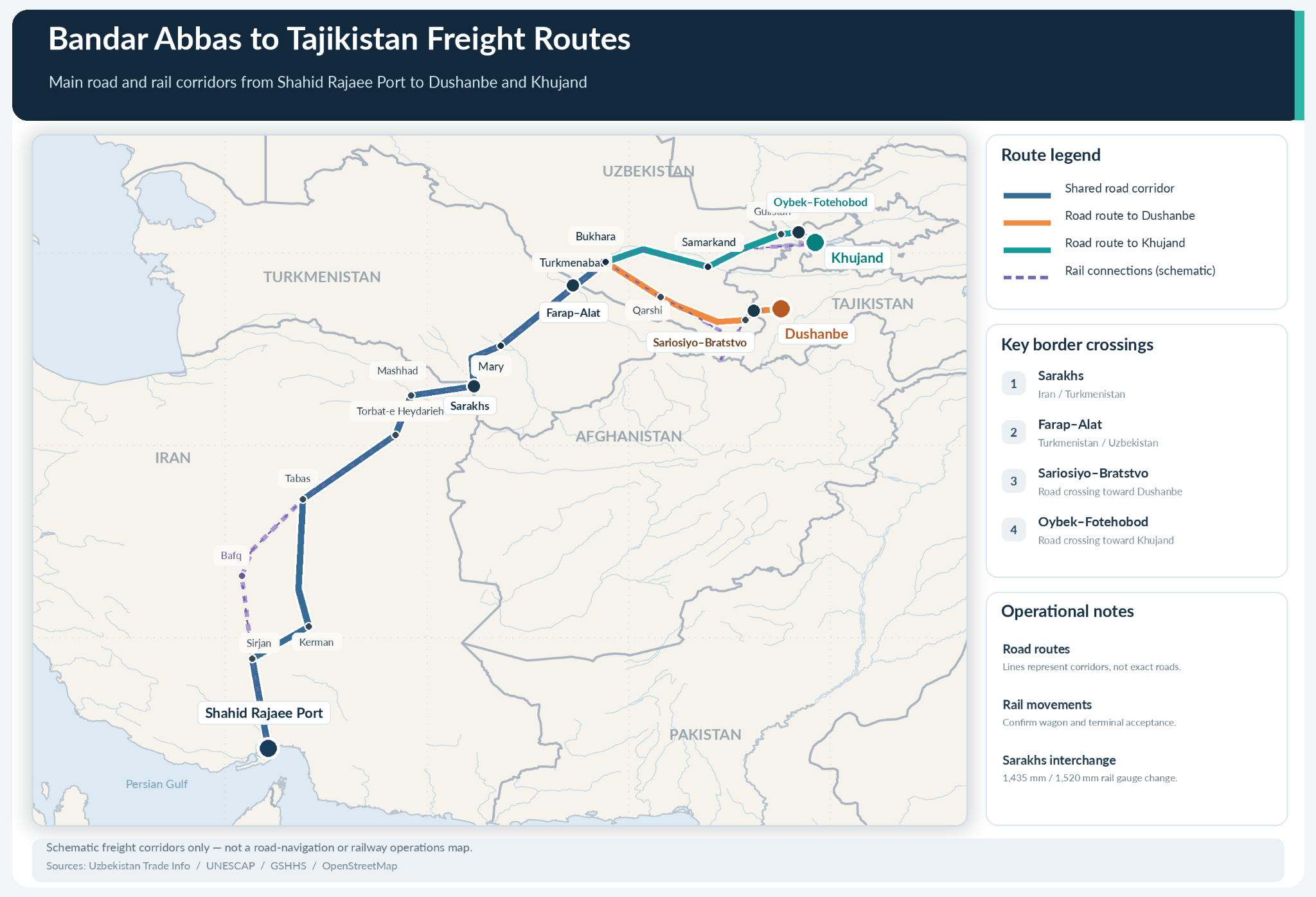
The main corridor crosses Iran, Turkmenistan and Uzbekistan, but the road and rail alignments require different border and terminal arrangements.
Road Route: Sarakhs–Farap–Alat
Trucks travel from Shahid Rajaee Port toward Sarakhs, cross Turkmenistan via Turkmenabat and enter Uzbekistan at Farap–Alat. Dushanbe-bound cargo generally continues toward Sariosiyo–Bratstvo; Khujand-bound loads can enter via Oybek–Fotehobod near Tashkent. Lotfabad–Artyk is a possible alternative Iran–Turkmenistan road gateway, subject to carrier permits and border capacity. These movements extend the established Bandar Abbas to Turkmenistan freight and transit to Uzbekistan via Iran corridors.
Rail Route: Sarakhs–Turkmenistan–Uzbekistan
Rail containers and wagons move from Bandar Abbas to Sarakhs, where Iran's 1,435 mm track meets the 1,520 mm Central Asian network. Appropriate container transfer or wagon/bogie arrangements are required. Trains then continue through Turkmenistan toward Uzbekistan. Onward rail routing differs: Dushanbe is served via Tajikistan's southern network, while Khujand uses its northern connection near Bekabad. Wagon acceptance and terminal handling must be confirmed.
Uzbekistan–Tajikistan Road Crossings
Uzbekistan Trade Info identifies Sariosiyo–Bratstvo for the Dushanbe direction and Oybek–Fotehobod for Khujand. These are road crossings; rail access follows separate rail junctions.
Afghanistan: A Conditional Road Option
Iran, Afghanistan and Tajikistan signed a road-corridor agreement in July 2026. This is not proof of a regular commercial service. Transit through Afghanistan requires verification of operating arrangements, border permissions, security, insurance and cargo acceptance before quoting.
Road vs. Rail Freight from Bandar Abbas to Tajikistan
Road Freight and FTL Trucking
Iran to Tajikistan road freight suits time-sensitive cargo, dedicated full truckloads and deliveries beyond railway terminals. Trucks or container chassis can reach Dushanbe or Khujand, but cross-border permits, queues and potential vehicle changes affect scheduling. SASCO's road freight services in Iran can be coordinated with port handling and onward trucking.
Rail Freight via Sarakhs
Bandar Abbas to Tajikistan rail freight suits heavier shipments, multiple containers and regular industrial volumes where rail capacity is available. At Sarakhs, cargo transfer or wagon/bogie arrangements address the gauge difference. Dushanbe and Khujand have separate Tajik rail branches, and final delivery may require a truck. SASCO's rail freight services in Iran can support this multimodal planning.
Road usually offers more flexible door-to-door delivery. Rail may lower the line-haul cost for suitable volumes, but terminal handling and waiting times affect the overall comparison. Confirm the complete route before promising a transit time or price.
|
Factor |
Road / FTL |
Rail |
|
Suitable cargo |
Urgent and dedicated loads |
Heavy cargo, containers, regular volumes |
|
Final delivery |
More flexible |
May require trucking |
|
Main constraints |
Permits, border queues |
Gauge transfer, wagon capacity |
|
Cost and timing |
Flexible; often higher line-haul cost |
Potentially lower line-haul cost; more terminal handling |
How Much Does Bandar Abbas to Tajikistan Freight Cost?
Bandar Abbas to Tajikistan freight cost can be provisionally budgeted at around USD 3,500–5,500 for a standard dry full truckload or container transported by road to Dushanbe or Khujand after port release. For rail or rail-plus-road transport, approximately USD 3,500–6,500 per standard container is a broad budgeting allowance, not a confirmed through-rail tariff. These estimates are not bookable quotations or guaranteed all-in charges.
The total charge begins with discharge, terminal handling, storage if applicable, and transit release at Shahid Rajaee Port. Inland trucking or rail transport across Iran is followed by border processing, Turkmenistan and Uzbekistan transit charges, possible carrier or equipment changes, and onward delivery in Tajikistan. Rail may also involve gauge-change handling, terminal lifting and final-mile trucking.
Container ownership matters. Carrier-owned (COC) equipment can incur detention, empty return and repositioning charges; shipper-owned (SOC) units may have different positioning and acceptance conditions. Ocean freight, insurance, destination import duties and exceptional delays are not included unless specified.
For an accurate total, request a freight quote from SASCO with the final city, cargo description, HS code, weight, dimensions, container size and ownership, readiness date, port status and Incoterm. SASCO can confirm route feasibility, inclusions and current pricing.
Bandar Abbas to Tajikistan Transit Time
For initial planning, Bandar Abbas to Tajikistan road freight generally requires approximately 10–16 days from cargo release at Shahid Rajaee Port to delivery in Dushanbe or Khujand. A dedicated truck may move faster, while carrier changes can extend the trip. Rail or rail-plus-truck movements can be budgeted at approximately 22–35 days, subject to wagon availability, Sarakhs transshipment, Uzbek connections and destination handling.
The road estimate already allows for normal border processing. Procedures and handovers at Sarakhs, Farap–Alat and the Uzbekistan–Tajikistan crossing can collectively account for roughly 2–5 days; unusually long queues may add more. Rail waiting depends on train schedules and terminal capacity, not only border clearance.
These are port-release-to-destination estimates, not vessel-arrival-to-destination times. Starting from vessel arrival also requires discharge, documentation checks, customs transit formalities, port release and equipment collection, potentially adding several days.
For a shipment-specific ETA, contact SASCO with your vessel arrival date, cargo-ready status, destination and proposed road or rail service.
Freight Delivery to Major Tajikistan Cities
Bandar Abbas to Dushanbe
Road cargo usually travels through Turkmenistan and Uzbekistan, entering Tajikistan through Sariosiyo–Bratstvo toward Tursunzoda. Dushanbe delivery can be arranged to an agreed customs terminal or consignee warehouse. Rail arrivals may require onward trucking from an available destination terminal.
Bandar Abbas to Khujand
Trucks generally approach Khujand through Uzbekistan's Tashkent region and the Oybek–Fotehobod crossing. This route serves northern Tajikistan without unnecessarily routing cargo through Dushanbe. Rail access uses Tajikistan's separate northern network, subject to terminal acceptance.
Bandar Abbas to Bokhtar
Bokhtar, in Khatlon, requires a southbound final-delivery plan. Cargo may enter through the Dushanbe-side corridor and continue by truck; alternative southern crossings depend on current commercial permissions and road conditions. Confirm unloading facilities, final address and last-mile vehicle requirements before booking.
Container Shipping and Equipment Options
Container shipping to Tajikistan via Iran uses 20GP, 40GP and 40HC dry containers. A 20GP is useful for dense cargo, while 40GP and 40HC provide greater loading space; weight limits and axle restrictions still govern acceptance. Full truckload (FTL) transport can alternatively use a covered trailer after cargo is stripped at an approved location.
Container ownership affects the route. An SOC (shipper-owned container) may be suitable for long inland journeys if accepted by all carriers and terminals. A COC (carrier-owned container) remains subject to the shipping line's written permission for movement beyond Iran, free time, detention and return conditions.
Confirm whether the container can travel intact through each border, or whether cargo must be transferred. Empty return to the nominated depot, repositioning costs and possible rail-terminal handling should be clarified before choosing equipment. SASCO's container guides describe equipment.
Customs and Documents for Tajikistan Transit
Cargo transiting Iran to Tajikistan needs a Commercial Invoice, Packing List, correct HS code and a Bill of Lading when it arrives by sea. A transit declaration and customs guarantee support movement from Shahid Rajaee Port toward the exit border under Iran's transit procedures. Road shipments generally use a CMR consignment note; a TIR Carnet applies only where the carrier, route and guarantee qualify. Rail movements require an appropriate rail consignment note, typically under applicable SMGS arrangements.
Depending on the goods, certificates of origin, conformity, phytosanitary documents or other import permits may also be required. The Tajikistan Trade Portal distinguishes border checks, customs transit and import declarations.
Foreign transit through Iran does not itself mean ordinary import clearance into Iran. The consignee must separately arrange Tajikistan import declaration, applicable duties and release. Matching cargo descriptions, weights, container numbers, seals and transit guarantees help prevent delays.
How Freight Moves from Bandar Abbas to Tajikistan
Moving freight from Bandar Abbas to Tajikistan involves six coordinated steps:
- Port discharge: Cargo is discharged at Shahid Rajaee Port and delivery documents collected.
- Document review: Invoice, packing list, transport papers, HS code and equipment details are checked for consistency.
- Iranian transit: The transit declaration and required guarantee are arranged before inland departure.
- Inland transport: Cargo leaves Bandar Abbas by truck or rail, with any planned transfer at Sarakhs coordinated in advance.
- Cross-border movement: Transit and handover procedures are completed through Turkmenistan and Uzbekistan at the applicable checkpoints.
- Final delivery: Tajikistan import formalities are completed, then cargo is delivered to the agreed terminal or warehouse under the contracted terms.
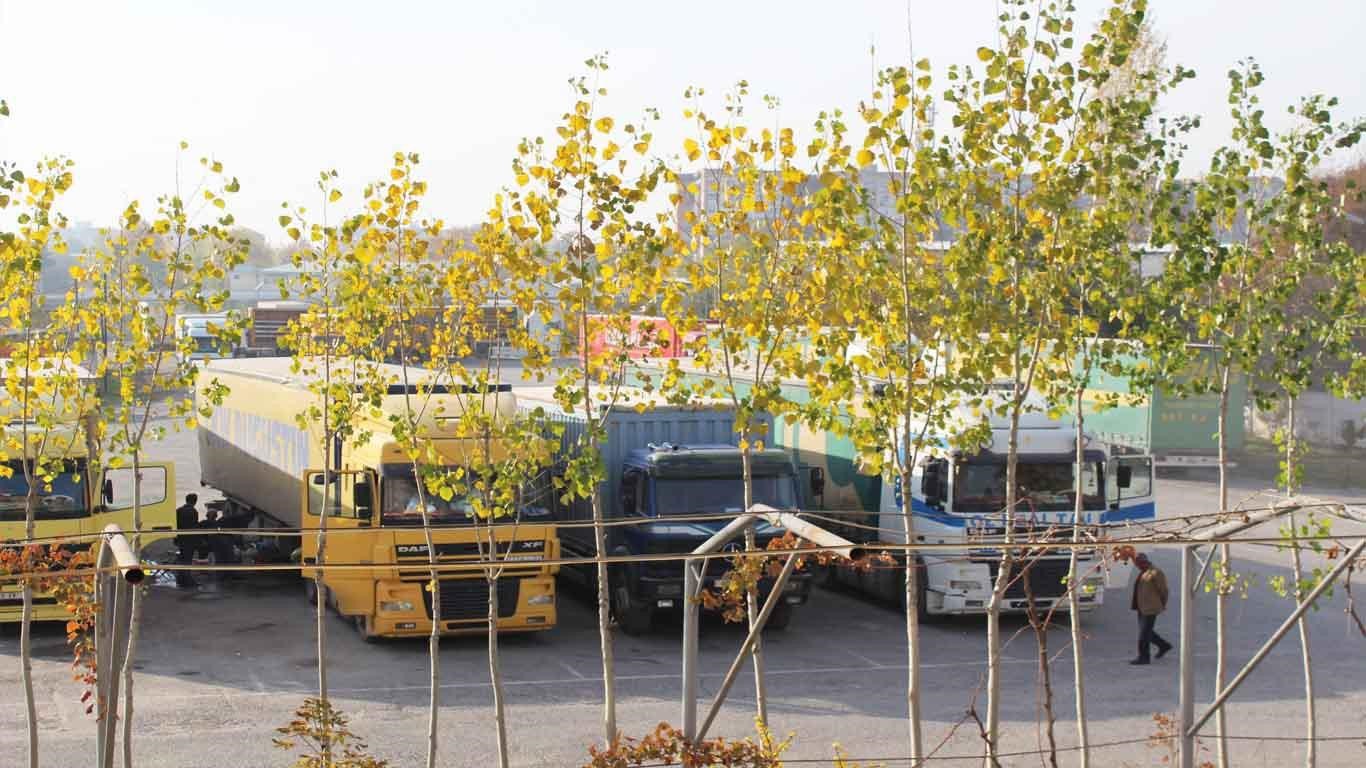
- International freight trucks at the Dushanbe Logistics Center, one of Tajikistan's cargo handling and customs facilities.
Cargo Types and Special Transport Requirements
General cargo, palletized goods, construction materials, industrial machinery and standard 20ft or 40ft containers can move from Bandar Abbas to Tajikistan, subject to transit acceptance and suitable equipment. Construction products and machinery should be checked for gross weight, loading arrangements and destination unloading facilities.
Project cargo, including generators, transformers and steel structures, may require flatbeds, low-bed trailers, lifting plans and route surveys. SASCO's project cargo and OOG transport services can support planning where loads exceed standard dimensions.
Reefer shipments require verified power or fuel arrangements, temperature monitoring and border-delay contingency plans. Out-of-gauge (OOG) cargo needs clearance checks and permits across every transit country. Dangerous goods require correct classification, approvals and carrier acceptance; not every commodity or route is eligible. Confirm these conditions before booking.
Why Choose SASCO for Tajikistan Freight?
SASCO coordinates port-related cargo handling at Shahid Rajaee Port with Iranian customs transit, inland trucking and rail planning. For Tajikistan-bound freight, our team can assess whether a road, rail or combined route is appropriate for the cargo, destination and required delivery date.
We also review container ownership, equipment suitability, loading constraints and the documentation needed for border handovers. Our multimodal transport planning connects port operations with onward movement through Iran and neighboring countries, subject to carrier acceptance and route availability.
We assess each shipment individually rather than promising an unverified service or delivery schedule.
Frequently Asked Questions
How much does freight from Bandar Abbas to Tajikistan cost?
For budgeting, a standard dry full truckload or container moved by road may cost approximately USD 3,500–5,500 after port release. Rail or combined transport may require USD 3,500–6,500. Final quotations depend on equipment, destination and included charges.
How long does shipping from Bandar Abbas to Dushanbe take?
Allow approximately 10–16 days by road after cargo release at Shahid Rajaee Port. Rail or rail-plus-road service may require about 22–35 days. Port dwell time, border queues and wagon availability can extend either estimate.
Is road or rail freight better for Tajikistan?
Road freight is generally preferable for flexible door-to-door delivery or urgent full truckloads. Rail may suit heavy cargo and regular container volumes, but gauge-change handling, wagon availability and final-mile trucking must be considered before comparing total costs.
Which borders does cargo cross on the way to Tajikistan?
A common road corridor uses Sarakhs between Iran and Turkmenistan, Farap–Alat into Uzbekistan, then Sariosiyo–Bratstvo for Dushanbe or Oybek–Fotehobod for Khujand. Rail movements use different rail junctions, so border details must match the selected transport mode.
Can 20ft and 40ft containers be delivered to Dushanbe and Khujand?
Potentially, yes, subject to shipping-line permission for COC containers, border and terminal acceptance, local road limits and equipment availability. For SOC containers, check ownership documentation and receiving arrangements. Confirm unloading and empty-return terms before dispatch.
Request a Bandar Abbas to Tajikistan Freight Quote
For a shipment-specific road, rail or multimodal proposal, send SASCO your cargo description, gross weight, dimensions, container type and ownership, destination city, Incoterm, readiness date and required delivery scope. Request a freight quote to confirm feasible routing, transit time and total charges before final booking.