

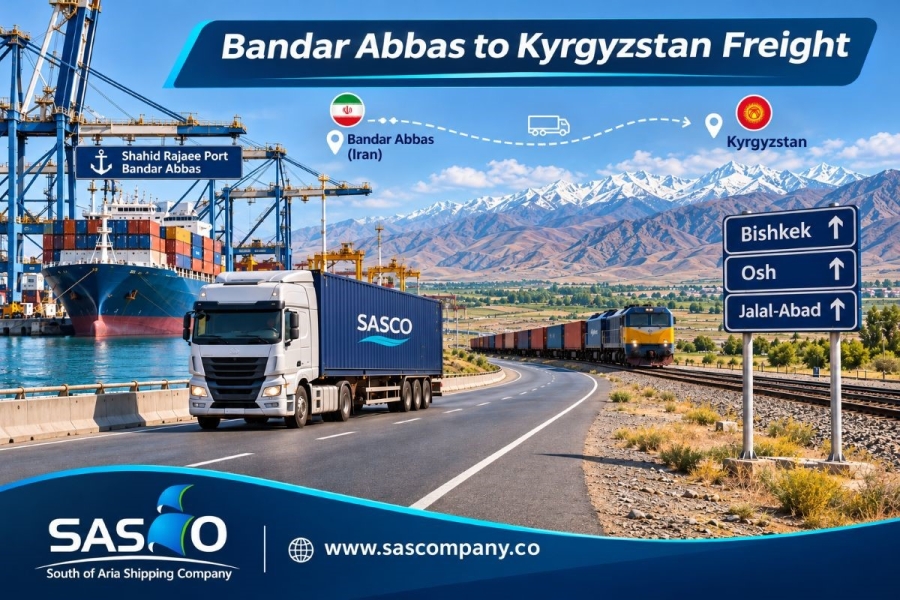
Bandar Abbas to Kyrgyzstan Freight at a Glance
These are planning options, not fixed schedules or tariffs. Final routing depends on the shipment and current border conditions.
|
Factor |
Information |
|
Origin |
Bandar Abbas / Shahid Rajaee Port |
|
Main destinations |
Bishkek, Osh, Jalal-Abad |
|
Freight modes |
Road, rail, rail + road |
|
Transit countries |
Turkmenistan, Uzbekistan; Kazakhstan where applicable |
|
Main border options |
Sarakhs, Farap–Alat, Dustlik–Dostuk; northern crossings for Bishkek |
|
Transit time |
Route- and mode-dependent; confirm before booking |
|
Freight cost |
Shipment-specific quotation |
Sea-arriving cargo requires port release and onward land transport; Kyrgyzstan has no seaport.
Main Freight Routes from Bandar Abbas to Kyrgyzstan
Bandar Abbas to Osh via Turkmenistan and Uzbekistan
A practical road route follows:
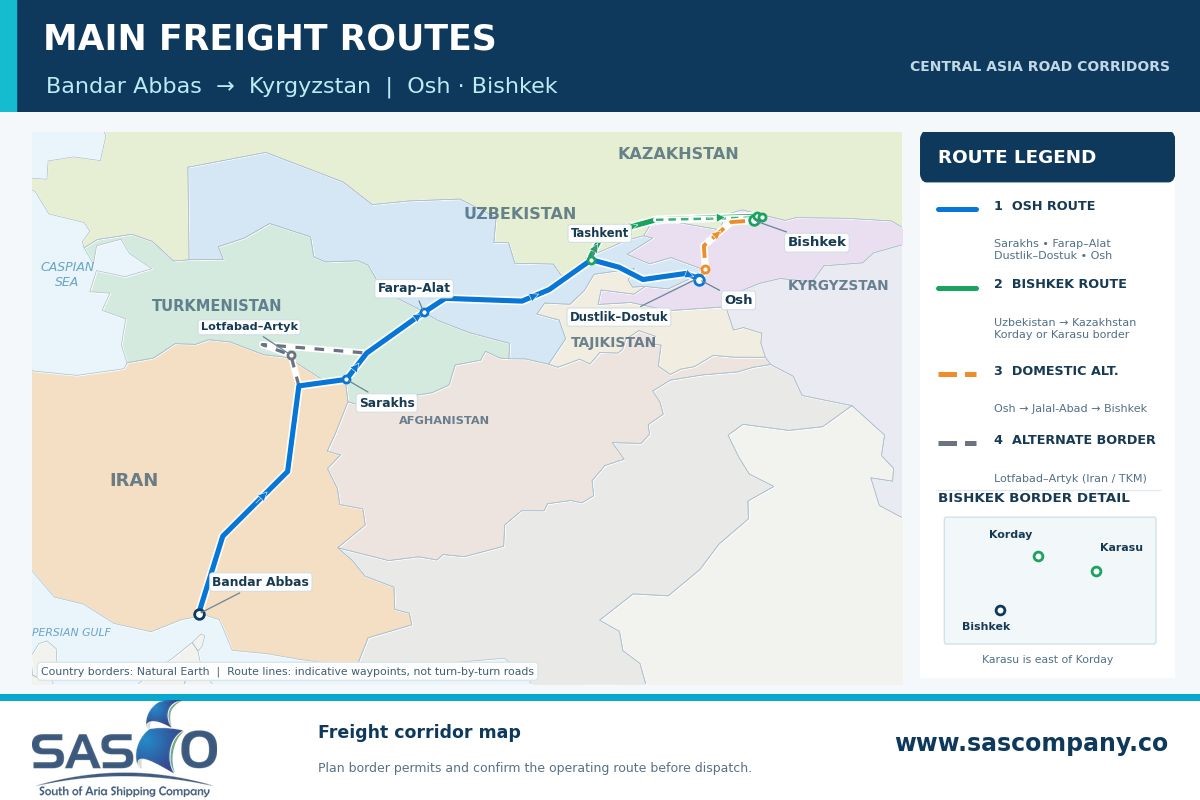
Bandar Abbas → Sarakhs → Turkmenistan → Farap–Alat → Uzbekistan → Dustlik–Dostuk → Osh
The Iranian leg uses the Bandar Abbas to Turkmenistan freight corridor toward Sarakhs. After crossing Turkmenistan and entering Uzbekistan at Farap–Alat, cargo continues toward Andijan. Uzbekistan’s official trade information portal identifies Dustlik–Dostuk as an international crossing into the Osh region. Truck permissions, customs procedures, and cargo acceptance must be confirmed before dispatch.
Bandar Abbas to Bishkek via Kazakhstan
For Bishkek-bound cargo, the established transit to Uzbekistan via Iran corridor can extend through Kazakhstan into northern Kyrgyzstan.
Korday–Ak-Zhol and Karasu–Ak-Tilek are relevant border options, but their suitability depends on vehicle type and operating conditions. Kazakhstan’s CarGoRuqsat checkpoint registry lists Karasu–Ak-Tilek as active. Commercial truck movements may require electronic queue bookings, transit permits, and carrier approval. The final crossing should match the cargo and delivery address.
Alternative Road Routes and Border Selection
An alternative is to enter Kyrgyzstan from Uzbekistan through Dustlik–Dostuk near Osh, then continue by road to Bishkek. This adds a substantial domestic journey, potentially affected by mountain-road and seasonal conditions.
Lotfabad–Artyk may also be considered instead of Sarakhs for suitable road shipments entering Turkmenistan. Route selection should account for border waiting times, permits, equipment availability, and total delivery cost.
A Caspian Sea route is not a direct continuation from Bandar Abbas; it would require a separate inland movement to a Caspian port.
Road vs. Rail Freight to Kyrgyzstan
Road Freight and FTL Trucking
Road freight from Bandar Abbas to Kyrgyzstan suits commercial goods, palletized cargo, and machinery requiring direct delivery. Full truckload (FTL) transport can reduce intermediate handling, subject to truck availability. Transit permits, border procedures, and possible tractor or trailer changes must be checked before dispatch.
Rail Freight via Sarakhs
Rail freight can suit containers, heavy cargo, and regular shipments. Trains travel toward Sarakhs, where Iran’s 1,435 mm tracks meet Central Asia’s 1,520 mm network. Container transfers or wagon/bogie changes may be required.
Northern Kyrgyz rail lines connect through Kazakhstan, while southern lines connect through Uzbekistan. The two networks are not directly linked, according to the OECD. Rail + road therefore requires terminal coordination and often final delivery by truck.
|
Factor |
Road |
Rail + Road |
|
Delivery flexibility |
Direct where permitted |
Last-mile trucking often needed |
|
Equipment |
Truck, trailer, permits |
Wagons, containers, trucks |
|
Transfer costs |
Border handovers possible |
Terminal and gauge-change charges |
|
Waiting time |
Border queues, truck availability |
Train schedules, wagon capacity |
How Much Does Bandar Abbas to Kyrgyzstan Freight Cost?
For standard dry full-truckload (FTL) cargo, estimated Bandar Abbas to Kyrgyzstan freight costs range from USD 4,000–6,500 to Osh and USD 4,500–7,500 to Bishkek. These preliminary road-transport budgets assume cargo is released at Bandar Abbas and exclude international ocean freight. Actual rates depend on equipment, route, weight, and handling requirements.
|
Cost Component |
What Affects the Price |
|
Bandar Abbas charges |
Terminal handling, storage |
|
Inland freight |
Distance, road or rail, equipment |
|
Border and transit |
Permits, waiting, carrier changes |
|
Container costs |
SOC/COC, detention, empty return |
|
Final delivery |
Destination, unloading |
|
Special handling |
Cross-stuffing, reefer, OOG |
Included: Only transport, routine transit arrangements, and delivery services explicitly covered by the quotation.
Excluded unless specified: Port charges, ocean freight, insurance, import duties, destination customs clearance, and exceptional delays.
For a shipment-specific rate, request a Bandar Abbas to Kyrgyzstan freight quote from SASCO with your cargo weight, dimensions, equipment type, and destination.
Bandar Abbas to Kyrgyzstan Transit Time
Road Freight Transit Time
Allow approximately 10–20 days for road freight from Bandar Abbas to Kyrgyzstan, measured from port release under normal operating conditions. The underlying inland journey may take around 8–15 days without port or border delays. Customs inspections, truck permits, border queues, and delivery distance can extend this timeframe.
Rail Freight Transit Time
Rail-oriented shipments to Bishkek or Osh may take approximately 25–30 days, potentially longer. Wagon availability, container transfers at Sarakhs, railway schedules, and final trucking affect delivery.
These estimates exclude the incoming ocean voyage and are not guaranteed. Port-release delays, seasonal road restrictions, or additional handling may extend total transit time.
For a more accurate schedule, contact SASCO.
Freight Delivery to Bishkek, Osh and Jalal-Abad
Bandar Abbas to Bishkek
Bandar Abbas to Bishkek freight can be delivered to a logistics terminal, warehouse, or consignee address. Northern access through Kazakhstan may be preferable, depending on border conditions and last-mile delivery requirements.
Bandar Abbas to Osh
Bandar Abbas to Osh freight can enter southern Kyrgyzstan through Uzbekistan. Road freight offers direct delivery where permitted, while rail shipments may require terminal handling and a final trucking connection.
Bandar Abbas to Jalal-Abad
Delivery to Jalal-Abad depends on the warehouse location, road accessibility, unloading facilities, and availability of suitable local vehicles.
Port-to-Door covers transport from Bandar Abbas to the consignee. Terminal-to-Terminal ends at an agreed destination terminal, while Door-to-Door includes collection from the original shipper's premises. Service availability and customs responsibilities must be confirmed before booking.
Container Shipping and Cargo Transfer Options
FCL, LCL and FTL Shipping
Full container load (FCL) gives one shipper use of a container, whereas less-than-container load (LCL) shares space with other consignments. On arrival at Bandar Abbas, LCL cargo may be separated at an approved facility and consolidated for onward trucking, subject to customs procedures and service availability. Full-truckload (FTL) moves one shipment by dedicated truck. LCL consolidation availability for Kyrgyzstan must be confirmed before booking.
SOC vs. COC Containers
Shipper-owned containers (SOC) may travel onward if accepted by road or rail operators and customs. Carrier-owned containers (COC) usually require the shipping line's permission to leave Iran. Check free time, detention charges, permitted route, and empty-container return point before release.
Cross-Stuffing and Container-to-Truck Transfer
If the ocean container cannot continue, cargo can be unloaded under authorized transit arrangements, counted, inspected if required, and reloaded into a suitable trailer or another container. Cross-stuffing adds handling costs and potential damage or delay; packing, seals and liability should be documented. Standard options include 20GP, 40GP and 40HC containers; final equipment selection depends on cargo weight and dimensions.
Customs Transit and Documents for Kyrgyzstan
Required Freight and Transit Documents
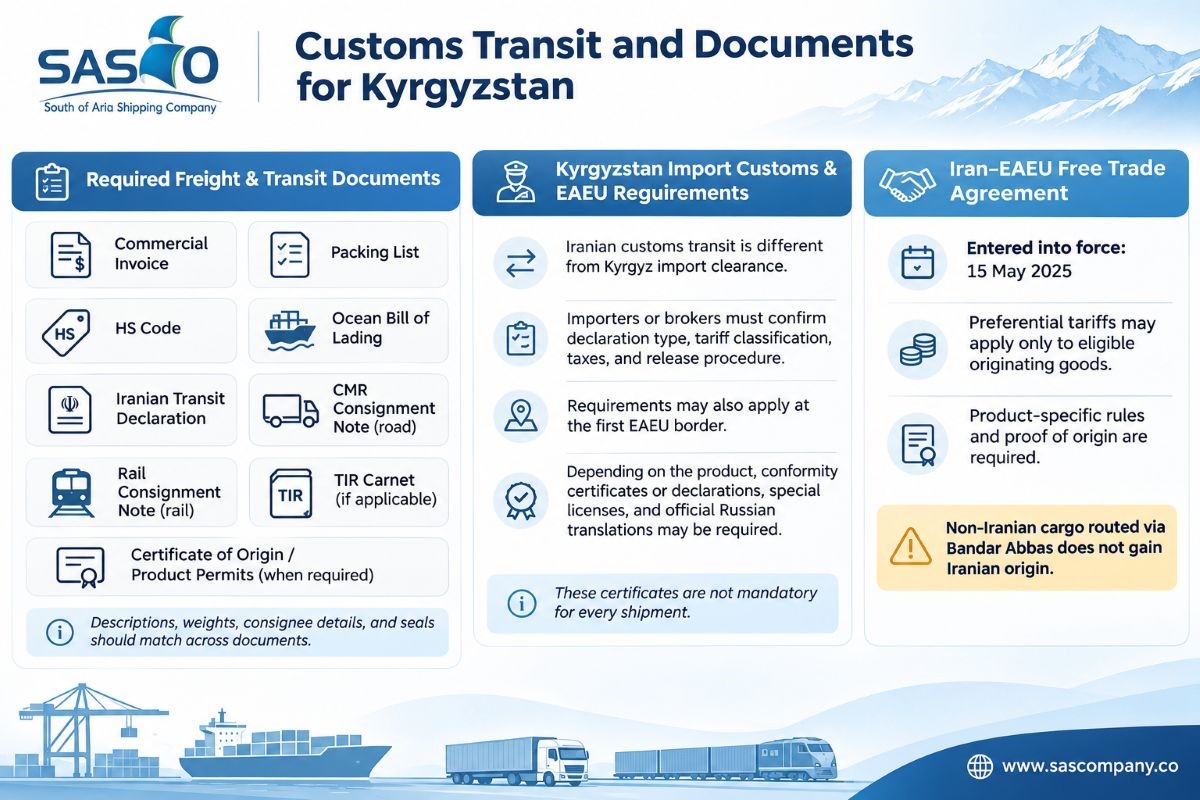
For Kyrgyzstan-bound shipments entering through Bandar Abbas, check the commercial invoice, packing list, HS code, ocean bill of lading, and applicable Iranian transit declaration. Road legs normally use a CMR consignment note; rail legs require the appropriate rail consignment note. A TIR carnet may be used where the carrier, route and customs arrangements qualify. Certificates of origin and product permits depend on cargo and destination requirements. Ensure descriptions, weights, consignee details and seals match across documents.
Kyrgyzstan Import Customs and EAEU Requirements
Iranian customs transit is different from import clearance into the Eurasian Economic Union (EAEU). Kyrgyzstan-bound importers or brokers must confirm the applicable declaration, tariff classification, taxes and release procedure, including any requirements at the first EAEU border. Depending on the product, conformity certificates or declarations, special licenses and official Russian translations may be requested under Kyrgyz import requirements. Such certificates are not mandatory for every shipment.
Iran–EAEU Free Trade Agreement
The Iran–EAEU Free Trade Agreement entered into force on 15 May 2025. Preferential tariffs may apply only to eligible originating goods meeting product-specific rules and proof-of-origin requirements. Routing non-Iranian cargo through Bandar Abbas does not confer Iranian origin.
How Freight Moves from Bandar Abbas to Kyrgyzstan
The shipping process involves six coordinated stages:
- Cargo arrival: Receive the shipment at Shahid Rajaee Port and complete terminal handling.
- Document review: Check shipping documents and arrange Iranian customs transit.
- Cargo release: Obtain container release or arrange authorized transfer to a truck or wagon.
- Inland dispatch: Select road or rail equipment and coordinate border permits.
- Central Asian transit: Monitor cross-border movements and address operational delays.
- Customs and delivery: Complete applicable EAEU entry procedures, Kyrgyzstan customs clearance and final delivery.
Clear responsibility for cargo handovers between transport operators helps control additional handling costs and delays. SASCO can coordinate these connections through multimodal transport via Iran.
Cargo Types and Special Transport Requirements
Bandar Abbas to Kyrgyzstan shipping can accommodate general cargo, palletized goods, containerized shipments, industrial machinery, spare parts and construction materials, subject to route feasibility and equipment availability.
Reefer cargo requires verified temperature control and continuous power arrangements. Dangerous goods need applicable permits and advance carrier acceptance. Out-of-gauge (OOG) loads require suitable equipment, route assessments and border approvals.
Special cargo requires individual evaluation before booking. SASCO's cold chain logistics services cover temperature-sensitive transport planning and handling requirements.
Why Choose SASCO for Kyrgyzstan Freight?
As a freight forwarder from Bandar Abbas to Kyrgyzstan, we help plan transport connections through Iran and onward Central Asian corridors.
Our team coordinates Shahid Rajaee Port operations, Iranian customs transit, road and rail transport planning, equipment selection and cargo transfers between transport modes.
We assess shipment specifications, destination requirements, border conditions and carrier availability before recommending a route. Our multimodal approach connects maritime arrivals with inland distribution while defining handling responsibilities and delivery arrangements.
Each proposed service remains subject to operational feasibility and shipment-specific confirmation.
Frequently Asked Questions
How much does freight from Bandar Abbas to Kyrgyzstan cost?
Indicative dry FTL road budgets are USD 4,000–6,500 to Osh and USD 4,500–7,500 to Bishkek. These are preliminary estimates, not current confirmed rates, and exclude ocean freight and certain additional charges.
How long does shipping from Bandar Abbas to Bishkek take?
Road freight generally requires approximately 10–20 days after port release. Rail-oriented shipments may take 25–30 days or longer. Border delays, equipment availability and final delivery arrangements affect actual transit times.
Can a shipping-line container be transported to Kyrgyzstan?
Yes, subject to the shipping line's approval, carrier acceptance and an agreed empty-container return location. Otherwise, the cargo may require authorized transfer into another container or suitable trailer.
Is LCL or consolidated cargo shipping available to Kyrgyzstan?
LCL cargo may be consolidated for onward transport after arrival at Bandar Abbas.
What customs documents are required for Kyrgyzstan-bound freight?
Typical documents include a commercial invoice, packing list, HS code, transport document and transit declaration. CMR, rail consignment notes, TIR documentation, certificates of origin or additional permits may apply.
Request a Bandar Abbas to Kyrgyzstan Freight Quote
For an accurate freight quote to Kyrgyzstan, provide your cargo type, HS code, gross weight, dimensions, container type and SOC/COC status. Include the shipment origin, destination address, cargo-ready date and Incoterm.
Submit these details through SASCO's Request a Shipping Quote form for a shipment-specific assessment of routing, equipment and transport costs.