

Understanding Freight to Iran
Before addressing the challenges and risks of freight to Iran, it is essential to clarify what the term actually covers in practical logistics operations. Many misunderstand it as a single transport activity, while in reality it includes multiple shipping methods, regulatory layers, and risk profiles depending on cargo type and route selection.
Freight to Iran refers to the organized movement of goods into the country through international shipping networks, often involving indirect routes, transit hubs, and strict compliance controls. The complexity of this process is one of the main reasons why shipping to Iran differs significantly from freight operations to other regional markets.
What Does “Freight to Iran” Include?
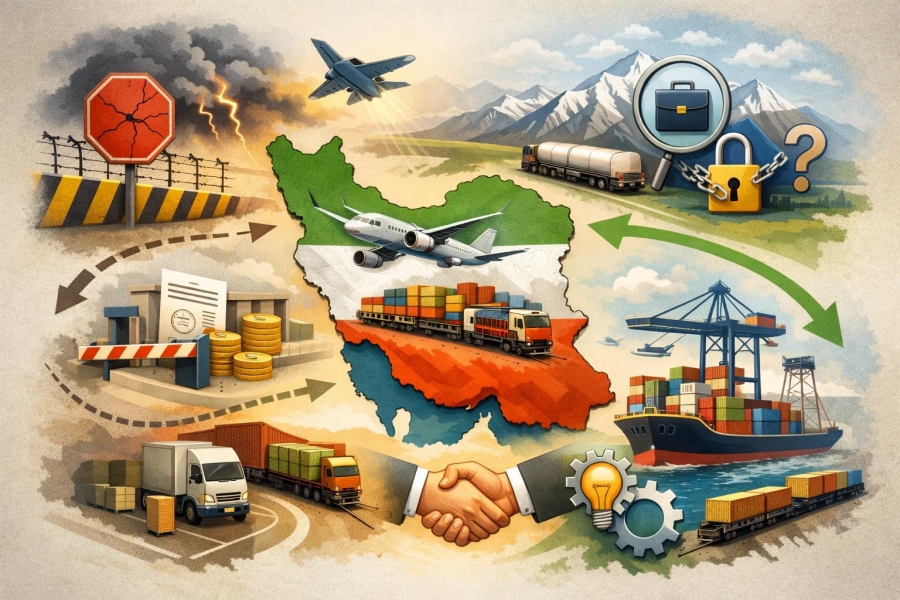
The scope of international shipping to Iran is diverse, catering to different budgets, timelines, and cargo types. Depending on the urgency and nature of the goods, Iran freight solutions may include a sea freight service, an air freight service, or land and multimodal transport.
- Sea Freight to Iran: The most cost-effective method for bulk commodities and large containers, primarily through major hubs like Bandar Abbas.
- Air Freight to Iran: The fastest solution for high-value or time-sensitive cargo, utilized when minimizing transit time is the top priority.
- Land & Multimodal Transport: A versatile approach combining trucking and rail, often used for shipments coming from Europe or neighboring CIS countries.
Who Needs Shipping Services to Iran?
Identifying the right freight forwarding to Iran solutions is critical for various stakeholders who keep the trade flow active:
- Manufacturers: International factories exporting industrial machinery, raw materials, or consumer goods to the Iranian market.
- Trading Companies: Middlemen and distributors who manage the supply chain and require reliable Iran logistics to maintain inventory.
- Project Cargo Owners: Large-scale energy, infrastructure, or mining projects that need specialized handling for oversized or heavy-lift equipment.
Navigating the Real-World Challenges of Freight to Iran: A Strategic Guide
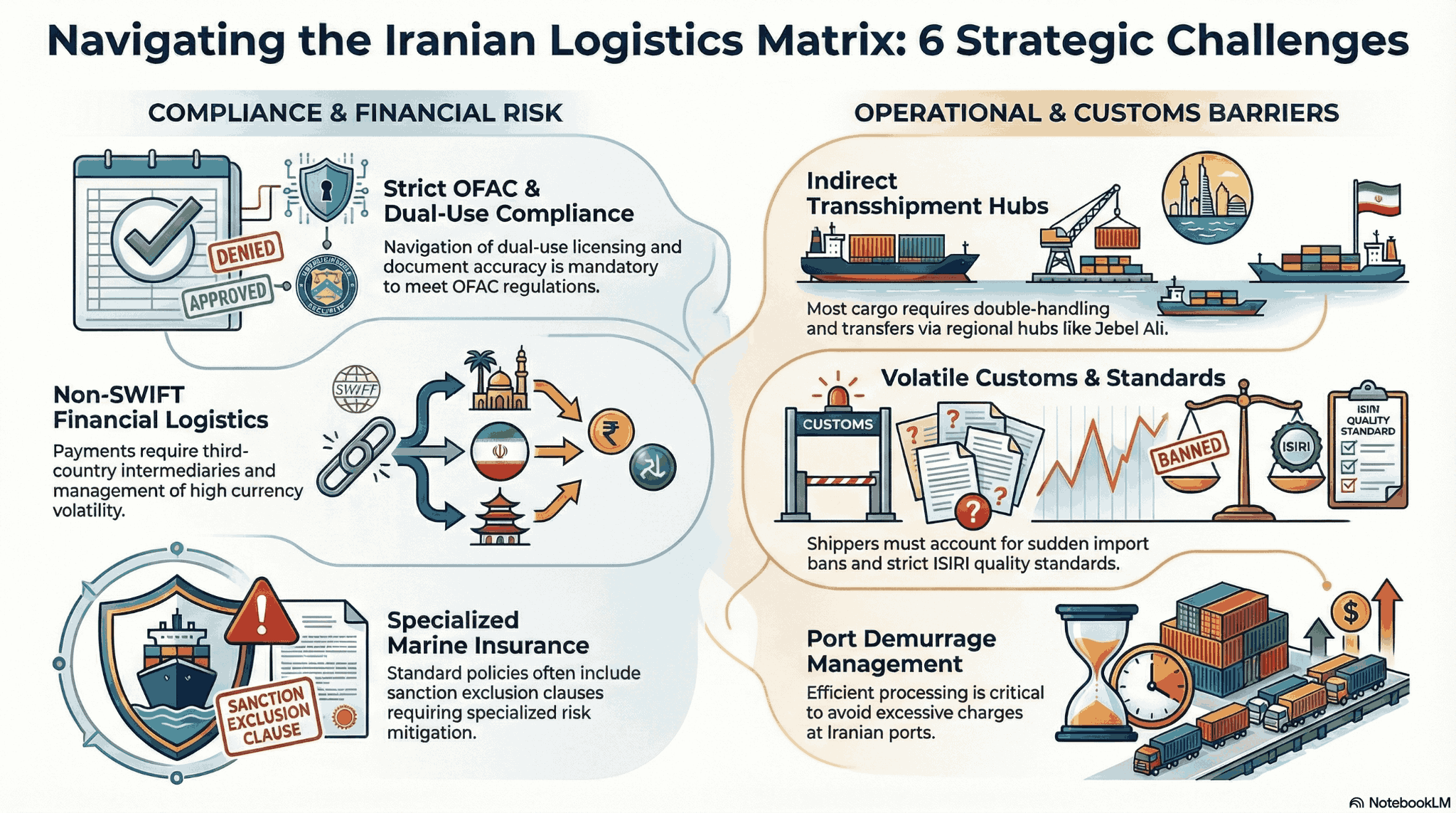
Expanding your business into the Iranian market is a high-reward move, but let’s be honest: the logistics landscape is a minefield of regulatory and operational shifts. At SASCO, we believe successful shipping to Iran isn't just about moving containers—it’s about sophisticated risk management and staying two steps ahead of international law.
1. The Compliance Tightrope: Sanctions and Beyond
The most daunting hurdle is, without doubt, the global regulatory framework. It’s not just about what you ship, but who is involved in every link of the chain.
- The Overlooked Reach of OFAC: Many non-U.S. firms mistakenly believe they are immune. However, Office of Foreign Assets Control (OFAC) regulations can impact any transaction involving global financial systems. One "red flag" entity in your supply chain can halt your operations overnight.
- The "Dual-Use" Dilemma: In our experience, many industrial components—like specific valves, sensors, or alloys—are flagged as dual-use. This requires meticulous technical documentation and specialized export licenses before the first crane even touches your cargo.
- Paperwork Precision: In freight forwarding to Iran, a typo on a Bill of Lading (BoL) isn't just a minor error; it’s a reason for seizure. We emphasize 100% alignment between the Certificate of Origin and Iranian customs requirements to avoid costly delays at transit hubs.
2. Financial Logistics: Solving the Payment Puzzle
Moving the cargo is often easier than moving the money. Since major Iranian banks are disconnected from SWIFT, traditional banking is off the table.
- The Third-Country Route: Most Iran freight solutions rely on complex (but legal) payment structures through intermediaries in the UAE, Turkey, or Oman. While this adds a layer of cost, it’s the only way to ensure liquidity and transaction security.
- Currency Fluctuations: The volatility of the Rial can turn a profitable shipment into a loss in a matter of days. Importers must account for rapid changes in customs valuation and local "inland" transport costs.
3. The Transshipment Reality: Logistics Constraints
While Iran boasts massive ports like Bandar Abbas, direct access for Tier-1 global shipping lines is often restricted due to secondary sanctions.
- The Jebel Ali Hub: Most sea freight service routes to Iran now require transshipment, typically at regional hubs like Jebel Ali. This "double-handling" increases the risk of cargo damage and adds demurrage pressure.
- Limited Carrier Choice: You aren't just choosing a price; you're choosing a carrier that is willing to navigate the legal complexities of Iranian waters. This scarcity often leads to volatile freight rates.
4. Domestic Bureaucracy: Iranian Customs
Once the ship docks, a new clock starts ticking. Iranian customs (IRICA) is known for its dynamic—and sometimes unpredictable—regulatory environment.
- Sudden Import Bans: A product that is "Green Lane" today might be banned tomorrow due to new domestic protectionist laws.
- Standardization (ISIRI): Goods must often undergo rigorous testing by the Institute of Standards and Industrial Research of Iran. Without the right pre-inspection certificates, your cargo could sit in port for weeks, racking up heavy demurrage charges that eat your margins.
5. The Insurance Gap: Protecting Your Investment
Perhaps the most overlooked risk of shipping to Iran is the "Sanction Clause" found in standard marine insurance.
- Voided Coverage: Most international P&I clubs will void a policy the moment a vessel enters Iranian territory.
- Specialized Brokers: To mitigate this, SASCO recommends working with specialized brokers who can provide a cargo insurance service with sanction-compliant coverage, even if it comes at a higher premium. In this market, cheap insurance is often no insurance at all.
Practical Solutions: How to Ship Freight to Iran Safely and Efficiently
Navigating the complexities of the Iranian market requires more than just a standard logistics provider; it demands a strategic partner who understands the nuances of the region. To overcome the hurdles mentioned earlier, businesses must adopt practical shipping solutions that ensure compliance while maintaining cost-efficiency. Here is how to optimize your freight to Iran.
Implementing Multimodal Transport & Alternative Routes
One of the most effective Iran freight solutions is the use of a multimodal transport service. By combining different modes of carriage, businesses can bypass many of the restrictions faced by direct shipping lines.
- Sea + Land: Shipping cargo to neighboring regional hubs and then completing the journey via truck or rail is a proven method to ensure how to ship freight to Iran safely.
- The INSTC Advantage: Utilizing the International North-South Transport Corridor (INSTC) provides a shorter, faster, and more secure route for goods coming from Russia or India, significantly reducing transit times compared to traditional paths.
H3: Strategic Transshipment: Utilizing Third-Country Hubs
Since many direct carriers have limited their calls, international shipping to Iran now heavily relies on strategic transshipment.
- Regional Gateways: Hubs like Jebel Ali (UAE), Mersin (Turkey), and Sohar (Oman) play a vital role. By rerouting cargo through these neutral points, you can mitigate the risks of shipping to Iran and manage documentation more flexibly.
- Risk Mitigation: This approach allows for a "buffer zone" where paperwork can be reviewed and aligned with both international compliance and Iranian customs requirements before the final leg of the journey.
Partnering with Specialized Iran Freight Forwarders
Experience is the most valuable asset in this market. Working with a dedicated freight forwarding to Iran specialist is no longer optional—it is a necessity.
- Compliance Expertise: A seasoned forwarder understands the "Sanction Clause" and knows how to navigate freight to Iran under sanctions without triggering legal red flags.
- Local Network: They possess the "on-the-ground" connections needed to handle inland transport and local bureaucracy, which are often the biggest bottlenecks in Iran logistics.
Documentation Mastery: HS Code Accuracy and Pre-Shipment Inspection
To avoid heavy fines and prolonged delays at the port of entry, technical precision is key.
- HS Code Alignment: For a customs clearance service, ensuring that the Harmonized System (HS) codes on your commercial invoice perfectly match Iranian customs' interpretations is one of the best ways to prevent shipping to Iran challenges.
- Pre-Shipment Inspection (PSI): Arranging for a third-party inspection before the cargo leaves the origin port provides a "Safety Certificate" that speeds up the clearance process significantly, reducing the risk of cargo being held for testing.
Utilizing Iran’s Free Trade Zones (FTZs) for Customs Optimization
For many businesses, shipping directly to an Iranian Free Trade Zone (such as Kish, Qeshm, or Chabahar) offers a strategic advantage.
- Reduced Bureaucracy: FTZs offer simplified customs procedures and tax exemptions, making them ideal for companies looking for efficient Iran logistics entry points.
- Storage and Distribution: These zones can serve as secure warehouses where goods can be stored until all financial and legal clearances are finalized, avoiding high demurrage costs at main commercial ports.
Practical Solutions for Freight to Iran
|
Solution |
Core Action |
Main Benefit |
|
Multimodal Transport & Alternative Routes |
Combine sea, road, and rail instead of relying on direct routes |
Reduces carrier restrictions and route dependency |
|
INSTC Utilization |
Use the International North-South Transport Corridor (INSTC) for cargo from Russia or India |
Shorter transit time and improved route security |
|
Strategic Transshipment via Third-Country Hubs |
Reroute cargo through hubs like Jebel Ali Port, Mersin Port, or Sohar Port |
Better compliance control and risk mitigation |
|
Specialized Iran Freight Forwarders |
Partner with forwarders experienced in Iran-related sanctions and logistics |
Lower compliance risk and fewer operational errors |
|
HS Code Accuracy & Pre-Shipment Inspection |
Verify HS codes and conduct third-party inspections before shipment |
Prevents customs delays, fines, and cargo holds |
|
Use of Iran Free Trade Zones (FTZs) |
Route cargo through FTZs such as Kish, Qeshm, or Chabahar |
Simplifies customs procedures and reduces costs |
Top Strategic Routes and Entry Points (Best Shipping Routes to Iran)
Choosing the best shipping routes to Iran today is not about finding the shortest distance on a map; it’s about finding the path of least resistance against regulatory and logistical barriers. Since direct calls from global Tier-1 carriers are limited, the most effective routes are now "Hybrid" and "Multimodal."
1. The Southern Corridor (Bandar Abbas)
Although Bandar Abbas (Shahid Rajaee Port) is the most developed entry point, it is currently reached primarily through a "Hub-and-Spoke" model.
- The Route: Global cargo first arrives at Jebel Ali (UAE) and is then transferred to smaller feeder vessels or barges to cross the Persian Gulf to Iran.
- Why it’s a Top Route: It offers the highest frequency of sailings and the most robust inland infrastructure for distribution across Iran. However, it requires expert handling of sea freight to Iran risks during the transshipment phase.
2. The Sanction-Bypass Route (Chabahar Port)
Located outside the volatile Strait of Hormuz on the Indian Ocean, Chabahar Port is becoming a premier Iran freight solution.
- The Advantage: Due to its strategic importance for regional connectivity (especially for India and Afghanistan), it has historically enjoyed certain exemptions and less congestion.
- Who it's for: Ideal for bulk commodities and businesses looking for a route with fewer Iran logistics restrictions compared to the traditional Persian Gulf ports.
3. The Northern Corridor (INSTC & Caspian Sea)
For shipments originating from Russia, Central Asia, or Northern Europe, the International North-South Transport Corridor (INSTC) is the most efficient alternative.
- The Route: Cargo enters via northern ports such as Anzali or Amirabad via the Caspian Sea.
- Why it’s Strategic: This is a "Sanction-Proof" corridor that bypasses Western-controlled maritime choke points, offering a secure path for freight to Iran under sanctions.
4. The Land Bridge (Europe to Iran via Turkey)
When sea freight is too complex or slow, the land route via Turkey remains one of the best shipping routes to Iran for European exporters.
- The Entry Point: The Bazargan border is the primary gateway for trucking and rail.
- The Benefit: It avoids the "double-handling" of sea transshipment and provides a direct link from European warehouses to Iranian industrial zones.
H2: Frequently Asked Questions (FAQ)
To conclude this guide on freight to Iran, we have compiled the most common queries from global traders regarding Iran logistics.
Is it legal to ship freight to Iran under sanctions?
Yes, provided the goods are not on the restricted "dual-use" lists and the entities involved (banks, carriers, and consignees) are not sanctioned by OFAC or the EU. Working with an expert in freight to Iran under sanctions is essential for compliance.
An import & export consulting service can help exporters review product eligibility, documentation requirements, and licensing risks before arranging freight to Iran.
How can I mitigate the risks of shipping to Iran?
The best way to mitigate risks of shipping to Iran is through "Documentation Mastery," obtaining Pre-Shipment Inspections (PSI), and using specialized insurance brokers who provide specific sanction-compliant clauses.
What are the main shipping to Iran challenges for new exporters?
The primary shipping to Iran challenges include lack of direct SWIFT payments, the necessity of transshipment at regional hubs like Jebel Ali, and navigating the frequently changing domestic customs regulations in Iran.
How can I safely ship freight to Iran despite sanctions?
The most secure solution is partnering with a local expert like SASCO, who leverages neutral regional hubs and deep compliance knowledge to turn Iran logistics restrictions into a seamless, legal, and risk-free supply chain.