

India to Iran Shipping at a Glance
The following rates are indicative public market benchmarks and are not binding SASCO quotations. The service scope, currency and pricing basis differ between the options, so the figures should not be compared without reviewing the “Service scope” column. Port-to-port sailing time refers only to the scheduled vessel journey and should not be confused with total door-to-door transit time. Final rates and transit times must be confirmed before booking.
|
Shipping option |
Suitable for |
Indicative public rate |
Rate basis |
Service scope |
Estimated transit |
|
LCL sea freight |
Pallets, cartons and commercial cargo that does not fill a complete container |
€100–€950 per CBM |
Charged per CBM or 1,000 kg, whichever is higher |
Published door-to-door benchmark; exact inclusions must be confirmed |
60–90 days door-to-door |
|
FCL 20GP sea freight |
Heavy, dense or larger commercial shipments requiring a dedicated container |
About 300 USD |
Per 20GP container |
Published door-to-door benchmark; exact origin and destination charges must be confirmed |
60–90 days door-to-door |
|
FCL 40GP or 40HC sea freight |
High-volume, bulky or handling-sensitive cargo |
About 700 USD |
Per container; rate depends on equipment type and loading port |
Published door-to-door benchmark; exact origin and destination charges must be confirmed |
60–90 days door-to- |
|
Air freight |
Urgent, lightweight or high-value cargo |
- |
Per kg of chargeable weight |
Airport-to-airport or door-to-door |
Subject to airline routing and service scope |
Get an India-to-Iran Freight Quote
Send cargo type, HS code, weight, dimensions, pickup city, destination and Incoterm.
The published sailing time represents the scheduled port-to-port vessel journey only. It does not include cargo pickup, booking lead time, port cut-off, export clearance, possible transshipment, destination handling, customs clearance or inland delivery in Iran.
Choosing between FCL and LCL shipping depends on cargo volume, handling needs and destination charges. For more detail, see SASCO’s FCL vs LCL shipping guide. To receive an accurate freight quote, provide the cargo type, HS code, weight, dimensions, origin, destination and Incoterm.
How Much Does Shipping from India to Iran Cost?
The India to Iran shipping cost depends on cargo type, transport mode, origin and destination. A complete quotation should separate international freight from origin, destination, customs and inland delivery costs.
Main Factors Affecting the Cost
The total shipping cost depends on several connected factors. For an accurate comparison, importers should evaluate the complete route and service scope rather than focusing only on the ocean or air freight rate.
- Origin and destination: The pickup city and loading port in India affect inland transport and origin charges, especially when cargo must travel to Mundra, Nhava Sheva, Mumbai or another export gateway. Sea cargo commonly arrives through Bandar Abbas, while urgent shipments may be delivered by air to Imam Khomeini International Airport.
- Weight, CBM and shipment size: Freight charges are calculated according to actual weight, volume and chargeable weight. Small commercial shipments may be more suitable for LCL shipping from India to Iran, while larger volumes often achieve a lower unit cost through FCL shipping from India to Iran.
- Container and equipment type: Standard options include 20GP, 40GP and 40HC containers. Reefer, open-top and flat-rack equipment usually involve higher freight and handling costs.
- Cargo classification: General cargo is normally less expensive to handle than dangerous goods, refrigerated products or OOG cargo. Special shipments may require additional documentation, packaging, permits and equipment.
- Incoterm and service scope: The selected Incoterm determines whether the quotation includes supplier pickup, export clearance, main freight, insurance, customs clearance and final inland delivery in Iran.
What an India-to-Iran Freight Quote Should Include
|
Cost item |
What it covers |
|
Pickup in India |
Collection from the supplier or factory |
|
Export customs clearance |
Export documentation and formalities |
|
Origin terminal charges |
Port, airport or CFS handling |
|
Ocean or air freight |
Main international transport |
|
Transshipment charges |
Intermediate handling, when applicable |
|
Destination handling |
Port or airport charges in Iran |
|
Customs clearance in Iran |
Import declaration and clearance services |
|
Storage or demurrage |
Charges caused by delays |
|
Cargo insurance |
Optional protection against cargo risks |
Sea Freight from India to Iran
Sea freight from India to Iran is usually the most cost-effective option for heavy, bulky or containerized commercial cargo. Shipments commonly move from major Indian ports such as Mundra, Nhava Sheva, Mumbai, Chennai or Cochin to Bandar Abbas and other southern Iranian ports. The best shipping arrangement depends on cargo volume, weight, dimensions, handling requirements and delivery schedule.
LCL Shipping from India to Iran
LCL shipping from India to Iran is suitable when the cargo does not require a full container. It is commonly used for smaller commercial shipments, although the final decision should be based on total chargeable volume rather than shipment size alone. Freight is generally calculated by CBM or chargeable weight, depending on the carrier and cargo density.
Under an LCL service, goods from different shippers are combined at a consolidation warehouse before departure. This process is known as consolidation. After arrival in Iran, the container is opened and each shipment is separated for customs clearance and delivery; this stage is called deconsolidation.
A low ocean freight rate does not always produce the lowest total cost. LCL shipments may involve origin CFS charges, documentation fees, consolidation costs, destination CFS handling, deconsolidation fees and local delivery expenses. Importers should therefore compare complete quotations rather than only the main sea freight rate.
FCL Container Shipping from India to Iran
FCL shipping from India to Iran gives one shipper exclusive use of the container and is generally more suitable for larger cargo volumes, high-value goods or shipments requiring greater control.
- A 20GP container is commonly used for dense or heavy cargo.
- A 40GP container provides more capacity for lighter and bulkier goods.
- A 40HC container offers additional internal height and volume.
- Reefer containers are used for temperature-sensitive cargo.
- Open-top and flat-rack containers are suitable for oversized, heavy or out-of-gauge cargo.
The cost of FCL container shipping from India to Iran is usually quoted per container. However, origin handling, terminal charges, documentation, destination fees, customs clearance and inland delivery may be quoted separately.
FCL or LCL?
LCL can be practical for smaller shipments, while FCL often provides a lower unit cost, faster handling and reduced cargo contact for larger volumes. The final choice should consider CBM, cargo value, sensitivity, schedule and destination charges. For a detailed comparison, see SASCO’s FCL vs LCL shipping guide.
Main Ports and Shipping Routes
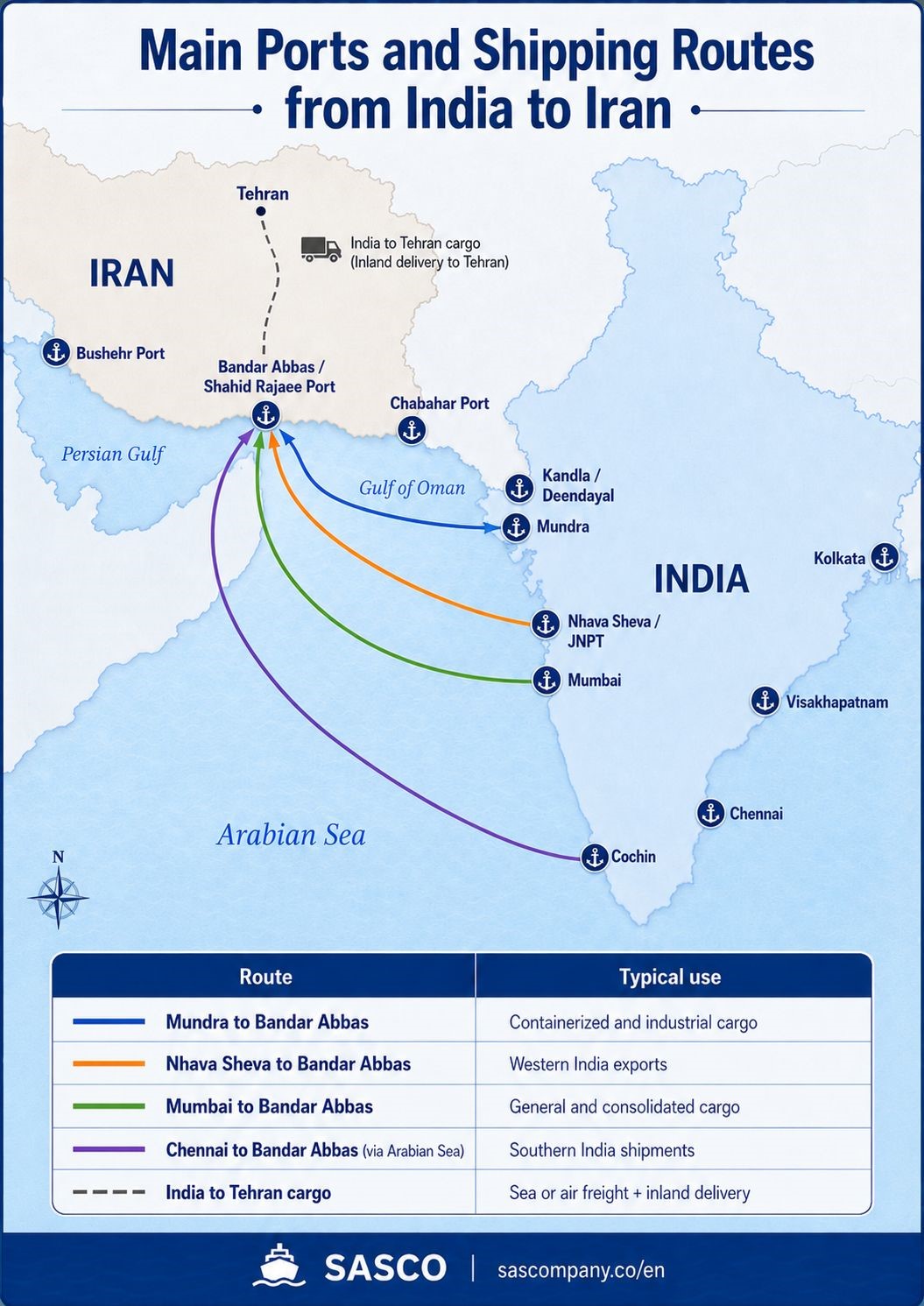
The main routes for India to Iran container shipping connect India’s western and eastern ports with Iran’s southern gateways. Port selection affects inland pickup cost, sailing frequency, transshipment requirements and total transit time.
On India’s west coast, Mundra, Nhava Sheva (JNPT), Mumbai and Kandla, also known as Deendayal Port, are important options for commercial cargo. Mundra to Bandar Abbas shipping is often suitable for exporters in Gujarat and northern India, while Nhava Sheva to Bandar Abbas freight serves Mumbai and major industrial areas in western India. Mumbai may also be used for general cargo and consolidated shipments.
On the east and south coasts, Chennai, Cochin, Kolkata and Visakhapatnam provide access for cargo originating in southern and eastern India. Chennai to Iran shipping can be suitable for machinery, automotive parts and industrial goods, although the route may involve a connection or transshipment. Cochin serves southwestern India, while Kolkata and Visakhapatnam may be considered for cargo produced closer to India’s eastern regions.
The principal Iranian destination is Shahid Rajaee Port in Bandar Abbas, which handles a large share of the country’s containerized imports. Chabahar Port may be considered when a suitable operational service is available. Bushehr and other southern ports should only be selected after confirming carrier schedules, cargo acceptance and destination handling arrangements.
|
Shipping route |
Port codes |
Best for |
Published port-to-port transit profile |
Main destination |
|
Mundra to Bandar Abbas |
INMUN → IRBND |
Containerized cargo, industrial goods and shipments originating in Gujarat or northern India |
About 4-5 Days |
Shahid Rajaee Port, Bandar Abbas |
|
Nhava Sheva (JNPT) to Bandar Abbas |
INNSA → IRBND |
FCL and LCL cargo from Mumbai, Maharashtra and the industrial regions of western India |
About 4-5 Days |
Shahid Rajaee Port, Bandar Abbas |
|
Mumbai to Bandar Abbas |
INBOM → IRBND |
General cargo and selected consolidated shipments when direct carrier service is available |
About 4-5 Days |
Bandar Abbas |
|
Chennai to Bandar Abbas |
INMAA → IRBND |
Machinery, automotive parts, industrial cargo and shipments originating in southern India |
About 4-5 Days |
Shahid Rajaee Port, Bandar Abbas |
Air Freight from India to Iran
Air freight from India to Iran is the fastest option for urgent, lightweight or high-value shipments. It is commonly used for commercial samples, electronics, spare parts, medical products and cargo that cannot wait for a sea freight schedule. Although air transport is more expensive than ocean shipping, the shorter transit time can reduce inventory delays and support time-sensitive supply chains.
Airlines calculate freight according to chargeable weight, which is the greater of the shipment’s actual weight and volumetric weight. Lightweight but bulky cargo may therefore cost more than its physical weight suggests. Accurate dimensions, gross weight and packaging details are required before an airline rate can be confirmed.
Major Indian departure airports may include Mumbai, Delhi, Chennai and Hyderabad, depending on airline availability, cargo type and routing. Other airports can also be used when a suitable connection is available. The main destination for India to Tehran air freight is Imam Khomeini International Airport, followed by customs clearance and delivery to Tehran or another Iranian city.
Two service arrangements are generally available:
- Airport-to-airport: The shipper delivers the cargo to the departure airport, while the importer manages clearance and collection in Iran.
- Door-to-door shipping from India to Iran: Pickup, export formalities, air transport, clearance and final delivery are coordinated as one service.
Importers should also account for airport handling, customs clearance, storage, cargo insurance and inland delivery costs in Iran. Dangerous goods, pharmaceuticals and temperature-controlled products may require airline approval, special packaging, permits, an MSDS or validated cold-chain procedures.
For more details about airline routing, chargeable weight and import procedures, see SASCO’s Air Cargo to Iran guide.
India to Iran Shipping Process
The shipping from India to Iran process should be planned before the cargo leaves the supplier. Early document and compliance checks help reduce customs delays, additional storage charges and unexpected destination costs.
- Provide the cargo details: Submit the product description, quantity, dimensions, gross weight, cargo value, pickup address and final destination.
- Confirm the HS code and import eligibility: The importer should verify the correct tariff classification and determine whether the product requires registration, standards approval, health permits or other import authorizations in Iran.
- Select the Incoterm: Terms such as EXW, FCA, FOB, CFR or CIP determine which party is responsible for pickup, export clearance, freight, insurance and destination costs.
- Choose the shipping method: LCL is generally suitable for smaller commercial loads, FCL for larger containerized cargo, and air freight for urgent or valuable shipments.
- Arrange pickup and export clearance in India: The cargo is collected from the supplier, checked, packed and delivered to the selected port, CFS or airport. Required export documentation is then completed.
- Complete the international transport: The shipment moves by sea or air according to the confirmed booking. Any connection or transshipment should be shown in the freight quotation.
- Complete customs clearance in Iran: The importer or appointed customs broker submits the declaration, supporting documents, permits and applicable duties before cargo release.
- Deliver the cargo to its final destination: After clearance, the shipment can be transported from Bandar Abbas, Imam Khomeini Airport or another arrival point to Tehran or another Iranian city.
Working with an experienced freight forwarder for India-to-Iran shipments helps coordinate origin handling, international freight, customs clearance in Iran and final delivery under one operational plan.
Documents Required for Shipping from India to Iran
The documents required for shipping from India to Iran depend on the transport mode, cargo type, HS code and Iranian import regulations. Preparing consistent documents before departure can reduce customs delays, storage charges and correction fees at the destination.
Use the following checklist as a general starting point:
- Commercial Invoice: Issued by the Indian supplier and showing the buyer and seller details, product description, quantity, unit value, total value, currency, country of origin and agreed Incoterm.
- Packing List: Provides the number and type of packages, net and gross weight, dimensions, marks and contents of each package. The information must be consistent with the invoice and transport document.
- Bill of Lading or Air Waybill: The Bill of Lading is used for sea freight, while the Air Waybill applies to air cargo. It identifies the shipper, consignee, routing, cargo and transport conditions.
- Certificate of Origin: Confirms the country where the goods were manufactured or produced. It may need to be issued or certified by an authorized chamber or institution in India.
- Import Order Registration: The Iranian importer may need approved order registration before the shipment can be cleared through customs.
- HS Code: The tariff classification determines import duties, restrictions, required permits and customs procedures. The code should be confirmed before booking.
- Insurance Certificate: Required when cargo insurance is included under the sales contract or Incoterm, and recommended for valuable or sensitive shipments.
- Product-Specific Permits: Food, pharmaceuticals, medical devices, chemicals, regulated machinery and other controlled products may require approval from the relevant Iranian authorities.
- Indian Export Documents: Depending on the shipment, the exporter may need a shipping bill, export declaration, GST-related documentation, inspection certificates or other origin-country approvals.
Document requirements can vary by product and entry point. For a more detailed explanation, see SASCO’s Required Documents for Shipping to Iran guide and Customs Clearance Checklist.
Customs Clearance in Iran
Successful customs clearance in Iran should be considered before the cargo leaves India. The Iranian consignee must be legally authorized to import the product and may need a valid Commercial Card, approved Import Order Registration and product-specific permits.
The HS code, product description, quantity, value and consignee details should remain consistent across the Commercial Invoice, Packing List, Certificate of Origin and Bill of Lading or Air Waybill. Incorrect classifications or document discrepancies may cause customs queries, amendments or delays.
Controlled products may require approvals related to standards, health, food and pharmaceuticals or other regulatory requirements. Delays in obtaining these documents can lead to storage charges and, for container shipments, demurrage or detention.
For full procedures and operational support, see SASCO’s Customs Clearance Services in Iran and guide to Iranian Customs Regulations.
Common Goods Shipped from India to Iran
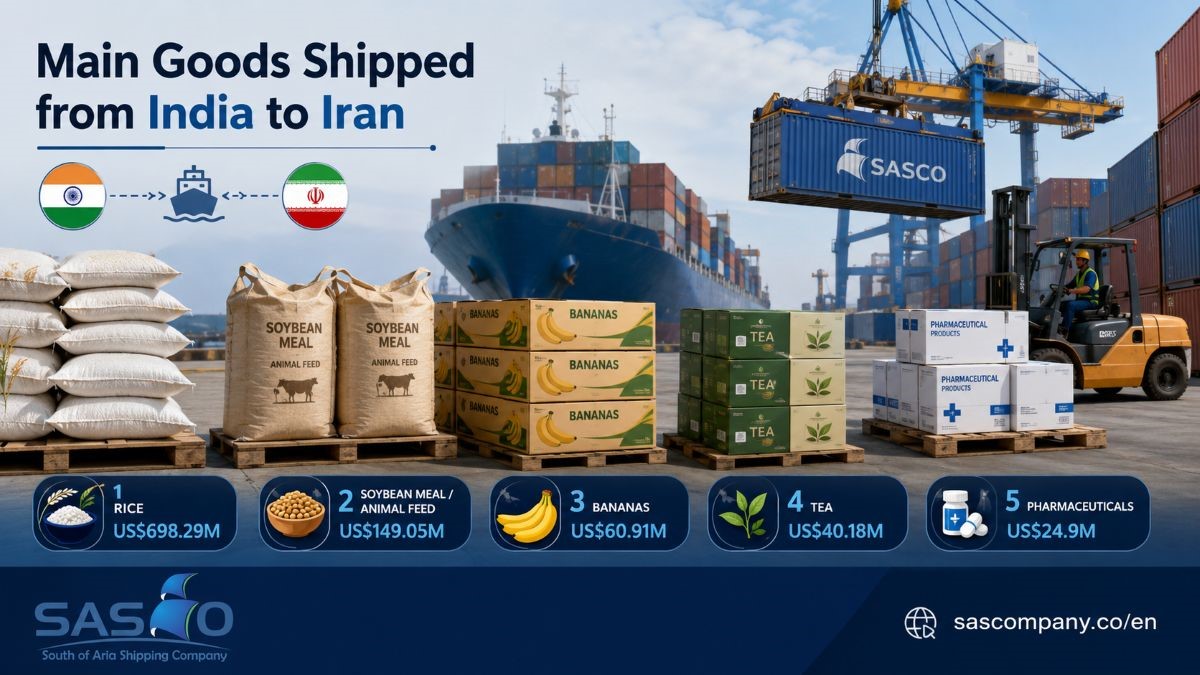
India’s exports to Iran are concentrated in agricultural and food commodities, although pharmaceuticals also remain an important part of bilateral trade. According to the Embassy of India in Tehran, India exported approximately US$1.24 billion to Iran in FY 2024–25 and US$1.25 billion in FY 2025–26. The product figures below use calendar-year 2024 data to ensure a consistent comparison.
- Rice: India exported approximately 745,254 metric tonnes of rice to Iran in 2024, valued at US$698.29 million. Rice was by far the largest individual product in India’s exports to Iran and represented more than half of the total merchandise export value recorded for that year.
Source: World Bank WITS / UN Comtrade – India’s rice exports by destination
- Soybean meal: India shipped approximately 285,437 metric tonnes of soybean oilcake and meal to Iran, worth US$149.05 million. Iran was the largest foreign market for this Indian product in 2024.
Source: World Bank WITS / UN Comtrade – Soybean oilcake exports
- Bananas: Indian banana exports to Iran reached approximately 126,867 metric tonnes, valued at US$60.91 million. Iran was India’s second-largest banana market after Iraq.
Source: World Bank WITS / UN Comtrade – Banana exports
- Tea: India exported about 12,034 metric tonnes of black tea to Iran, with a combined value of approximately US$40.18 million across the main black-tea classifications.
Sources: WITS – HS 090240 and WITS – HS 090230
- Pharmaceutical products: India exported approximately US$24.9 million in pharmaceutical products to Iran in 2024. The Embassy of India also identifies drugs and pharmaceuticals among the established Indian exports to the Iranian market.
Sources: UN Comtrade-derived pharmaceutical trade data and Embassy of India – India–Iran Economic Relations
Overall, the data show that commercial cargo from India to Iran is led by rice and animal-feed materials, followed by fresh fruit, tea and pharmaceuticals. Bulk agricultural commodities generally move by sea, while urgent or temperature-sensitive pharmaceutical cargo may also move by air.
Why Work with an Iran-Based Freight Forwarder?
An Iran-based freight forwarder can coordinate the shipment from origin to final delivery. SASCO works with agents in India, arranges sea or air freight, checks documents before departure, and manages handling in Iran. Its services include customs clearance, warehousing, cargo insurance, inland delivery, cold-chain logistics, and project cargo. Using one operational contact reduces handovers, document errors, and delays.
Frequently Asked Questions
How much does shipping from India to Iran cost?
It depends on cargo type, weight, volume, route, Incoterm, and destination charges.
How long does sea freight take?
Transit time varies by port pair, carrier schedule, and possible transshipment.
What is the cheapest commercial option?
LCL suits smaller shipments; FCL is often better for larger volumes.
Is LCL available?
Yes, subject to route, cargo type, and consolidation schedules.
Which Indian ports are commonly used?
Mundra, Nhava Sheva, Mumbai, Chennai, and Cochin are common options.
What documents are required?
Usually an invoice, packing list, transport document, certificate of origin, HS code, and permits.
Can SASCO arrange clearance and delivery?
Yes. SASCO can coordinate customs clearance and inland delivery in Iran.
Can food and pharmaceuticals be shipped?
Yes, with the required permits, packaging, and temperature controls.
What is needed for a quote?
Provide cargo description, HS code, dimensions, weight, origin, destination, and Incoterm.
Is door-to-door service available?
Yes, depending on the cargo, route, and final destination.