

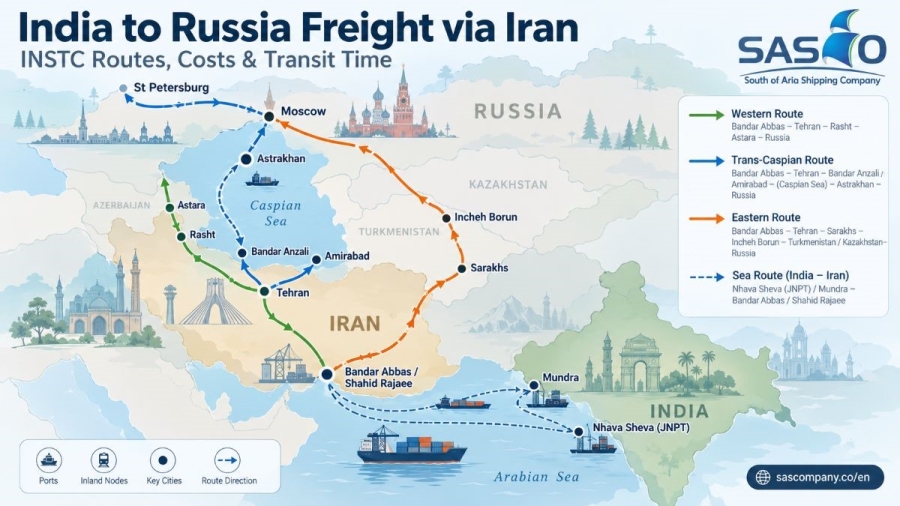
India to Russia Freight at a Glance
The India to Russia freight via Iran corridor offers several routing options rather than one fixed service. The main differences between them are the Iranian transit path, border or Caspian crossing, transport mode, available equipment, and final destination in Russia. The table below summarizes the key planning points before route, cost, and transit-time options are examined in detail.
|
Factor |
Planning Information |
|
Main corridor |
International North–South Transport Corridor (INSTC) |
|
Typical Indian origin ports |
Nhava Sheva (JNPT) / Mundra |
|
Main Iranian gateway |
Bandar Abbas / Shahid Rajaee Port |
|
Main route options |
Eastern / Trans-Caspian / Western |
|
Main Russian destinations |
Astrakhan / Moscow region / St Petersburg |
|
Transport modes |
Sea + Rail / Sea + Road + Rail / Sea + Road + Caspian Sea |
|
Typical container options |
20GP / 40GP / 40HC / SOC |
|
Transit time |
Route-specific |
|
Freight cost |
Route- and scope-specific |
How Does Freight Move from India to Russia via Iran?
Freight from India to Russia via Iran is not moved on one vessel, truck, or train from origin to destination. It is a multimodal transport chain. Cargo is first collected or delivered to an Indian export port, commonly Nhava Sheva or Mundra, and shipped by sea to Bandar Abbas. After discharge and Iranian transit formalities, it moves north through Iran by road, rail, or a combination of both.
The onward route depends on the selected INSTC branch. Eastern-route cargo continues toward Turkmenistan and Kazakhstan before entering Russia. Trans-Caspian shipments move to an Iranian Caspian port and cross the Caspian Sea to a Russian port. Western-route cargo moves toward Azerbaijan and then Russia.
For this reason, the India to Russia train route is not a single uninterrupted railway. Rail is one part of a wider sea–land multimodal movement, and equipment changes, border handling, or transshipment may be required.
Main INSTC Routes from India to Russia
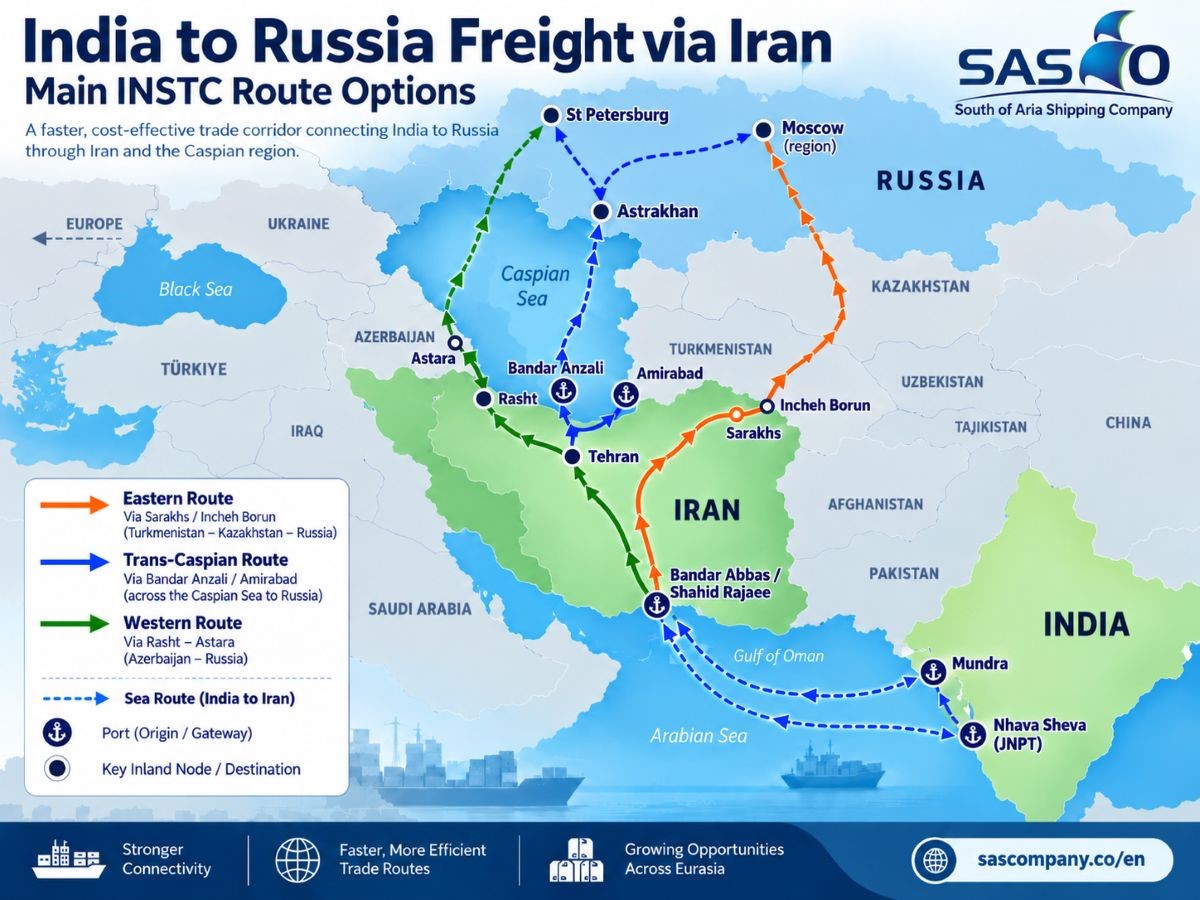
The three main INSTC routes offer different operational advantages depending on the cargo profile, Russian destination, and available transport connections. Although all routes connect India and Russia through Iran, their logistics structure, border requirements, and handling procedures are different.
The Eastern Route mainly relies on rail connections through Central Asia, the Trans-Caspian Route combines Iranian inland transport with Caspian Sea shipping, and the Western Route connects Iran with Russia through Azerbaijan.
Understanding these differences is essential when planning India Russia logistics, because route selection affects transit time, equipment requirements, handling procedures, and overall freight cost.
Eastern INSTC Route via Turkmenistan and Kazakhstan
The Eastern INSTC Route connects India and Russia through Iran, Turkmenistan, and Kazakhstan. A typical route is:
India → Bandar Abbas → Iran inland transit → Sarakhs / Incheh Borun → Turkmenistan → Kazakhstan → Russia
This corridor mainly combines sea freight and rail transport. After arriving at Bandar Abbas, containers move north through Iran’s railway network and continue toward border connections with Turkmenistan. Cargo can enter Central Asia through gateways such as Sarakhs or Incheh Borun before continuing through Kazakhstan toward Russia.
One of the key operational considerations on this route is the difference in railway gauge systems. Iran uses the 1,435 mm standard gauge, while Kazakhstan, Turkmenistan, and much of the Russian railway network use the 1,520 mm broad gauge system. Therefore, some shipments may require wagon exchange, cargo transfer, or other forms of handling at gauge-change points.
The Eastern route has an important advantage because it does not depend on the completion of the Rasht–Astara railway project. It can therefore provide a practical option for certain container flows and regular cargo movements. However, rail schedules, border operations, available equipment, and capacity should always be confirmed before booking.
Trans-Caspian Route via Iranian Caspian Ports
The Trans-Caspian INSTC Route connects India with Russia through Iran’s northern Caspian ports and maritime services across the Caspian Sea.
A typical route is:
India → Bandar Abbas → Iranian inland transit → Bandar Anzali / Amirabad → Astrakhan or Olya → Russia
After reaching Bandar Abbas, cargo moves through Iran by road or rail toward the northern Caspian region. At ports such as Bandar Anzali or Amirabad, shipments can be transferred to Caspian vessels and transported toward Russian ports, including Astrakhan and Olya.
This option combines sea freight, inland transport, and short-sea shipping and can be suitable for cargo requiring access to southern Russian ports or Caspian-connected regions.
The main operational factors include vessel availability, port handling capacity, weather conditions in the Caspian Sea, cargo handling arrangements, and onward Russian road or rail connections.
SASCO has operational experience on the Russia–Iran Caspian leg, including a documented Nizhny Novgorod → Astrakhan → Anzali movement using rail transportation, vessel coordination and container operations.
However, transit times from the Russia–Iran Caspian segment should not be directly applied to the complete India–Russia route because shipments from India require additional sea transport and Iranian inland transit stages.
Western INSTC Route via Azerbaijan
The Western INSTC Route connects India and Russia through northern Iran and Azerbaijan.
A typical route is:
India → Bandar Abbas → Tehran / Northern Iran → Rasht → Astara → Azerbaijan → Russia
This corridor provides a geographic connection between Iran, Azerbaijan, and Russia and can be considered for cargo moving toward western Russian destinations.
However, an important operational consideration is the status of the Rasht–Astara railway connection. The railway project has been under development and has not yet created a fully completed rail corridor across the entire western route. Russian Transport Ministry updates in 2026 continued to discuss implementation steps, including land preparation and construction arrangements. Russian Transport Ministry
Therefore, the Western branch should not be described as a fully connected rail-only route. Instead, it should be considered a multimodal transport option where road transport, rail services, border procedures, and infrastructure conditions all affect the final logistics plan.
For companies evaluating India Russia logistics options, the Western route should be compared with Eastern and Trans-Caspian alternatives based on destination, cargo characteristics, cost structure, and current operational conditions.
Indian Ports and Iranian Gateways
For India–Russia freight via Iran, Nhava Sheva (JNPT) and Mundra are the principal Indian container gateways, particularly for cargo originating in western and northern India. Chennai can also be considered for southern Indian cargo, but only when the available carrier routing, transshipment plan, and total through-rate are commercially suitable. SASCO’s Shipping from India to Iran guide covers these port pairs and the India–Iran sea leg in greater detail.
On the Iranian side, Bandar Abbas / Shahid Rajaee Port is the main southern gateway for containerized INSTC cargo and the usual transfer point to Iranian road or rail transport. For Trans-Caspian movements, Bandar Anzali and Amirabad provide access to Russian Caspian ports. Chabahar is a potential alternative gateway; India has officially examined a Chabahar–Bandar Anzali–Astrakhan INSTC connection, but commercial use should depend on confirmed shipping service, cargo acceptance, equipment, and inland connectivity.
How Long Does India to Russia Freight via Iran Take?
The India to Russia transit time via Iran varies by INSTC branch, origin port, Russian destination, and the connections between each transport leg. For container shipments, the following ranges can be used as initial planning estimates under normal operating conditions:
|
INSTC Route |
Approx. Transit Time |
|
Eastern Route |
24–32 days |
|
Trans-Caspian Route |
20–30 days |
|
Western Route |
25–30 days |
These ranges are terminal-to-terminal planning estimates, not guaranteed delivery times. Actual India to Russia shipping time can change depending on vessel schedules, port handling, border procedures, rail capacity, Caspian connections, equipment availability, and the final destination in Russia.
|
Leg |
Main Factors Affecting Transit Time |
|
Indian export handling |
Cargo readiness, documentation, terminal cut-off |
|
India → Bandar Abbas |
Sailing schedule, vessel space, transshipment |
|
Bandar Abbas handling |
Discharge, terminal processing, transit formalities |
|
Iranian inland movement |
Road/rail mode, equipment, train schedule |
|
International interface |
Border handling, gauge change, Caspian connection |
|
Russian inland movement |
Entry point, onward rail/road and final destination |
The Eastern Route generally offers the most predictable rail-based planning because existing connections run through Iran, Turkmenistan, Kazakhstan, and Russia. The Trans-Caspian Route is more dependent on matching Iranian inland transport with Caspian vessel departures and Russian port connections. On the Western Route, border procedures and the multimodal arrangement around the incomplete Rasht–Astara rail link can affect the schedule.
For a specific shipment, the final transit time should therefore be confirmed against the selected route, equipment, departure schedule, and Russian delivery point.
How Much Does India to Russia Freight via Iran Cost?
The India to Russia shipping cost via Iran depends on the INSTC branch, container size, cargo weight, origin port, Russian destination, and the services included in the quotation. For initial budgeting, the following late-2025 market benchmarks can be used as a reference for a 40HC container moving from India to Moscow:
|
Route |
Equipment |
Indicative Planning Rate |
Scope |
|
Eastern INSTC |
40HC |
USD 5,800–7,200 |
India → Moscow; exact inclusions must be confirmed |
|
Western INSTC |
40HC |
USD 6,000–7,500 |
India → Moscow via Azerbaijan; multimodal scope |
|
Trans-Caspian |
20GP / 40HC |
Live quote |
Depends on Caspian ports, vessel connection and final destination |
These figures are planning benchmarks rather than fixed tariffs. The final India to Russia freight cost can change with ocean freight, rail tariffs, equipment availability, border charges, currency movements, port conditions, and the actual delivery point in Russia.
A complete quotation may include Indian origin handling and export charges, sea freight to Bandar Abbas, terminal charges, transit through Iran, Iranian road or rail transport, border or gauge-change handling, Caspian vessel costs where applicable, Russian inland transport, and final delivery.
SASCO’s dedicated Transit Through Iran service covers road, rail, border coordination, and transit documentation within Iran.
For India to Moscow freight, the scope of the quotation is as important as the headline rate. A lower offer may exclude Bandar Abbas handling, border costs, Russian terminal charges, or final delivery, while another may include several of these items. Rates should therefore be compared on the same origin, destination, equipment, Incoterm, and terminal-to-terminal or door-to-door basis.
For 20GP containers, heavy or project cargo, and Trans-Caspian movements, shipment-specific pricing is more reliable than scaling a 40HC benchmark. For a confirmed rate based on your cargo, equipment, origin, destination, and required service scope, request a freight quote from SASCO before booking.
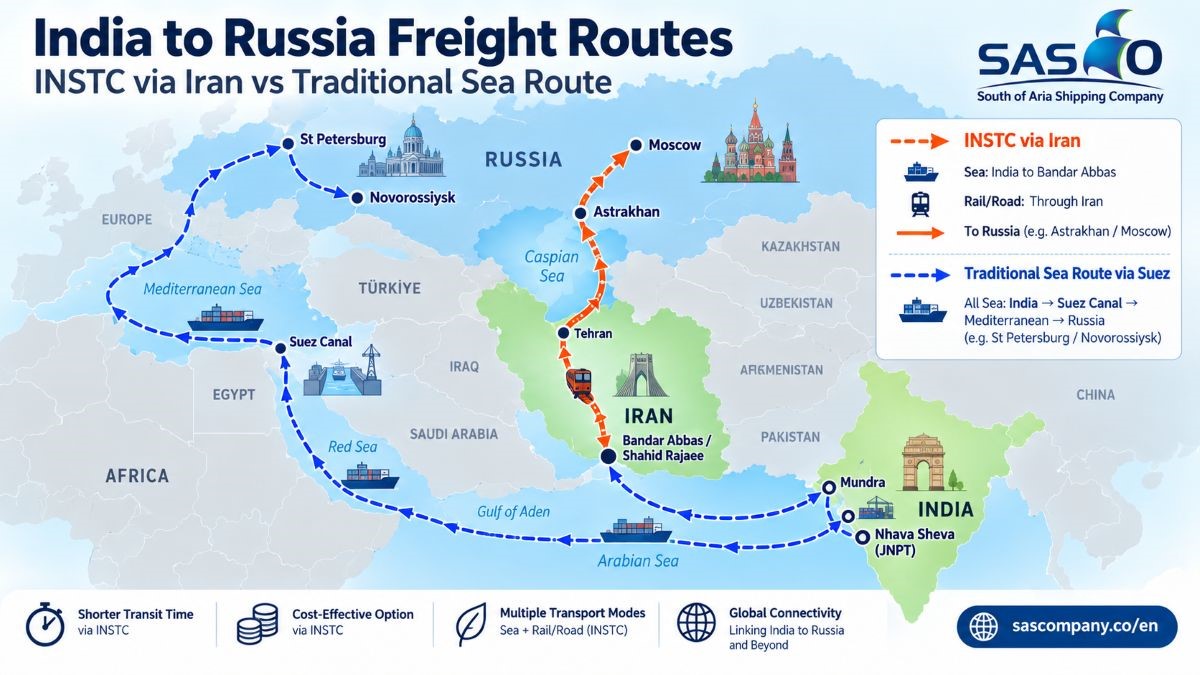
INSTC vs Suez for India–Russia Freight
For companies comparing India to Russia via INSTC with the traditional Suez route, the key difference is the transport structure. INSTC combines sea, rail, road, and sometimes Caspian shipping, while the conventional route relies mainly on ocean transport to Russian seaports.
|
Factor |
INSTC via Iran |
Traditional Sea Route |
|
Transport modes |
Multimodal |
Mainly sea |
|
Transfers |
More operational handoffs |
Fewer handoffs |
|
Transit potential |
Shorter for suitable inland destinations |
More standardized |
|
Cost structure |
Route- and scope-specific |
Often easier to compare |
|
Documentation |
More cross-border coordination |
Generally simpler |
|
Best fit |
Selected Russian/CIS inland destinations |
Established liner movements |
INSTC should not be assumed to offer a fixed cost advantage over the traditional Suez route. Late-2025 market benchmarks for 40HC shipments to Moscow show that freight ranges can overlap depending on the routing and service scope.
For time-sensitive India Russia multimodal transport, INSTC can offer a useful transit advantage when connections are aligned. For less urgent cargo, an established sea service may provide simpler handling and fewer transfers.
Container and Cargo Options
India to Russia freight via Iran can accommodate standard containerized cargo as well as selected industrial and non-containerized shipments. FCL is the most straightforward option, with 20GP, 40GP and 40HC containers commonly considered depending on cargo weight, volume and equipment availability.
Both COC and SOC containers may be used, but carrier acceptance, free time, empty-return requirements and rail compatibility should be checked before booking. These equipment issues become particularly important on inland and cross-border legs; SASCO’s experience with container and rail planning between Bandar Abbas and Turkmenistan illustrates these operational considerations.
Industrial machinery, project cargo, and suitable bulk or breakbulk shipments can also use INSTC arrangements. LCL may be possible where a reliable consolidation service is available, but it should not be assumed for every route or departure.
Documents and Transit Formalities
Documents for shipping from India to Russia via Iran depend on the cargo, transport mode and selected INSTC branch. A standard file normally includes the Commercial Invoice, Packing List and Bill of Lading for the sea leg, together with the correct HS code and container or equipment details.
Depending on the movement, additional documents may include a Certificate of Origin, commodity-specific certificates or permits, an Iranian customs transit declaration, and the relevant road or rail transport document. Road movements may require a CMR/TIR document, while rail shipments use the applicable rail consignment note. Russian import documentation must also be prepared according to the consignee, commodity and final customs regime.
Cargo crossing Iran as international transit is not necessarily imported or customs-cleared for consumption in Iran. Instead, it normally moves under a customs transit procedure, remaining under customs control until it exits the country. SASCO’s Transit Through Iran operations include transit declarations, rail consignment notes, port documentation and border-transfer coordination.
Document consistency is important: cargo description, HS code, weight, container number and consignee information should match across the transport and customs documents.
Operational Bottlenecks and Route Conditions
The main operational risks on the India Russia INSTC route occur at the interfaces between transport modes rather than on one single leg. At Bandar Abbas, vessel access, port handling and onward equipment availability can affect the connection to the Iranian inland movement.
For rail-based shipments, wagon or container availability and confirmed train schedules are important. The Eastern Route also requires handling at the 1,435 mm / 1,520 mm gauge interface at Iran–Turkmenistan connections. On the Trans-Caspian branch, vessel departure windows and Caspian port capacity can influence the schedule.
The Western branch has a different constraint: the Rasht–Astara railway remains under development, so the route still requires multimodal planning. Russia’s Ministry of Transport continued to describe construction of this link as an active project in September 2026.
For all branches, route, equipment, carrier acceptance and schedule should therefore be checked against actual conditions before booking.
Route Conditions — Updated October 2026
Maritime conditions should be rechecked before booking. Shipping through the Strait of Hormuz remains exposed to security and access disruptions, while the sanctions environment affecting Iranian transport has also changed. Carrier acceptance, routing, freight rates, insurance conditions and available equipment should therefore be reconfirmed for each shipment.
Why Choose SASCO for India–Russia Freight via Iran?
SASCO supports India–Russia freight via Iran through route-specific coordination at Bandar Abbas, Iranian transit planning, and road, rail, and Caspian multimodal connections to Russia and the CIS. Its role can include port handling, transit documentation, inland transport, equipment planning, and coordination between Iranian and regional partners.
SASCO also has operational experience on the Russia–Iran Caspian leg. In one documented project, industrial equipment moved from Nizhny Novgorod by rail to Astrakhan, then crossed the Caspian Sea on a fully chartered vessel to Bandar Anzali using SASCO-owned containers. This experience is directly relevant to Trans-Caspian and other multimodal freight planning through Iran.
Frequently Asked Questions
How long does shipping from India to Russia via Iran take?
A practical planning range for many container shipments is about 20–32 days terminal-to-terminal, depending on the INSTC branch, origin port, Russian destination, border handling, rail schedules and Caspian connections. For Nhava Sheva to Russia freight moving to St Petersburg, about 24–32 days is a useful planning range.
How much does India to Russia freight via INSTC cost?
For a 40HC container to Moscow, late-2025 planning benchmarks were about USD 5,800–7,200 via the Eastern branch and USD 6,000–7,500 via the Western branch. Final India Russia freight rates depend on origin, equipment, routing, inclusions and delivery scope.
Which INSTC route is used from India to Russia?
Cargo may use the Eastern branch through Turkmenistan and Kazakhstan, the Trans-Caspian branch via Iranian and Russian Caspian ports, or the Western branch through Azerbaijan. Route selection depends on the Russian destination, equipment, schedule, border conditions and available services.
Is there a direct train from India to Russia?
No. The India to Russia train route is multimodal rather than one uninterrupted railway service. Cargo first moves by sea to Iran, after which rail can be used on selected Iranian, Central Asian and Russian legs, with transfer or gauge-change handling where required.
Does cargo need customs clearance in Iran when transiting to Russia?
Not necessarily. Cargo crossing Iran as international transit generally moves under an Iranian customs transit procedure rather than being imported for domestic consumption. It remains under customs control until exit, subject to the required transit documents, guarantees, permits and border procedures.
Is INSTC faster than shipping via the Suez Canal?
It can be faster for some origin–destination pairs, particularly when Russian inland destinations connect efficiently with rail or Caspian services.