

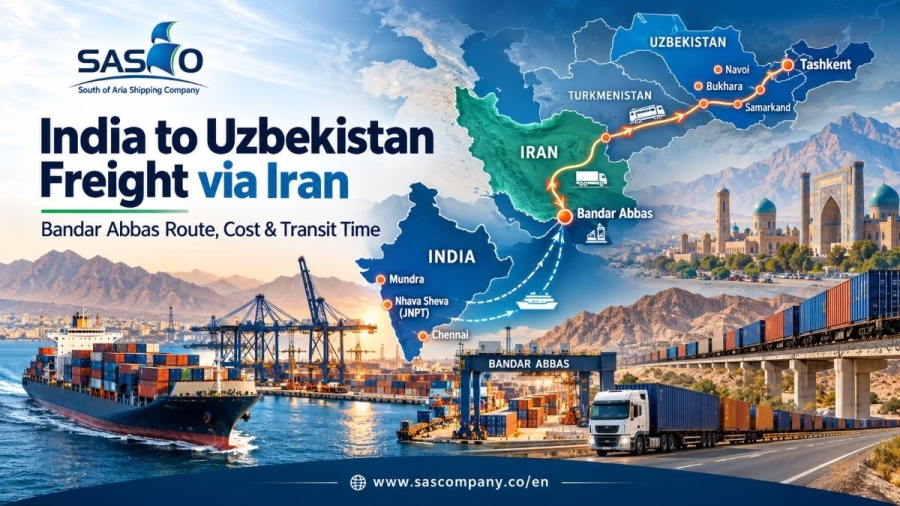
India to Uzbekistan Freight at a Glance
For planning purposes, the core route combines an Indian ocean leg with transit through Iran and Turkmenistan. Mundra, Nhava Sheva (JNPT), and Chennai are relevant Indian gateways, while Bandar Abbas—principally Shahid Rajaee Port—serves as the Iranian entry point for many containerized movements. From there, cargo can continue by road or rail toward the Iran–Turkmenistan border and onward to Uzbekistan. The appropriate structure depends on cargo size, equipment ownership, final destination, available schedules, and current border and carrier conditions.
|
Factor |
Planning Information |
|
Main route |
India → Bandar Abbas (Iran) → Turkmenistan → Uzbekistan |
|
Main Indian ports |
Mundra / Nhava Sheva (JNPT) / Chennai |
|
Iran gateway |
Bandar Abbas / Shahid Rajaee Port |
|
Main modes |
Sea + Road / Sea + Rail |
|
Main Iran–Turkmenistan gateway |
Sarakhs for key road/rail movements; alternatives depend on mode and destination |
|
Main Uzbekistan destinations |
Tashkent / Samarkand / Bukhara / Navoi |
|
Standard containers |
20GP / 40GP / 40HC |
|
Service options |
FCL / project cargo / LCL or consolidation subject to service availability |
|
Transit time |
Route-specific planning range; not guaranteed |
|
Freight cost |
Shipment-specific quotation |
How Does Freight Move from India to Uzbekistan via Iran?
Freight from India to Uzbekistan via Iran is handled as connected transport legs rather than a single sea shipment.
Step 1 — Indian origin and export handling. Cargo is collected or delivered to the nominated Indian port, where export documentation, terminal handling, container loading, and customs formalities are completed.
Step 2 — Ocean freight to Bandar Abbas. The container or cargo is shipped from an Indian port such as Mundra, Nhava Sheva (JNPT), or Chennai to Bandar Abbas. This first leg follows the same general structure used for shipping from India to Iran, although Uzbekistan-bound cargo continues under transit arrangements rather than entering the Iranian market.
Step 3 — Transit handling in Iran. After discharge at Shahid Rajaee Port, Uzbekistan-bound cargo is normally prepared for Iranian customs transit rather than import clearance for the Iranian market.
Step 4 — Inland movement across Iran. Cargo continues north by road or rail, depending on cost, schedule, equipment, and shipment profile.
Step 5 — Iran–Turkmenistan border. Sarakhs is important for rail and can also serve road traffic. Border, equipment, and handover procedures should be coordinated before arrival. The Iranian leg can be planned as part of a wider Bandar Abbas to Turkmenistan freight movement.
Step 6 — Transit across Turkmenistan. The shipment continues through Turkmenistan toward the Uzbek border.
Step 7 — Uzbekistan entry and final delivery. After border and customs procedures, cargo moves to Tashkent, Samarkand, Bukhara, Navoi, or another agreed destination.
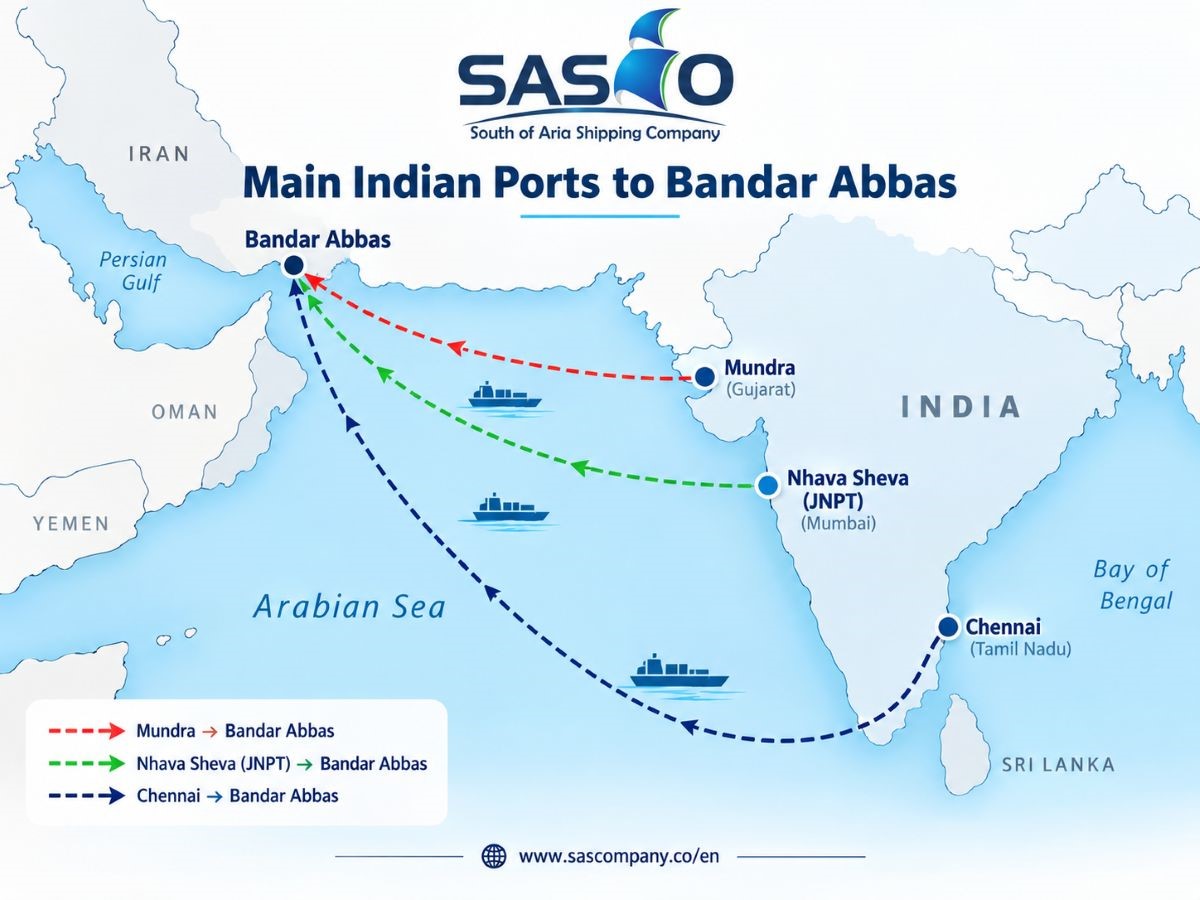
Main Indian Ports for India–Uzbekistan Freight
The origin port affects the ocean leg to Bandar Abbas, sailing availability, inland pickup cost, and the overall India to Uzbekistan freight plan.
Mundra to Uzbekistan
Mundra is relevant for cargo from Gujarat and northern or northwestern India. As India’s largest container-handling port, it combines container capacity with strong road and rail connectivity. Mundra to Uzbekistan freight can move by sea to Bandar Abbas before continuing through Iran and Turkmenistan. For more detail on the ocean leg, see SASCO’s shipping from India to Iran guide.
Nhava Sheva (JNPT) to Uzbekistan
Nhava Sheva (JNPT), near Mumbai, is a major gateway for Maharashtra and western India and handles a large share of India’s containerized trade. Nhava Sheva to Uzbekistan freight, including JNPT to Uzbekistan shipping, normally connects with the Bandar Abbas corridor before continuing inland by road or rail.
Chennai to Uzbekistan
Chennai is a practical origin for cargo from Tamil Nadu and other southern markets. Chennai to Uzbekistan freight can have a different sailing profile and a longer ocean leg than shipments from western Indian ports. Carrier routing and the actual departure schedule should therefore be checked before booking rather than applying one transit figure to every Indian origin.
Road vs Rail from Bandar Abbas to Uzbekistan
After discharge, Bandar Abbas to Uzbekistan freight can continue by road or rail. The appropriate mode depends on the final destination, cargo weight and volume, equipment, schedule, border conditions and available capacity.
|
Factor |
Sea + Road |
Sea + Rail |
|
Flexibility |
Higher; routing can be adjusted more easily |
Lower; depends more on train and wagon availability |
|
Final delivery |
Strong for direct inland delivery |
Usually requires a road last mile |
|
Container volumes |
Suitable for single or multiple containers |
Well suited to regular or larger container volumes |
|
Heavy cargo |
Possible subject to vehicle, axle, permit and route limits |
Often suitable, subject to wagon and terminal capability |
|
Schedule dependency |
Truck availability and border queues |
Train schedules, wagon supply and terminal handling |
|
Sarakhs handling |
Road border procedures |
Rail interchange and break-of-gauge procedures |
|
Best fit |
Flexible, destination-specific commercial cargo |
Containerized, heavier or repeat-volume cargo |
Road freight to Uzbekistan via Iran generally offers greater routing flexibility and easier door delivery. Alternative Iran–Turkmenistan road crossings can also be considered according to destination and current operating conditions. SASCO’s road freight transport in Iran service covers cross-border and transit trucking within this type of multimodal movement.
Rail freight to Uzbekistan via Iran can be attractive for containerized, heavier, or regular-volume traffic, but it is more dependent on wagon allocation, train schedules, terminal capacity, and border interchange. SASCO’s rail freight services in Iran cover Central Asian corridors including Sarakhs.
Sarakhs is a key technical point. Iran uses 1,435 mm standard-gauge rail, while Turkmenistan and Uzbekistan use the 1,520 mm Central Asian gauge. The same wagon therefore cannot simply continue through the entire corridor without an appropriate interface. Depending on the operation, containers may be transferred between platforms, or wagon/bogie arrangements may be used.
For a broader comparison of border options, timing, and routing, see SASCO’s guide to transit to Uzbekistan via Iran.
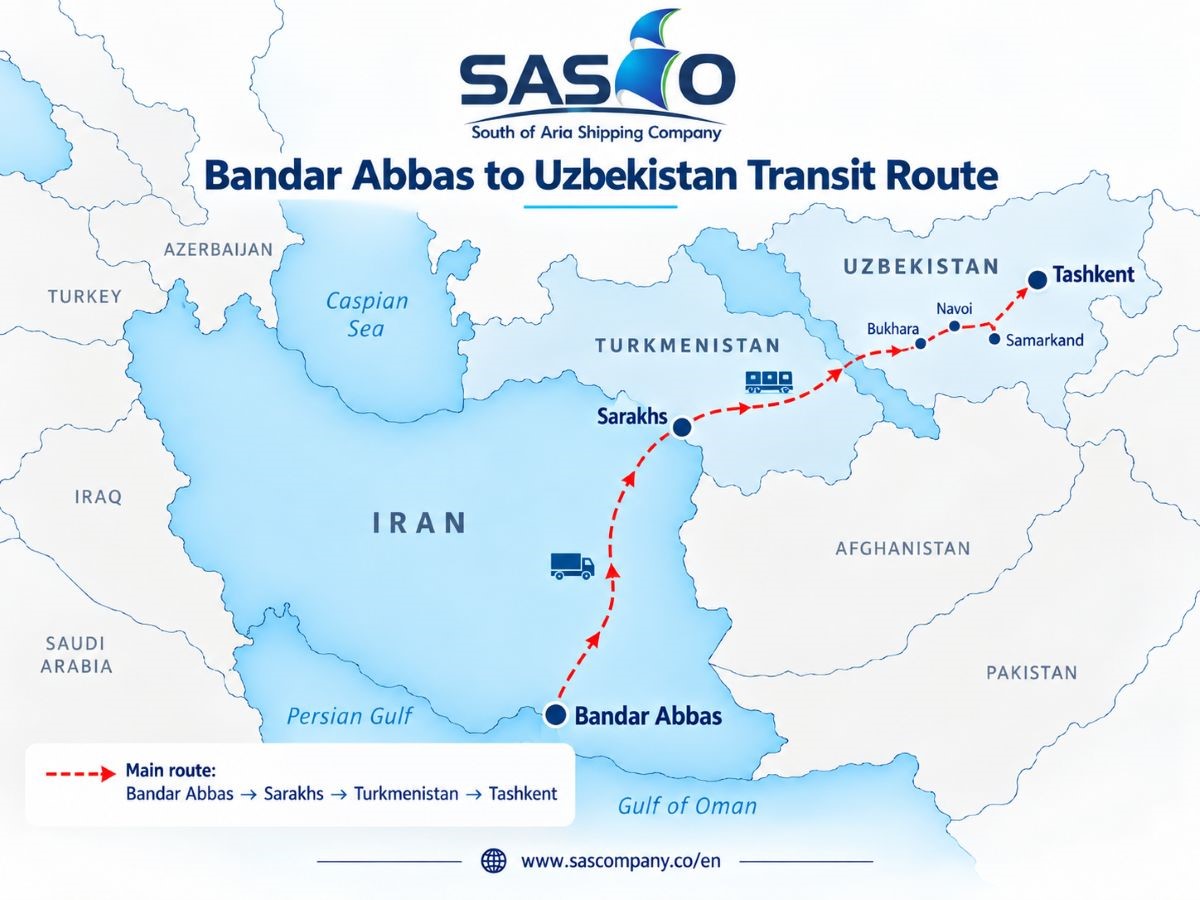
Real India–Bandar Abbas–Uzbekistan Container Route
This corridor is not only theoretical. In August 2024, UzTemirYulKonteyner reported the launch of a multimodal container service connecting the Indian ports of Mundra, Nhava Sheva, and Chennai with Uzbekistan through Iran. Cargo moved by sea to Bandar Abbas and then by rail on Iranian platforms to Sarakhs. At Sarakhs, the containers were reloaded onto Uzbekistan Railways platforms and continued through Turkmenistan to Sergeli station in Uzbekistan.
The first reported freight train consisted of 20 × 20-foot containers and covered 2,673 km in 20 days. The operator also stated an intention to reduce delivery time to 15 days in future operations.
For shippers, the importance of this example is operational: it confirms that an India → Bandar Abbas → Sarakhs → Turkmenistan → Uzbekistan container chain has been executed in practice. This recorded movement demonstrates corridor feasibility; it should not be treated as a guaranteed transit time for every India–Uzbekistan shipment.
How Long Does Freight from India to Uzbekistan Take?
Transit time depends on how the sea and inland legs are connected. The shipment first moves from the selected Indian port to Bandar Abbas, then continues across Iran and Turkmenistan before entering Uzbekistan.
|
Leg |
Main Timing Variable |
|
Indian export handling |
Origin, cargo readiness and documentation |
|
India → Bandar Abbas |
Loading port, carrier and sailing schedule |
|
Bandar Abbas handling |
Discharge, terminal handling and transit release |
|
Iranian inland leg |
Road or rail |
|
Iran–Turkmenistan |
Border processing or rail interchange |
|
Turkmenistan |
Transit procedures and operating conditions |
|
Uzbekistan entry |
Border and document processing |
|
Final delivery |
Tashkent or another destination |
For the inland section, Bandar Abbas to Tashkent freight by road can typically be planned at about 7–12 days under normal operating conditions. Border congestion, port delays or permit issues can extend this leg toward 15–20 days.
Rail usually requires a wider planning window. Bandar Abbas to Uzbekistan by rail may take around 18–35 days, depending on wagon availability, train schedules, terminal capacity and interchange at Sarakhs.
For an India-origin shipment, the confirmed sailing from Mundra, Nhava Sheva or Chennai should be added to the inland plan. This gives a more useful shipment-specific estimate than applying one transit figure to every route.
For the Iran–Turkmenistan section, see SASCO’s guide to Bandar Abbas to Turkmenistan freight.Transit time should not be treated as guaranteed until the routing and departure are confirmed.
Route Conditions — Updated September 2026
Operating conditions affecting Bandar Abbas and the Strait of Hormuz remain subject to disruption. Carrier acceptance, port access, insurance conditions, equipment availability, border operations and transit schedules can change at short notice. Confirm the planned sailing and onward route with SASCO before booking.
How Much Does Freight from India to Uzbekistan Cost?
There is no fixed India to Uzbekistan freight cost because the shipment combines several independently priced legs. A useful quotation should separate ocean, port, transit, inland and equipment costs instead of presenting one unexplained all-in figure. SASCO’s sea freight services in Iran cover the maritime and port-coordination side of this type of multimodal movement.
|
Cost Component |
What Changes the Cost |
|
India pickup |
Origin city and distance to port |
|
India export charges |
Port, CFS, documentation and handling |
|
Ocean freight |
Loading port, carrier, container type and sailing |
|
Bandar Abbas charges |
Terminal handling, discharge and dwell |
|
Iran inland freight |
Road vs rail, weight, equipment and distance |
|
Turkmenistan transit |
Border, permits, carrier and conditions |
|
Uzbekistan delivery |
Final city and last mile |
|
Container costs |
SOC vs COC, free time, detention and empty return |
|
Special cargo |
DG, reefer, OOG, permits and handling |
For a standard 40HC container moving by road from Bandar Abbas to Tashkent, a practical current planning range starts at around USD 2,700 for the inland leg. The total India-to-Uzbekistan freight cost will also include the India origin charges, ocean freight to Bandar Abbas, port handling and any additional transit or destination costs.
For a firm rate based on your actual shipment details, request a shipping quotation from SASCO.
The India to Uzbekistan shipping cost also changes with the Indian origin port, current ocean rate, cargo weight, container ownership, border costs and destination. For an accurate quote, provide pickup location, commodity, gross weight, dimensions, container size and ownership, number of units, Incoterm, final Uzbek city, preferred mode and cargo-ready date. Special cargo should also include DG, reefer, OOG or lifting requirements.
Container Options for India–Uzbekistan Freight
SOC vs COC for India–Uzbekistan Container Transit
Container ownership can affect cost and route feasibility for container shipping from India to Uzbekistan. A COC (Carrier-Owned Container) belongs to the shipping line, so the booking is subject to free time, detention rules and empty-return location. These conditions should be checked before departure because an inconvenient empty return can add cost.
A SOC (Shipper-Owned Container) is owned or controlled by the shipper. It is generally not exposed to carrier detention in the same way as COC equipment, although terminal storage or demurrage may still apply. This can offer more flexibility when the box travels far inland or empty return is difficult. However, SOC acceptance is not automatic: the ocean carrier, terminals, rail operators and destination facilities must accept the equipment, and valid CSC documentation may be required.
For either an SOC container India to Uzbekistan movement or a COC booking, confirm acceptance, return terms and onward-mode compatibility before booking.
FCL and LCL Shipping from India to Uzbekistan
FCL India to Uzbekistan is the usual option when a shipper requires a dedicated container or has enough cargo to justify one. Standard equipment can include a 20ft container from India to Uzbekistan or a 40ft/40HC container, depending on cargo volume, weight and equipment availability.
LCL India to Uzbekistan may be possible for smaller shipments through consolidation, but availability should be confirmed for the specific origin, sailing and onward transit arrangement. Unlike a simple port-to-port shipment, the cargo must also be coordinated beyond Bandar Abbas through Iran and Central Asia.
For this reason, sea freight from India to Uzbekistan should be planned together with the inland leg rather than treating the ocean shipment separately. FCL is generally more straightforward for through-container movements, while LCL depends more heavily on available consolidation and deconsolidation arrangements.
India to Uzbekistan Shipping Documents
India to Uzbekistan shipping documents must cover the Indian export leg, international transport, transit through Iran and Turkmenistan, and entry into Uzbekistan. For a standard commercial shipment, the core documents normally include a Commercial Invoice, Packing List, Bill of Lading, and the relevant Indian export documentation, including the Shipping Bill or other applicable export filing.
For the overland transit section, the shipment may also require an Iranian transit declaration and the relevant road or rail transport document, such as a CMR or rail consignment note. SASCO can coordinate these procedures as part of its transit through Iran services.
A Certificate of Origin may be required depending on the commodity, buyer requirements or customs treatment. Regulated cargo can require additional certificates or permits, including phytosanitary, veterinary, inspection or other commodity-specific documentation.
For dangerous goods, the appropriate DG transport documentation and declarations must accompany the shipment. The exact document set should therefore be checked against the commodity, HS code, transport mode and final customs requirements before dispatch.
Main Uzbekistan Destinations for Freight from India
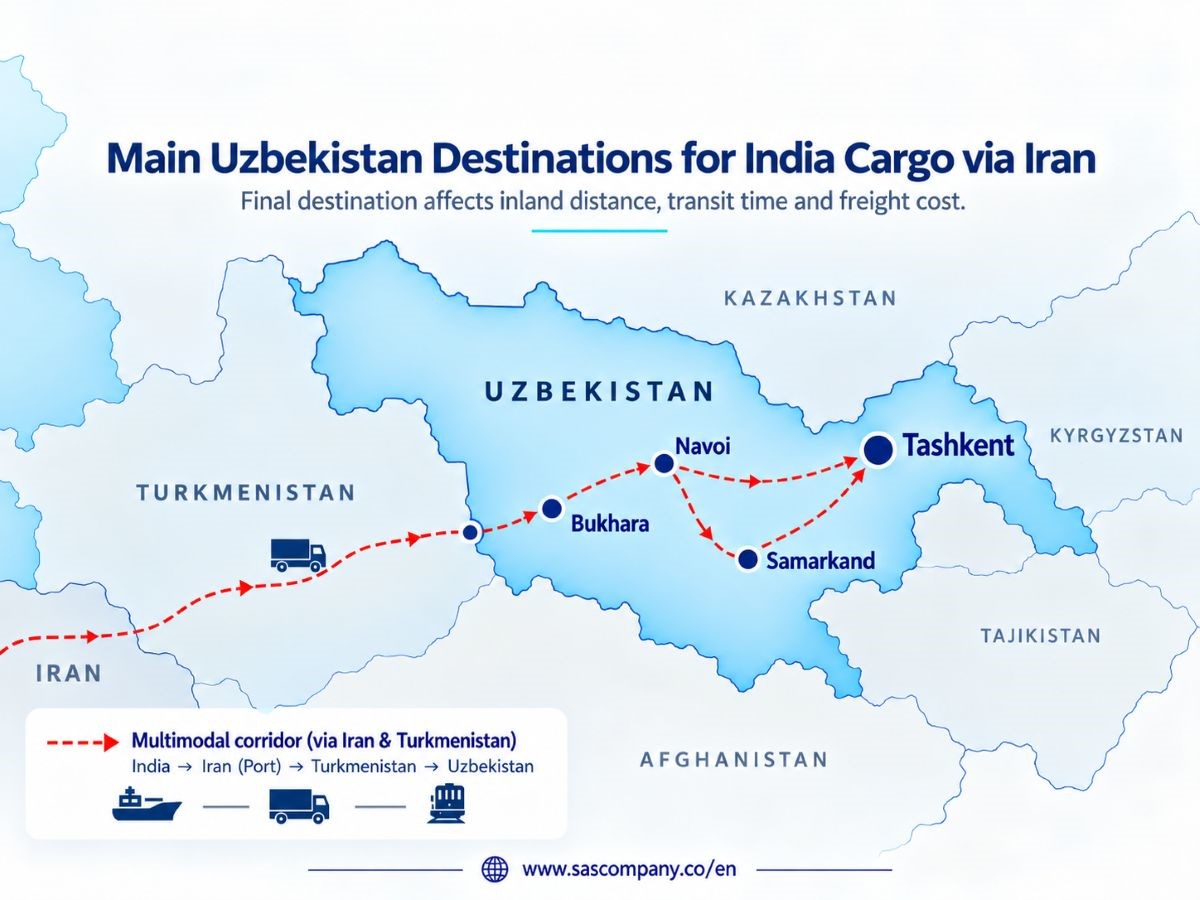
India to Tashkent freight is the most useful benchmark for comparing cost and transit time because Tashkent is Uzbekistan’s principal commercial and distribution center. Cargo arriving through Turkmenistan can continue by road or rail to Tashkent for final delivery or onward distribution.
India to Bukhara freight and India to Navoi freight may require less onward travel after entering western Uzbekistan, depending on the border and route selected. Navoi is particularly relevant for industrial and project-related cargo.
India to Samarkand freight continues farther into central Uzbekistan and requires destination-specific inland planning.
The final Uzbek city matters because it changes the distance after border entry, last-mile transport, delivery time and total freight cost. A quotation for Tashkent should therefore not automatically be applied to Bukhara, Samarkand, Navoi or other destinations.
SASCO can plan the final inland leg as part of a coordinated multimodal transport via Iran movement.
Frequently Asked Questions About India to Uzbekistan Freight
How much does freight from India to Uzbekistan cost?
The total India to Uzbekistan freight cost combines Indian origin charges, ocean freight to Bandar Abbas, port handling, transit through Iran and Turkmenistan, and delivery in Uzbekistan. As an inland benchmark, a standard 40HC road movement from Bandar Abbas to Tashkent can currently start at around USD 2,700.
How long does shipping from India to Uzbekistan take?
The schedule combines the India–Bandar Abbas sailing with port handling and the inland route. After release at Bandar Abbas, road freight to Tashkent can typically be planned at about 7–12 days under normal operating conditions. Rail usually requires a wider planning window. The confirmed Indian sailing should be added separately to the inland schedule.
What is the main freight route from India to Uzbekistan via Iran?
A common corridor is:
Mundra / Nhava Sheva / Chennai → Bandar Abbas → Iran → Sarakhs → Turkmenistan → Uzbekistan.
A container movement using this corridor was documented by the Uzbek rail operator in 2024, confirming its practical use for India–Uzbekistan traffic.
Can SASCO arrange door-to-door freight from India to Uzbekistan?
SASCO can coordinate a door-to-door freight from India to Uzbekistan solution where suitable origin, carrier and destination arrangements are available.
For a firm India to Uzbekistan freight quote, submit your shipment details to SASCO.